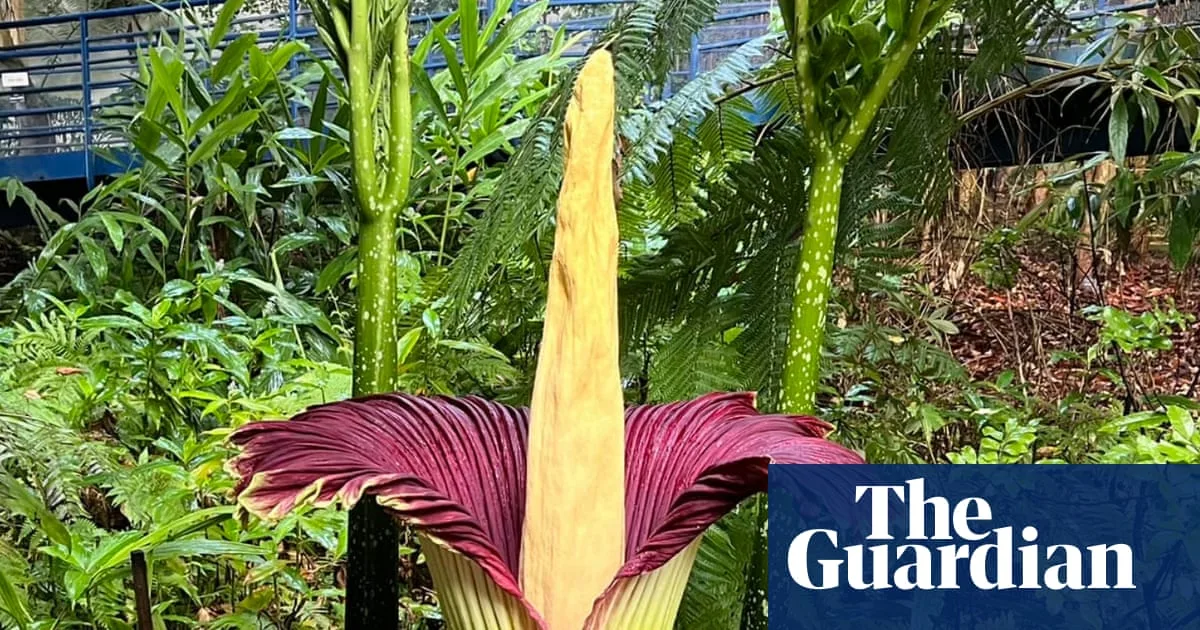
Australia has emerged as a global hotspot for the rare and notoriously smelly corpse flower, with more than a dozen blooms recorded across the country in 2025. The endangered plants, native to the equatorial rainforests of Sumatra, have become a major attraction, with nicknamed specimens such as Putricia in Sydney, Smellanie in Adelaide, and Big Betty in Cooktown drawing thousands of visitors.
Matt Coulter, senior horticulture curator at the Botanic Gardens of South Australia, said Australia now ranks among the top three countries for corpse flower blooms. Adelaide, with its hot, dry summers, has become an unlikely centre for propagation. The city's collection now holds more than 250 plants across different generations, possibly the largest in the world. Smellanie, one of the original plants grown from seeds acquired in 2006, recently finished its second flowering, reaching 2.13 metres tall and emitting a powerful stench reminiscent of fermenting cabbage, strong blue cheese, or old sweaty socks.
Corpse flowers are notoriously unpredictable. Most plants take 10–12 years to produce their first flower, and subsequent blooms can occur at intervals of three to five years or longer. The plants require careful management, storing energy in underground tubers that can weigh up to 75kg. Coulter noted that transporting the plants from climate-controlled glasshouses to public display is a stressful event. Despite the challenges, Adelaide has had corpse flowers blooming every year since its first in 2015.

In Sydney, the Botanic Gardens hosted three blooms last year, including Putricia, Baby Stink, and Stinkerella. Nearly 27,000 people visited to experience Putricia's fragrance, described as 'like the rich stench of a public bin on a 40 degree day'. John Siemon, horticulture director at the Botanic Gardens of Sydney, said the plant personas help the public overcome 'plant blindness', though he noted that attributing gender is inaccurate as the plants have both male and female organs. Putricia has three genetically identical siblings made from leaf cuttings, and Siemon expects the fourth clone to bloom within the next 12 months.
Geelong's botanic gardens are also watching closely. The garden's plant Betsy bloomed in November 2024 with a fragrance of decaying possum and parmesan cheese, and another corm of similar age and size is expected to flower soon. Australia also has native corpse flower varieties, including the elephant yam and cheeky yam, found in northern parts of the country.