UN Declares Era of Global Water Bankruptcy with 700 Turkish Sinkholes as Stark Warning
A stark new United Nations report has declared that humanity has entered an era of "global water bankruptcy", with profound implications for billions of people worldwide. The comprehensive assessment warns that the overuse and pollution of water resources must be tackled with extreme urgency, as critical systems are already past the point of restoration.
Visible Signs of a Broken System
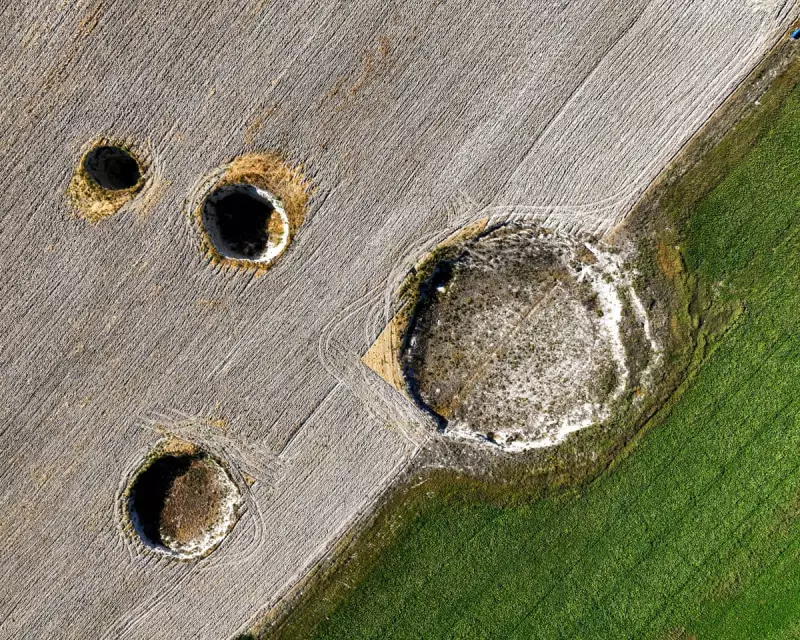
Among the most dramatic physical manifestations of this crisis are the 700 sinkholes now peppering the heavily farmed Konya plain in Turkey. These gaping chasms serve as a powerful visual testament to the catastrophic depletion of groundwater aquifers beneath the surface. The report, authored by experts at the UN University's Institute for Water, Environment and Health, states that many human water systems have crossed a critical threshold, fundamentally altering global water security.
Professor Kaveh Madani, the report's lead author, issued a grave warning: "This report tells an uncomfortable truth: many critical water systems are already bankrupt. It's extremely urgent because no one knows exactly when the whole system would collapse." The climate crisis is exacerbating the problem by melting vital glacial water stores and creating violent swings between extreme drought and deluge.

Global Scale of the Crisis
The consequences of water bankruptcy are already being felt on a planetary scale. The report reveals that 75% of the global population now lives in countries classified as water-insecure or critically water-insecure. Furthermore, a staggering 2 billion people reside on land that is physically sinking due to the collapse of groundwater aquifers, a process known as subsidence.
Major river systems are failing, with iconic waterways like the Colorado in the United States and the Murray-Darling in Australia frequently failing to reach the sea. The number of water-related conflicts has skyrocketed from just 20 in 2010 to more than 400 in 2024, highlighting how water scarcity is becoming a primary driver of social unrest and geopolitical tension.
Agriculture Under Threat and Global Interconnections
Agriculture, which consumes about 70% of all human freshwater withdrawals, is at the epicentre of the crisis. Professor Madani emphasised the interconnected nature of the threat: "Millions of farmers are trying to grow more food from shrinking, polluted or disappearing water sources. Water bankruptcy in India or Pakistan, for example, also means an impact on rice exports to a lot of places around the world." More than half of global food production now occurs in areas where water storage is in decline or highly unstable.
Even nations with relatively damp climates, such as the United Kingdom, are not immune. Their risk stems from a heavy reliance on imports of water-intensive food and other products from regions experiencing severe water stress.
Vanishing Lakes and Sinking Cities
The report documents a widespread retreat of surface water. Half of the world's large lakes have shrunk since the early 1990s, from Lake Urmia in Iran to Lake Chad in Africa. The over-exploitation of groundwater is causing cities worldwide to subside at alarming rates. Rafsanjan in Iran is sinking by 30cm per year, Tulare in the US by about 28cm, and Mexico City by 21cm. Other major urban centres like Jakarta, Manila, Lagos, and Kabul are also severely affected.
Humanity is also actively destroying natural water stores. The report notes that wetlands equal in size to the entire European Union have been erased over the past five decades, while pollution continues to degrade the quality of remaining water sources.
A Call for a Fundamental Reset
The UN report calls for nothing less than a fundamental reset in how water is protected, managed, and used globally. This requires cutting water withdrawal rights to match today's degraded supply and transforming water-intensive sectors like agriculture and industry through crop changes, efficient irrigation, and less wasteful urban systems.

"Water bankruptcy management requires honesty, courage and political will," said Professor Madani. "We cannot rebuild vanished glaciers or reinflate acutely compacted aquifers. But we can prevent further losses, and redesign institutions to live within new hydrological limits." Tshilidzi Marwala, a UN undersecretary general, stated that managing water bankruptcy fairly is now central to maintaining peace, stability, and social cohesion worldwide.
Expert Perspectives on the Challenge
Independent experts acknowledge the severity of the challenge. Professor Albert Van Dijk of the Australian National University noted the increasing erraticism of the climate, where water arrives in bursts at the wrong place and time, making management genuinely harder. Dr Jonathan Paul of Royal Holloway, University of London, highlighted the "elephant in the room" of massive and unequal population growth driving the manifestations of water bankruptcy, suggesting that addressing this would be more effective than tinkering with outdated management frameworks.
The era of global water bankruptcy is here, and the 700 sinkholes in Turkey are just one stark symbol of a planet pushing its most vital resource to the brink of systemic collapse.