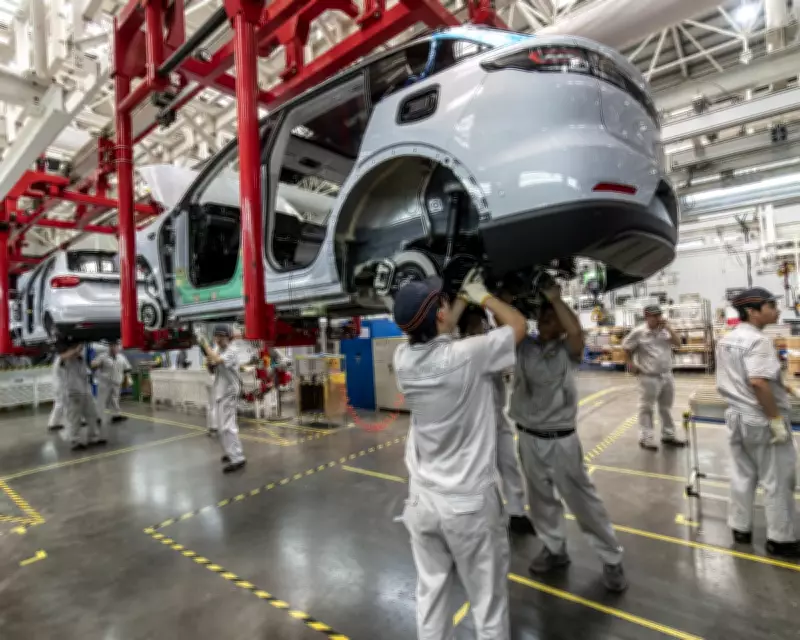
China's clean energy industries have emerged as the dominant force behind the nation's economic expansion, with a groundbreaking new analysis revealing they drove more than 90% of investment growth last year. This remarkable surge has positioned the sector as larger than all but seven of the world's entire economies, underscoring its pivotal role in global energy transitions.
A Transformative Economic Engine
The comprehensive study, produced by the Centre for Research on Energy and Clean Air and published in Carbon Brief, demonstrates that for the second time in three years, the manufacture, installation, and export of batteries, electric vehicles, solar panels, wind turbines, and related technologies accounted for more than a third of China's overall economic growth. This represents a profound structural shift in the world's second-largest economy.
Record-Breaking Financial Performance
In 2025, these clean-energy sectors generated an unprecedented 15.4 trillion yuan (approximately $2.2 trillion or £1.6 trillion) in business revenue. This staggering figure is comparable to the entire gross domestic product of major economies like Brazil or Canada. The analysis shows this accounted for 11.4% of China's GDP, a significant increase from 7.3% recorded in 2022.

Without this clean energy contribution, Beijing's leadership would have missed their 5% annual growth target by a substantial margin, highlighting the sector's critical importance to national economic stability and planning.
Domestic Demand and Technological Advancement
Most of the additional capacity is being deployed to satisfy domestic requirements, with China's rollout of wind and solar infrastructure recently doubling the combined efforts of the rest of the world. Chinese government advisers now describe this as more than just a transition in power generation—it represents a comprehensive, system-wide transformation in how the nation is powered, connected, and mobilised.
The most spectacular investment growth occurred within the battery sector, where increasingly efficient technologies are being developed for electric vehicles and grid storage upgrades. This technological advancement is creating ripple effects across multiple industries and supply chains.
Global Export Surge and Accessibility
Exports from China's clean energy sectors are experiencing a dramatic surge. Thanks to expanding production capacity in the world's manufacturing powerhouse, solar power has been credited by the International Energy Agency for delivering "the cheapest electricity in history", making renewable energy affordable for many nations across the global south.
"In a lot of other countries things are accelerating," observed Lauri Myllyvirta, the report's lead author. "Many African countries have imported substantial solar infrastructure. Electric vehicles are just beginning to gain traction in regions where an EV breakthrough wasn't anticipated for years, if not decades."
The Carbon Peak Question and Political Challenges
Myllyvirta noted that the uptick in clean energy investment represents positive news for global climate efforts. If the world's largest emitter of greenhouse gases maintains this pace of transition away from fossil fuels, it may soon—or possibly already has—reached peak carbon emissions, which would signify a crucial global turning point.
However, this outcome is not yet guaranteed. China's coal industry remains a powerful political force actively contesting the speed of the energy transition. Last year alone, developers submitted proposals to construct 161 gigawatts of new coal-fired power plants, with additional projects in the pipeline.
The future trajectory of China's energy sector should become clearer next month when the government unveils its next five-year plan, setting official priorities and investment directions.
Climate Campaigners' Perspective
Climate activists argue that China now faces a decisive moment. "This is a historic turning point: solar power is set to overtake coal in China for the first time in 2026," said Andreas Sieber, head of political strategy at 350.org. "This may be the clearest demonstration yet that clean energy has triumphed—on cost, scale, and air quality benefits."

Sieber continued with a cautionary note: "However, China is responding to coal's economic decline by accelerating its construction. With approximately 290 gigawatts of new coal capacity already permitted or under construction, and another record year for approvals, the country is simultaneously proving coal obsolete while rushing to entrench it. This primarily serves a coal industry racing against inevitable decline. The consequences are predictable: stranded assets, higher system costs, and a more difficult transition overall."
The analysis ultimately presents a complex picture of a nation at an energy crossroads, where remarkable clean energy achievements coexist with continued fossil fuel expansion, setting the stage for crucial policy decisions in the coming years.