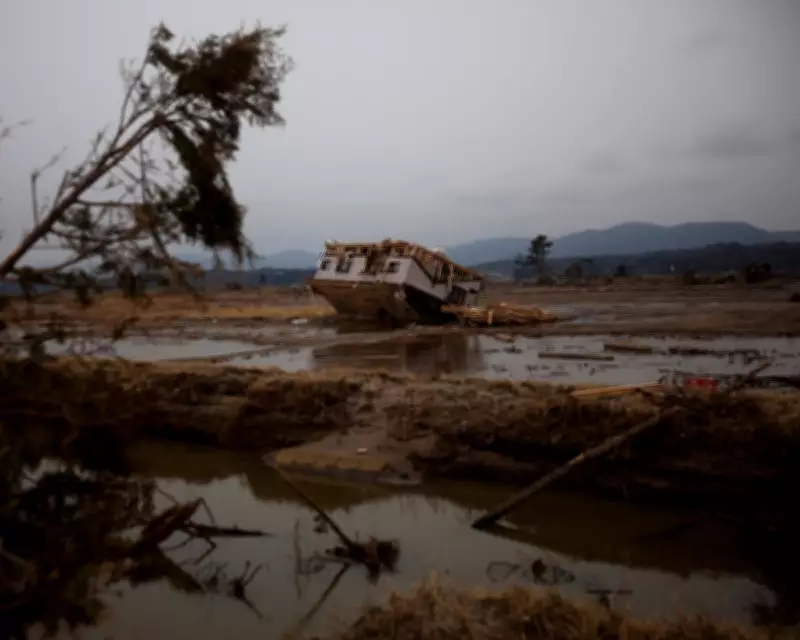
Fifteen years after the catastrophic Tohoku earthquake and tsunami struck north-east Japan, a groundbreaking study has uncovered a critical factor that intensified the disaster's impact. Fresh analysis of video footage reveals that the mud-rich coastline near Yamamoto significantly amplified the tsunami's destructive power, leading to greater devastation than previously understood.
Unveiling the Tsunami's Transformation
Researchers, led by Patrick Sharrocks from the University of Leeds, meticulously examined helicopter video footage and before-and-after satellite images from Google Earth. Their goal was to estimate the speed, shape, and force of the tsunami's flow front as it surged inland. The findings, published in the Journal of the Geological Society, demonstrate a dramatic shift in the wave's characteristics as it traversed the region's mud-rich rice paddies.
Initially, the tsunami presented as a fast-moving, clear-water flow. However, upon encountering the sediment-laden agricultural fields, it transformed into a thick, gloopy, and mud-laden torrent. This alteration had profound implications for the wave's destructive capacity.

Increased Force and Devastation
The study explains that a dense, fast-moving mud-rich flow exerts considerably more force than its clear-water equivalent. This amplified power resulted in more severe damage to buildings and infrastructure in its path, contributing to the high casualty count of nearly 20,000 people. The disaster also triggered the Fukushima Daiichi nuclear crisis, compounding the tragedy.
This type of flow is akin to destructive mud flows observed on volcanoes, where water mixes with sediment to create a powerful, damaging surge. The researchers emphasize that such dynamics were previously underestimated in tsunami hazard assessments.
Implications for Future Preparedness
The authors strongly recommend updating tsunami hazard models to account for the amplified risks posed by mud-rich coastal environments. Key recommendations include:
- Integrating geological data on sediment composition into coastal risk evaluations.
- Informing land-use planning and building codes in tsunami-prone areas to mitigate future impacts.
- Enhancing public awareness and emergency response strategies based on these refined assessments.
This research underscores the importance of considering local environmental factors in disaster preparedness. By understanding how mud-rich settings can exacerbate tsunami effects, communities in vulnerable regions like the Asia Pacific can better safeguard against future catastrophes.