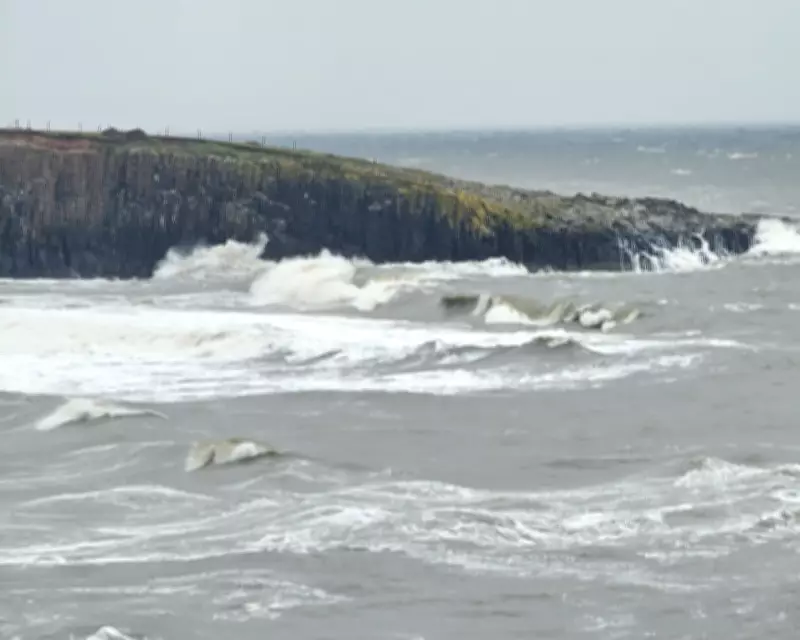
At Cullernose Point in Northumberland, the dolerite cliffs of the Whin Sill form a massive wedge as they descend sharply into the turbulent sea. This dramatic landscape is always awe-inspiring, but today it transforms into a sensory spectacle, with roaring sounds, biting winds, and air thick with ocean spray.
A Raging Sea and Thrilling Atmosphere
The sea continues to churn violently after a recent storm, producing waves of unprecedented height for this location, more reminiscent of a vast ocean than the North Sea. The water, a murky grey-green hue from stirred-up sand, froths and erupts against dark rocks, bursting with geyser-like force upon impact with the land.
Sheltered Path and Coastal Flora
We follow the coastal path southward, passing between high banks of bent scrub that offer brief shelter from the elements. Stunted sycamores and leaning hawthorns, their branches woven by persistent winds and adorned with vivid lime-green lichens, line the route. Scattered gorse flowers, sprawling dead grasses, bracken, and barbed wire arcs of brambles dot the landscape. Frazzled seedheads top the stalks of last year's knapweed, mingling with fragmented skeletons of hogweed.

Geological Wonders of the Bay
Emerging into the full force of the weather reveals the best view of the bay's geology. Below, the lower foreshore displays whaleback folds of limestone and sandstone, curving gently like collapsed arches. Rising beyond are the massive hexagonal columns of the Whin Sill, projecting boldly into the sea. Approximately 295 million years ago, tectonic movements allowed molten magma to intrude vertically between older landmasses, creating this spectacular northern landscape. This hard rock underpins historic castles, supports Hadrian's Wall along its cliffs, and forms the plunging falls of High Force.
Seabird Havens and Avian Life
At Cullernose Point, the columns and fractured planes characteristic of dolerite provide ideal ledges for nesting seabirds. A few pairs of white dots stand out against the grey-brown crags—fulmars that will soon be joined by kittiwakes returning from their winter at sea. Their strident yet sweet calls will soon resound through the air, creating an uplifting soundscape along the Northumberland coast and even reaching the centre of Newcastle.
Riding the Wind with Fulmars
For now, fulmars circle overhead, hanging effortlessly in the air, steadied by the powerful gale. Despite numb hands from the cold, the experience is exhilarating on the cliff edge, evoking a sense of riding the wind alongside these majestic birds.