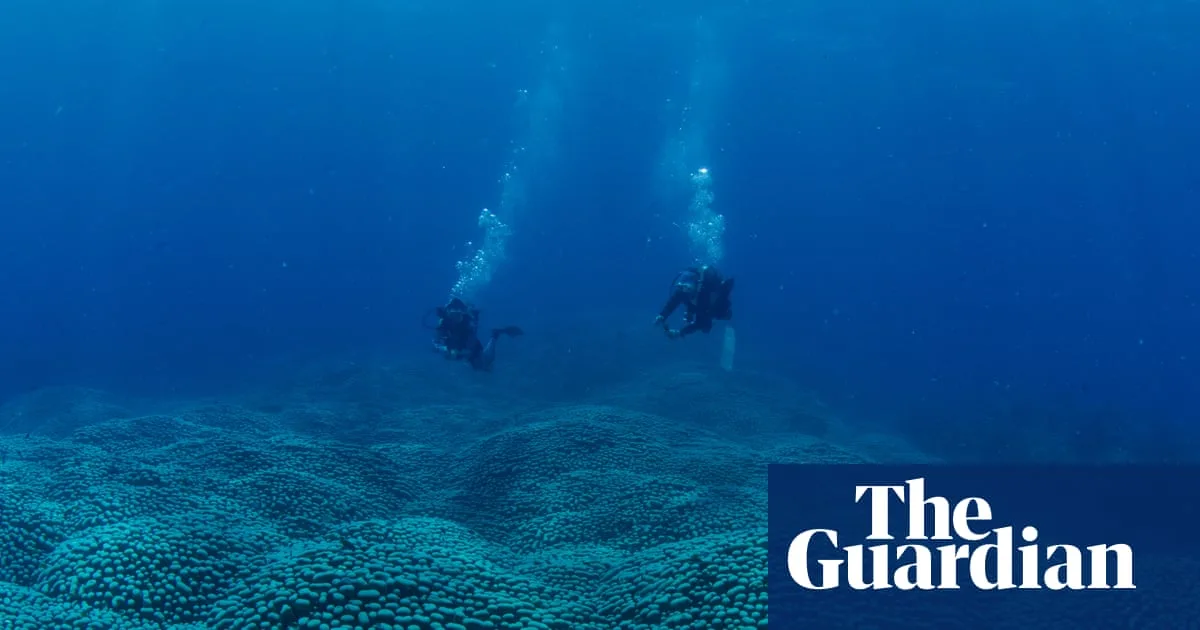
Citizen scientists have discovered what is believed to be one of the largest coral colonies ever documented on the Great Barrier Reef. The coral, a Pavona clavus, spans approximately 111 metres in maximum length and covers an estimated area of 3,973 square metres, about half the size of a soccer field.
The discovery was made by Jan Pope, a volunteer with the citizen science project Great Reef Census, run by Citizens of the Reef. Pope spotted the coral in waters a few hours offshore from Cairns. 'It was quite glassy and I could see this very strange pattern in the water,' she said. 'When I jumped in the water, it became obvious to me that I’d found something that I’d never seen anything like it before.'
Pope, who has been diving on the reef for 35 years, described the coral as 'a very surreal underwater landscape. It looks like a rolling meadow.' Her daughter, Sophie Kalkowski-Pope, marine operations coordinator at Citizens of the Reef, surveyed the site a fortnight later. 'We had no idea that something so significant was right here on our doorstep,' she said.
The Great Reef Census uses crowd-sourced images to monitor coral cover across the reef, and has surveyed a quarter of it since 2020. One aim is to identify 'hotspots of resilience' that can supply other reefs with larvae. Dr Tom Bridge, curator of corals at the Queensland Museum, said Pavona clavus is uncommon but can form 'really, really ridiculously huge colonies'. However, he noted that very large colonies are becoming rare due to increasing bleaching events.
Genetic testing is needed to confirm whether the coral is a single colony formed from one original polyp, or multiple colonies that coalesced. To estimate its size, the colony was mapped using photogrammetry, stitching photographs into a 3D model. Serena Mou, a research engineer at QUT Centre for Robotics, said the coral was larger than initially thought.