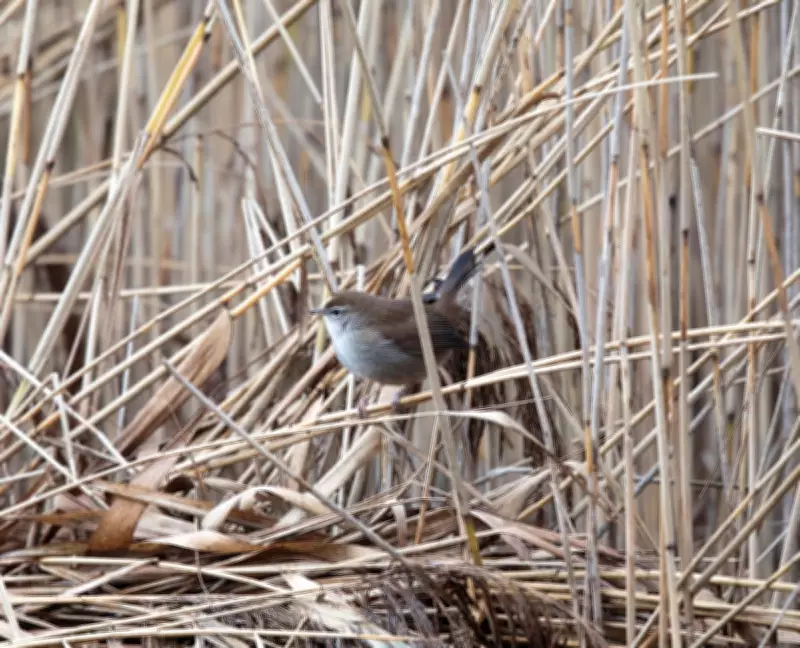
I achieved it. I genuinely spotted a Cetti's warbler at Walthamstow Wetlands in London. These birds are expert skulkers, renowned for their loud vocalisations yet highly elusive nature. And yet, there one emerged from the reeds, creating a memory to cherish forever.
The Tranquil Setting of Walthamstow Wetlands
It was weather you might consider emigrating to avoid. Gloomy and cold, with a Tupperware-like sky and a persistent drizzle in the air. However, it offered tranquillity, at least. That was a small mercy. Walthamstow Wetlands is a 211-hectare nature reserve centred on ten reservoirs in north-east London. It serves as a jewel in the Lee Valley's crown and stands as one of the finest locations for observing waterbirds in the capital.
A Peaceful Birdwatching Experience
Six tufted ducks drifted across the water, forming a posse of monochrome floaters on a mission to nowhere. A little grebe, resembling a floating powder puff, executed its trademark jump-and-dive manoeuvre, surfacing thirty seconds later and twenty-five yards to the left of where I anticipated. An extreme sense of peace descended upon me. This state of birdfulness represents the optimal way to be.

The Startling Call of the Cetti's Warbler
Chack! What was that? Chack-a-dack! An eruption of sound, abrupt, violent, and startling. Chack-a-dack-adackadockadiggadoggadack! Despite the volume, it was a welcome sound. A singing Cetti's warbler was vocalising from deep within the reeds. I scanned the area without expectation. Hearing a Cetti's warbler is commonplace, as their far-carrying voice and fondness for shouting ensure that, but seeing one is an entirely different matter. Field guides describe them as loud and elusive. If skulking is required, you can reliably depend on a Cetti's warbler.
Historical Context and Population Growth
During my childhood, Cetti's warblers barely existed in Britain, with only a handful of sightings recorded. However, since the first breeding record in 1972, they have made significant inroads. Nowadays, if I visit a watery reserve and do not hear one, I feel compelled to write a strongly worded letter of complaint to the relevant authorities.
The Crafty Behaviour of the Warbler
The song commenced again, strident and insistent, but this time behind me, nowhere near where I was looking. This crafty devil employs such tactics. It sings loudly to attract attention, falls silent, moves location, and then sings loudly once more. This aligns with the Beau Geste hypothesis, giving the impression that there is more than one bird, a strategy designed to deter competitors and confuse hapless birdwatchers.
A Rare and Memorable Sighting
I turned as stealthily as possible and began scanning afresh. However, stealth was not required on this occasion. Perhaps the bird was curious, perhaps bold, or perhaps it simply desired a bit of company. Whatever the reason, for a few seconds, it forgot its reputation as a skulker. A rustle in the scrub transformed into a brown flash, which then became a vibrant chestnut bundle with a fanned tail quivering with energy. It quickly tired of my company and dashed back under cover, but the sighting stayed with me, dispelling the gloom and imprinting on my memory.