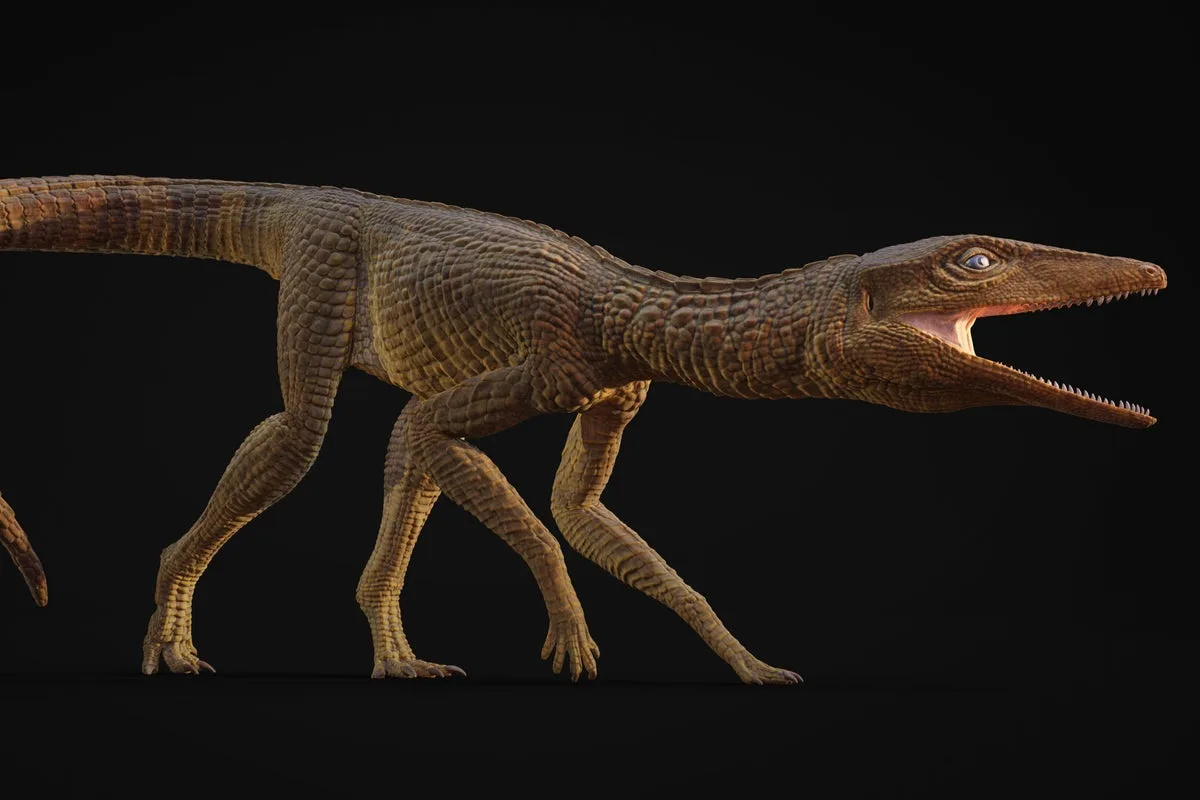
A newly identified species of prehistoric crocodile from the Triassic period has been named in honour of a Welsh schoolteacher. The crocodylomorph, whose fossils were discovered near Gloucester, has been officially designated Galahadosuchus jonesi.
Researchers describe the creature as resembling a reptilian greyhound, a fast-moving, land-dwelling predator with long, slender limbs. It is believed to have hunted small reptiles, amphibians, and early mammals in dense undergrowth, during a time when this part of Britain was an upland region surrounded by hot, arid plains.
The first part of its scientific name, Galahadosuchus, draws inspiration from Galahad, the knight of Arthurian legend known for his moral uprightness, reflecting the animal’s upright posture. The second part, jonesi, pays tribute to David Rhys Jones, a physics teacher at Ysgol Uwchradd Aberteifi in Cardigan, Wales, who taught the study’s lead author, Ewan Bodenham.
“Mr Jones was just such a good teacher, not only in being able to explain things well, but you could tell that he was genuinely interested in the sciences,” said Bodenham, a PhD student at the Natural History Museum London and University College London. “He also didn’t let me settle. He was very good at challenging people and helping students be the best they can be. Above all, he’s a very funny, genuine, nice guy.”
The remains were recovered from fissure deposits on both sides of the Bristol Channel, in southern Wales and south-west England. Scientists believe animals that died on the surface were washed into caves and later buried by sediment. Among the fossils was an animal previously identified as Terrestrisuchus, an early member of the broader crocodylomorph group that also includes modern crocodiles. Unlike today’s crocodiles and alligators, these early relatives had long legs and lived entirely on land.
Bodenham’s PhD project involved a detailed anatomical description of the specimen, comparing it to other early crocodiles. The researchers identified 13 key anatomical differences, significant enough to classify the fossil as a completely new species. The find adds to evidence of rich animal diversity in the region during the Late Triassic, shortly before the Triassic–Jurassic mass extinction event. The species is described in the journal The Anatomical Record.