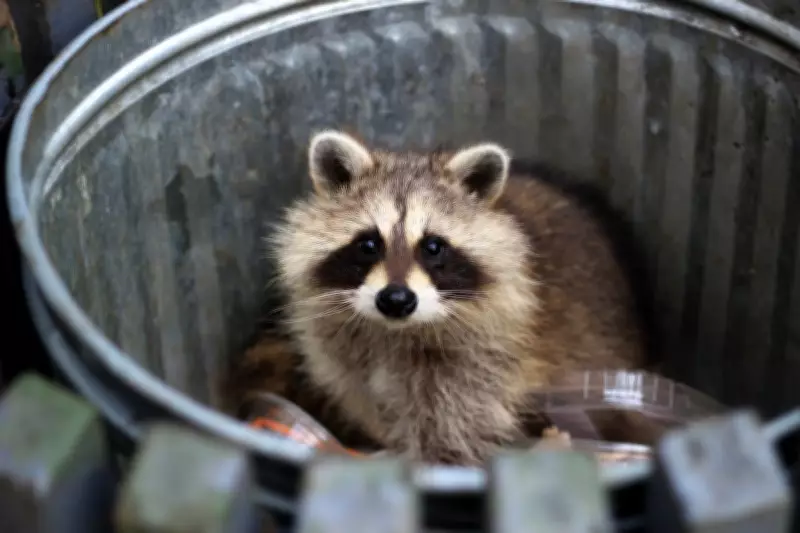
Raccoons Display Intrinsic Curiosity by Solving Puzzles Without Food Rewards
A groundbreaking study from the University of British Columbia has revealed that raccoons are not merely opportunistic scavengers driven by hunger, but genuinely curious creatures that engage in problem-solving for its own sake. The research, published in the journal Animal Behaviour, demonstrates that these animals continue manipulating complex puzzle mechanisms long after any food reward has been consumed.
Experimental Design Reveals Unexpected Behaviour Patterns
Researchers developed a custom multi-access puzzle box featuring nine distinct entry points categorized as easy, medium, and difficult. The container held a single marshmallow treat accessible through various mechanisms including latches, sliding doors, and knobs. During twenty-minute trial sessions, scientists observed raccoons persistently opening new mechanisms even after consuming the available food.
"We weren't expecting them to open all three solutions in a single trial," explained study author Hannah Griebling. "They kept problem-solving even when there was no marshmallow at the end. This suggests a more intrinsic motivation beyond hunger is driving their behaviour."

Strategic Exploration and Risk Assessment
The animals demonstrated sophisticated exploration strategies, trying multiple openings and varying their approach order even when puzzles were easily solved. When confronted with increased difficulty, raccoons showed preference for dependable solutions while still exploring alternative routes. This behaviour mirrors decision-making frameworks observed in other animals and humans.
Dr Griebling drew a compelling parallel: "It's a pattern familiar to anyone ordering at a restaurant. Do you order your favourite dish or try something new? If the risk is high – an expensive meal you might not like – you choose the safe option. Raccoons explore when the cost is low and quickly decide to play it safe when the stakes are higher."
Urban Adaptation and Cognitive Advantages
This intrinsic motivation for information gathering provides raccoons with significant advantages in complex urban environments. Their ability to solve problems for knowledge, rather than just sustenance, helps explain their remarkable success in accessing secured garbage bins, compost containers, and other human-made food sources in cities.
The animals' physical attributes complement their cognitive abilities. Their forepaws contain rich concentrations of sensory nerves, enabling sophisticated manipulation of latches, handles, and other mechanisms during foraging activities.
Broader Implications for Wildlife Management
"Understanding the cognitive traits that help raccoons thrive can guide management of species that struggle," noted Dr Griebling. "This research informs strategies for other species, like bears, that use problem-solving to access human-made resources."
Sarah Benson-Amram, another study author, emphasized the scientific significance: "Raccoon intelligence has long featured in folklore, yet scientific research on their cognition remains limited. Studies like this provide empirical evidence to support that reputation."
The findings challenge conventional perceptions of raccoons as simple scavengers, revealing complex cognitive processes that enable their urban proliferation. This research opens new avenues for understanding animal intelligence and developing more effective wildlife management approaches in human-dominated landscapes.