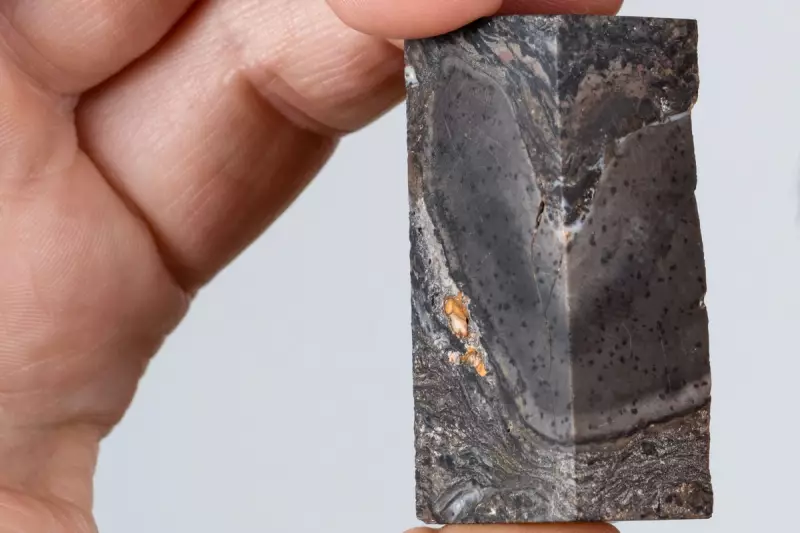
A fascinating fossil from a life form that once dominated ancient landscapes is set to go on public display at the National Museum of Scotland in Edinburgh, following significant scientific research that has shed new light on its mysterious origins.
Discovery of an Ancient Giant
The Prototaxites fossil, which dates back approximately 410 million years, was discovered near the village of Rhynie in Aberdeenshire. This remarkable specimen was found within the Rhynie chert, a sedimentary deposit renowned for its exceptional preservation of early terrestrial ecosystems.
A Mysterious Life Form
Prototaxites represents one of nature's most intriguing evolutionary puzzles. These organisms grew to impressive heights of more than eight metres, towering over the primitive landscapes of their time. For over 165 years, scientists have debated their classification, with early theories suggesting they were a form of fungus.

Recent research published in Science Advances has fundamentally challenged these assumptions. A team of scientists from National Museums Scotland and the University of Edinburgh has concluded that Prototaxites belonged to what they describe as "an entirely extinct evolutionary branch of life."
Groundbreaking Research Findings
The study, which combined chemical analysis with anatomical examination of the fossil, has provided compelling evidence that Prototaxites cannot be classified within known biological groups.
Dr Sandy Hetherington, co-lead author of the research and a senior lecturer at the University of Edinburgh, explained the significance of their findings: "They are life, but not as we now know it, displaying anatomical and chemical characteristics distinct from fungal or plant life, and therefore belonging to an entirely extinct evolutionary branch of life."
Dr Corentin Loron, co-lead and first author from the UK Centre for Astrobiology, highlighted the importance of the Rhynie chert site: "The Rhynie chert is incredible. It is one of the world's oldest, fossilised, terrestrial ecosystems and because of the quality of preservation and the diversity of its organisms, we can pioneer novel approaches such as machine learning on fossil molecular data."
An Independent Evolutionary Experiment
The research team's conclusions suggest that Prototaxites represents what they term "an independent experiment that life made in building large, complex organisms." These organisms became extinct approximately 360 million years ago, leaving behind only exceptionally preserved fossils as evidence of their existence.
Laura Cooper, a PhD student and co-first author from the Institute of Molecular Plant Sciences, elaborated on this point: "Our study demonstrates that prototaxites cannot be placed within the fungal group. As previous researchers have excluded prototaxites from other groups of large complex life, we concluded that prototaxites belonged to a separate and now entirely extinct lineage of complex life."
Museum Collections and Scientific Advancement
The fossil has now been formally added to the collections of National Museums Scotland, where it will be available for both public viewing and continued scientific study.
Dr Nick Fraser, keeper of natural sciences at National Museums Scotland, emphasised the importance of museum collections in advancing scientific knowledge: "This study shows the value of museum collections in cutting-edge research as specimens collected over time are cared for and made available for study for direct comparison or through the use of new technologies."
The addition of this specimen to the national collection represents another significant piece in documenting Scotland's remarkable geological and biological history, spanning billions of years of Earth's development.