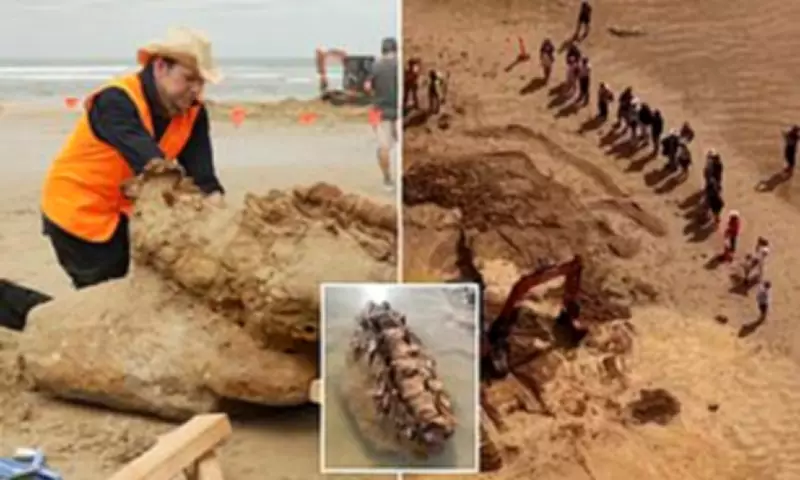
A remarkable 20-million-year-old whale fossil has been successfully excavated from a Victorian beach after being discovered by a Queensland family during their holiday late last year. The one-tonne fossil was uncovered at Ocean Grove Beach on the Bellarine Peninsula in December when holidaymaker Kristina Davidson noticed bones protruding from the sand and immediately contacted Museums Victoria.
Chance Discovery During Family Holiday
Ms Davidson described the extraordinary find as completely accidental. 'I pretty much stumbled over it... we spent some time trying to dig it up and look at it and took some photos,' she explained to Nine News. 'There's the spine, there's rib bones, it's just kind of all there. It's just mind blowing.'
The family's casual beach walk in December 2025 has resulted in what experts believe could be one of the largest fossil discoveries ever made in Australia. Approximately twenty staff members from Museums Victoria and Barwon Coast collaborated to carefully excavate the fossil using heavy machinery, completing the delicate operation just yesterday.

Scientific Significance of the Find
Museums Victoria senior paleontologist Dr Erich Fitzgerald received an email about the fossil buried beneath half a metre of sand just before Christmas. 'I was actually about to go on leave for Christmas ... a member of the public sent an inquiry to the museum's public enquiry line,' he recalled. '[They said:] "We think we've found something on the beach at Ocean Grove".'
Dr Fitzgerald visited the site on December 19th to investigate and confirmed the significance of the discovery. He described the whale fossil as one of the more important finds he has encountered in his career, particularly because many of the bones appear to remain connected in their original anatomical positions.
'Every fossil we find has its own unique significance ... it's rare to find a skeleton where there are many of the bones connected together,' Dr Fitzgerald emphasized.
Clues to Ancient Whale Evolution
The fossil has now been transported to Melbourne Museum, where scientists are conducting detailed studies of the ancient remains. A small exposed tooth visible on the side of the fossil block offers crucial information about the whale's origins.
'There's one little tooth that we can see exposed on the side of this block, and that tooth suggests that this is from a really quite primitive group of toothed echo-locating whales,' Dr Fitzgerald explained.
Fossils from this geological period, approximately 21 to 23 million years ago, are exceptionally rare worldwide. This discovery could provide valuable insights into a critical phase of whale evolution when Earth's climate and oceans were undergoing dramatic transformations.
Dr Fitzgerald highlighted the international importance of the find: 'This fossil from Ocean Grove doesn't just have local, state, national significance, it has the real chance to shed light on the global picture of whale evolution through what you might consider the missing years of whale history.'
The well-preserved skeleton offers paleontologists a unique opportunity to study anatomical connections that are rarely found in such ancient marine mammal fossils. As research continues at Melbourne Museum, scientists hope this discovery will fill important gaps in our understanding of how modern whales evolved from their ancient ancestors during a period of significant environmental change.