Four decades ago, the area known as Mousley Bottom in Derbyshire was a blighted landscape, a place where nature had been all but extinguished. Today, it stands as a powerful testament to the environment's extraordinary capacity for renewal, transformed from a literal wasteland into a rich, biodiverse woodland that echoes with birdsong.
The Industrial Past: A Landscape Devoid of Life
To stand by the River Goyt now, hearing the deep croak of ravens and the spirited song of wrens, is to experience a serene blend of town and country. Yet 40 years ago, the scene was one of profound degradation. The location was dominated by a municipal dump, a sewage works, and a historic gasworks. The latter produced town gas from coal tar, saturating the soil with heavy toxins.
The River Goyt itself acted as a conduit for pollution, carrying away waste from the town. This onslaught of industrial and human filth left the river system almost completely devoid of life, making Mousley Bottom a textbook example of a brownfield site considered beyond all hope.

A Vision for Green Transformation
The catalyst for change was the late Sir Martin Doughty, who served on New Mills council from the age of 26. His vision, combined with sustained local effort, set in motion a recovery that would span generations. The most visible symbol of this change was the planting of 22,000 trees in the 1980s, including 500 oaks planted by the town's schoolchildren.
This nascent woodland was then nurtured by a dedicated council ranger team, whose habitat creation work helped the straight lines of saplings evolve into a complex, natural forest. It is a poignant footnote that the resources for this team have since been drastically reduced, from 300 days of work per year to just five.
Nature's Hidden Heroes: The Unseen Network
While human initiative provided the initial framework, the true architects of Mousley Bottom's rebirth are the countless unseen organisms that rebuilt the ecosystem from the ground up. The real recovery was engineered below the surface by a whole-system collaboration of archaebacteria, actinomycetes, nematodes, annelids, and rotifers.
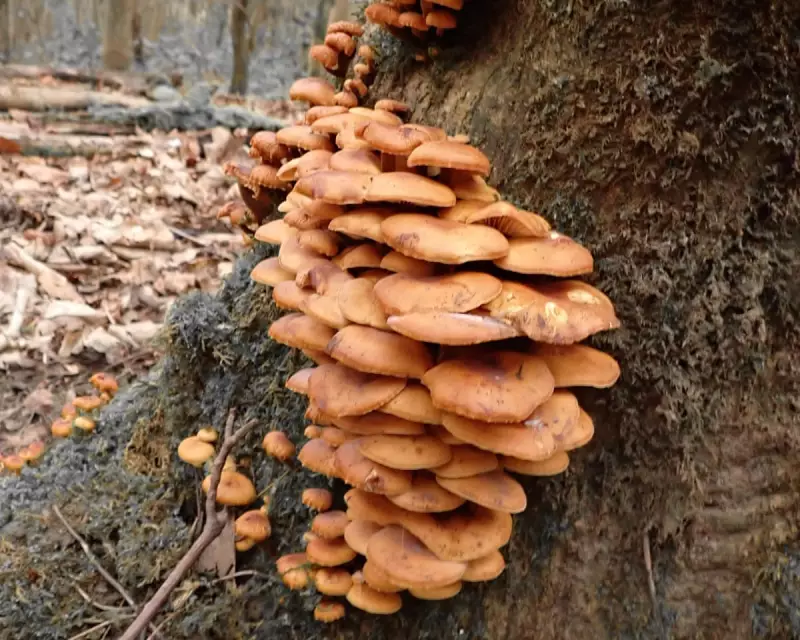
This largely subterranean network detoxified the soil, creating the foundation for the visible life we celebrate today. They enabled the plants, insects, and fungi to return, which in turn supported the birds and mammals that now call the wood home. The sheathed woodtuft mushrooms photographed growing on one of those original 22,000 trees are a perfect symbol of this intricate, life-giving web.
Over three decades, these combined forces performed an environmental miracle. They converted a poisoned "shit-heap" into a beautiful town park, a glorious riverside walk, and a genuine tourist attraction. The story of Mousley Bottom delivers an unequivocal message: no brownfield site is beyond redemption. It stands as a lasting monument not just to human vision, but to the patient, powerful resilience of nature itself when given a chance.