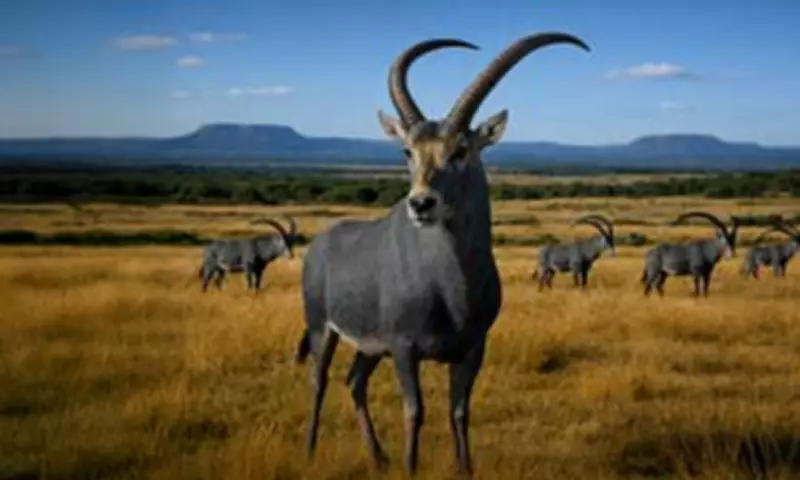
Colossal Biosciences, the company striving to bring back the woolly mammoth, has now turned its attention to another extinct species: the bluebuck antelope. This antelope thrived in Southern Africa until it was hunted to extinction roughly 230 years ago, prized for its distinctive silvery slate-blue skin.
Bluebuck Characteristics and Extinction
Standing about four feet tall, the bluebuck was smaller than modern antelopes but featured enormous curved horns that could reach up to two feet (65 cm) in length. It holds a somber place in history as the first animal in modern times to be completely wiped out by humans. After playing a vital role in the grassland ecosystem of South Africa's southwestern Cape for millennia, the last bluebuck was killed around 1800, merely 34 years after being scientifically documented.
De-Extinction Strategy
Colossal Biosciences plans to modify the genes of the bluebuck's living relatives—the roan and sable antelopes—to create a hybrid that closely mirrors the extinct species. This technique mirrors the one recently used to recreate the dire wolf, which vanished 12,000 years ago. Scientists have been working on the bluebuck project for two years and report significant breakthroughs. While no timeline for the species' return has been announced, the company is scouting potential rewilding sites in South Africa.

Technological Breakthroughs
Ben Lamm, CEO and co-founder of Colossal Biosciences, stated: "The bluebuck represents a pivotal step forward for Colossal and conservation, marking our first major focus on antelope conservation. Every reproductive technology, genome editing protocol, and conservation tool we develop through this effort is designed to scale. By focusing on the bluebuck, we're not only working to restore a lost species, but also building solutions that can help protect entire ecosystems."
The company's method involves reconstructing the bluebuck genome from a historical specimen at the Swedish Museum of Natural History, then comparing it to the genomes of roan and sable antelopes to identify key differences. Professor Michael Hofreiter, a geneticist at the University of Potsdam leading the genomic work, said: "Our initial genomic work with Colossal scientists on bluebuck specimens two years ago demonstrated that viable DNA could be recovered from this extinct species and placed it within the evolutionary context of other African antelopes. The technological advances Colossal has made transformed what was possible even a few years ago, taking us from reading ancient genomes to rewriting them for conservation."
Scientists have also developed a method to turn adult roan antelope cells into induced pluripotent stem cells (iPSCs), which can differentiate into any tissue type. Dr. Beth Shapiro, chief science officer, explained: "Once you have a pluripotent cell line, you can differentiate it into virtually any tissue type, which means you can test how genetic changes affect biology without needing a living animal. That matters enormously for species where every individual counts."
Conservation Implications
These techniques could aid conservation for antelopes currently on the brink of extinction. Two-thirds of all antelope species are experiencing population declines, with over 25% considered at risk. Five species—addax, hirola, Ader's duiker, dama gazelle, and saiga—are classified as Critically Endangered. Colossal is creating a genetic library of DNA from threatened species to enable breeding if numbers dwindle.
Controversy and Criticism
The de-extinction approach has sparked controversy. Critics noted that the company's claimed "dire wolf" was actually a genetically modified grey wolf. Ecologists question whether a species can be safely reintroduced to an ecosystem that has changed significantly in its absence. Professor Stuart Pimm, an ecologist at Duke University, remarked: "Can you put a species back into the wild once you've exterminated it there? I think it's exceedingly unlikely that they could do this in any meaningful way."

Despite this, Colossal continues its work, collaborating with Advanced Conservation Strategies (ACS) to plan reintroduction pathways, considering sites, ecological requirements, population viability, and regulatory issues. Professor Alto Charo, a bioethicist at the University of Wisconsin-Madison and advisor to Colossal, stated: "De-extinction done well is an act of ecological responsibility as well as scientific ambition."