
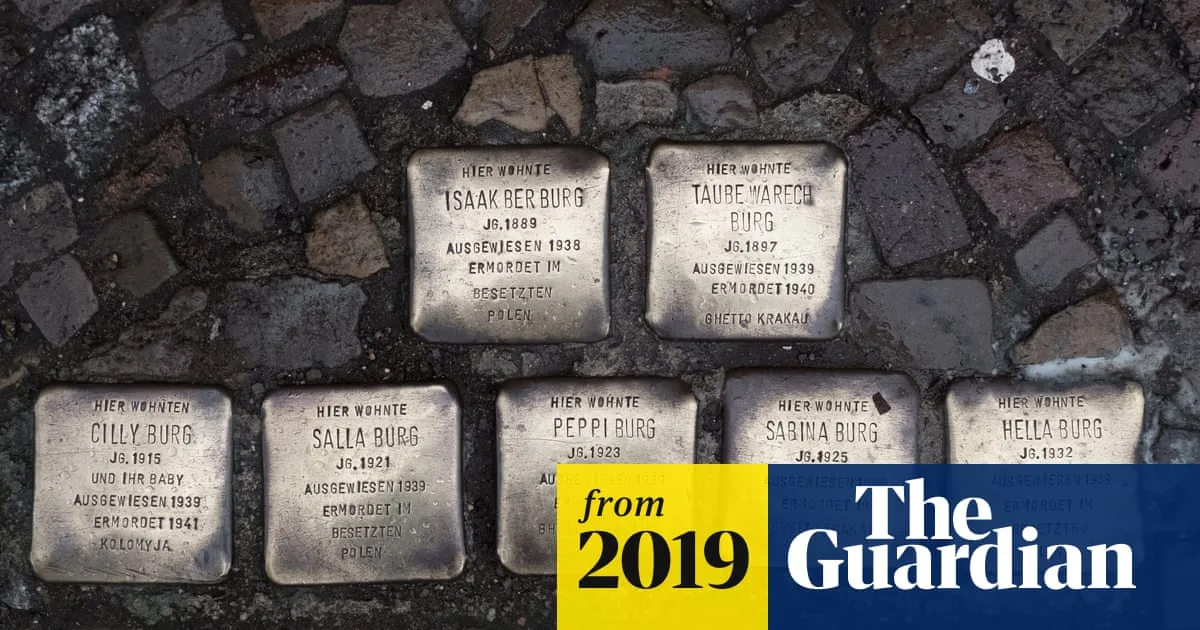
On a recent winter afternoon, residents of Duisburger Strasse in Berlin gathered to remember neighbours killed in the Holocaust. The organiser told the story of Manfred Hirsch, a young boy deported from house No 18 at the age of four. Volker Spitzenberger, who lives there with his husband, reacted with a sharp intake of breath. "That's our house," he said.
The memorial that prompted their gathering was not a large monument but a small brass stone, just under 10 sq cm, set into the cobblestones. Known as Stolpersteine, or "stumbling stones", more than 70,000 have been laid in over 1,200 towns and cities across Europe and Russia. Each one sits outside a victim's last-known freely chosen residence and begins with the words "Here lived", followed by their name, date of birth and fate.
Artist Gunter Demnig conceived the idea in Cologne in 1992 as part of an initiative to commemorate Roma and Sinti victims. He installed the first Berlin stone four years later. Now the stones exist in 20 languages and 24 countries and form the world's largest decentralised monument, honouring all victims of the Nazi regime, including Jewish, Sinti, Roma, disabled, dissident, Afro-German and "asocial" citizens. In 2017, the Pestalozzi school in Buenos Aires became the first site outside Europe to host one. The 70,000th stone was laid for Willy Zimmerer, a man with learning disabilities murdered at Hadamar psychiatric hospital.
The project remains grassroots. Local groups research the biographies of victims and raise the €120 needed for each stone. Norbert and Astrid Wollschläger invited fellow residents in their building to join in; about half agreed. "We would go in pairs to the archives," said Wollschläger. "It really knocks it out of you. The Nazis kept meticulous records, right down to the last silver spoon a victim left behind." He said the project bonded the building: "It made our building feel like a community."
Before installation, organisers must find as many relatives as possible and invite them to the ceremony. Retired principal Dietmar Schewe, 67, welcomed 25 visitors from Israel to his building's event. The small stones offer a personal contrast to larger memorials. Translator Marion Papi, who lives nearby, said: "I find it much more moving than these colossal or labyrinthine memorials, which to me feel quite bombastic and anonymous. The Stolpersteine are so much more vivid and personal."




