
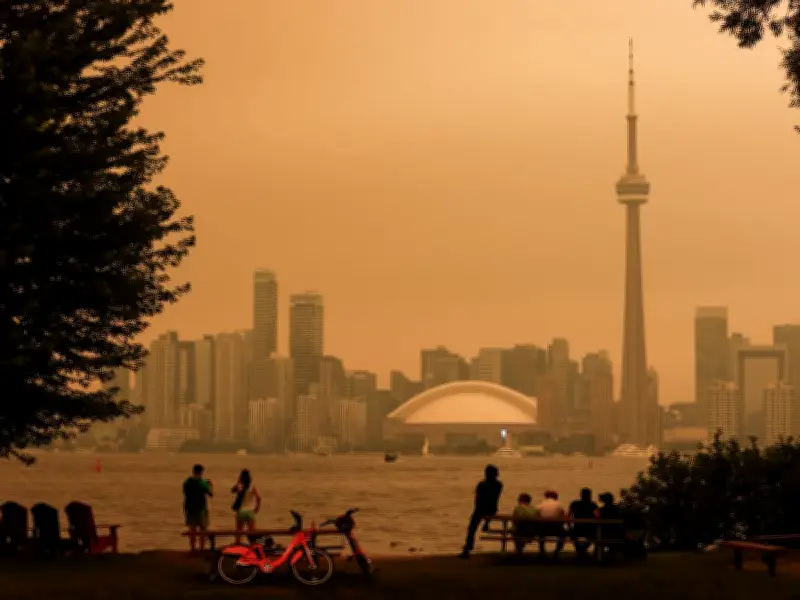
Toronto's Air Quality Plummets to Worst Globally
Toronto, Canada, has been labelled the world's worst city for air quality after a series of horrific wildfires turned the sky a dark red apocalypse. Warnings were issued by Environment Canada after wildfires and heatwaves broke 30-year records, causing the sky to turn yellow and orange. According to IQAir, Toronto now has an air quality rating of 274, classified as 'very unhealthy,' surpassing Delhi, India, and Kinshasa, Democratic Republic of Congo.
Record-Breaking Temperatures and Evacuations
Temperatures reached 37.3°C across the city, while the international airport's runway hit a scorching 55°C. Wildfires sparked mandatory evacuations across Ontario, with social media videos of the fires going viral. Sol Mamakwa, a member of the province’s New Democratic Party, stated: 'What we are witnessing right now is devastating. An entire First Nation community has been erased because of this disaster.'
Collins First Nation Destroyed
The entire Collins First Nation community has been burned down. Local news outlets report that fire bans have been introduced in Thunder Bay, Oliver Paipoonge, Neebing, Nolalu, and Dryden. Lise Vaugeois, the provincial representative for the region, said: 'Collins has burned to the ground. This is a tragedy and we are grateful that everyone got out safely. Fires are part of a natural cycle, but the extreme temperatures we are experiencing across the country and the growing severity of weather events are indicators of climate change.'
Tourism Infrastructure Damaged
Laurie Marcil, executive director of Nature and Outdoor Tourism Ontario, told the public that although there have been no injuries, tourism infrastructure has been destroyed. She said: 'We've lost some planes, some air bases, and that's devastating for these operators. In talking with the operators this morning, they had lots of questions like which fires are going to be let to burn? Which ones are the priority to do fire suppression? What's the timing of things? Because there's been a loss of some of the planes in the industry, is there going to be some help for them if they don't have enough planes to if they have to do more evacuations? So it's all of these things that are really, really important right now. But the way that the industry is coming together and helping one another . . . it's just really heartwarming.'




