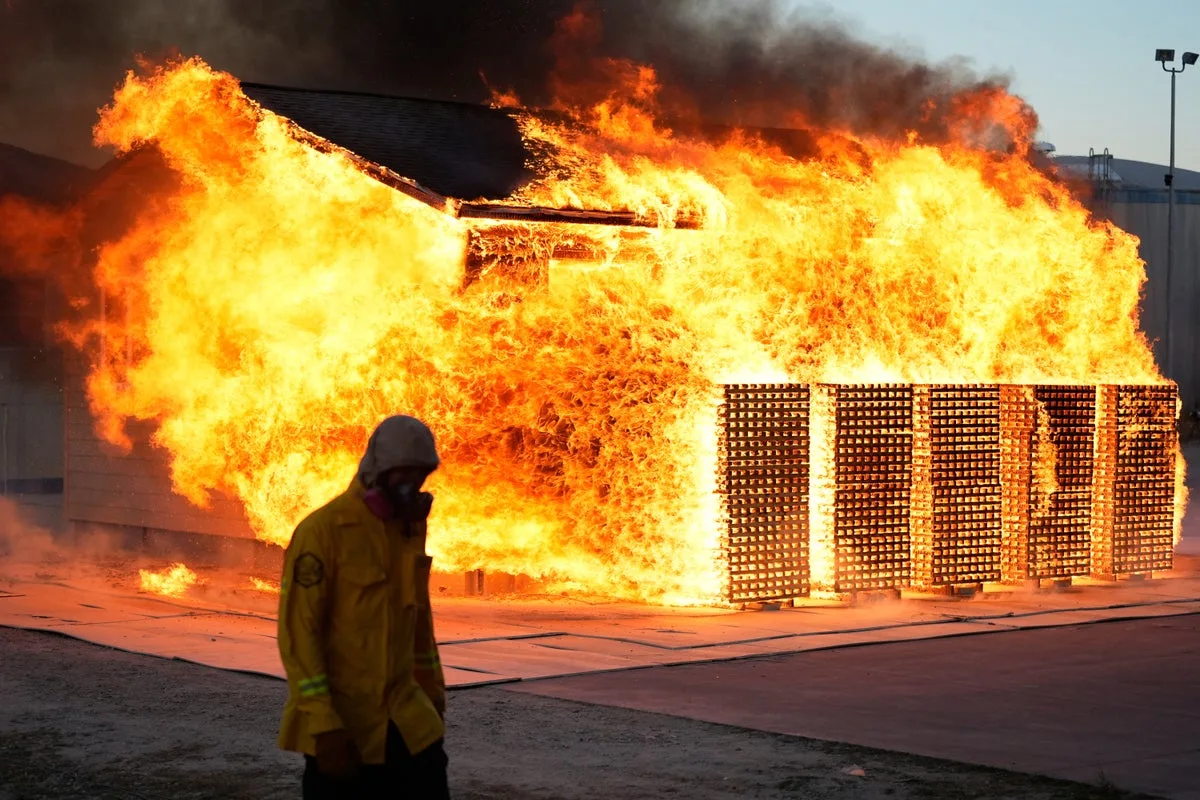
Scientists Burn Homes in Controlled Fires to Study Wildfire Protection Methods
As global temperatures continue to rise, scientists are taking an unconventional approach to understanding how to safeguard homes from the growing threat of wildfires. In a remote facility in South Carolina, researchers are deliberately setting houses ablaze in controlled experiments to determine the most effective materials and strategies for protecting residential structures.
Rapid Destruction Versus Fortified Resistance
In one dramatic demonstration, wind-whipped flames consumed an unprotected house in less than three minutes, shattering windows and burning everything inside. Weeks later, another house built in the exact same location burned much more slowly because it was constructed with superior, fire-resistant materials. Experts emphasize that by using better building materials, moving vegetation away from structures, and creating defensible spaces around properties, homeowners can significantly reduce their vulnerability to wildfires.
The research is being conducted by the Insurance Institute for Business & Home Safety, a nonprofit organization created by insurers to enhance building resilience. Their 100-acre facility in Richburg, South Carolina, originally focused on hurricane and storm damage but has expanded to study wildfire threats as climate change intensifies fire seasons.
Wildfires Worsening Across North America
Statistical evidence confirms that wildfires are becoming more severe and destructive. From 2016 to 2025, wildfires in the United States burned an average area equivalent to Massachusetts each year—approximately 11,000 square miles. This represents a 2.6-fold increase compared to average burn areas during the 1980s. Similarly, Canada has experienced land burned at 2.8 times the rate of the 1980s over the past decade.
In financial terms, wildfires have caused an average of $17.7 billion in annual damage in the United States since 2020. Climate change is extending fire seasons while population growth places more communities in fire-prone areas. Recent devastating wildfires in California, Hawaii, and the Carolinas highlight the escalating danger.
"Drought across much of the United States—particularly in the West and Southeast—has reached record severity levels for this time of year," explained UCLA climate and fire scientist Park Williams. "Combined with unprecedented heat and low moisture levels in the West during early 2026, this upcoming fire season could be exceptionally severe unless significant late spring or early summer rainfall occurs."
Scientific Testing Leads to Practical Solutions
The institute's research has already influenced building codes, particularly in California where new homes must now feature ignition-resistant walls, tempered or double-paned windows, and mesh-covered vents to prevent ember intrusion. Equally important is maintaining a five-foot buffer zone around structures where flammable materials like pine straw, wooden fences, or overhanging branches are removed.
During controlled tests, researchers simulate wildfire conditions using a massive wall of 105 fans that can generate winds between 30 and 55 miles per hour. These winds push flames toward test homes, demonstrating how quickly fires can spread once windows and walls are breached. Inside burning structures, combustible materials like furniture and plastics rapidly ignite, sending dangerous embers flying to neighboring properties.
"We crash test houses," said Roy Wright, president of the Insurance Institute for Business & Home Safety. However, Syracuse University fire researcher Jacob Bendix cautions that "under really severe fire conditions, especially those involving very high winds, fire standards probably are of more limited value."
Fire Prevention Becomes a Growing Industry
As wildfire risks increase, fire prevention has evolved into a significant business sector. After witnessing the 2018 Woolsey fire near his California home, Nicholai Allen developed Safe Soss—a line of products including carbon filters for attics and vents, heat-resistant fiberglass tape, and spray fire retardants that can be applied with garden hoses. These products are now available through major hardware retailers.
Allen compares wildfire preparedness to winter readiness in colder climates. "It's kind of like if you live in the snow, you have a snow shovel, you have scrapers, and you know that you have to take certain preventative steps in order to live in an environment that, hey, sometimes snows," he explained.
Meticulous Testing Under Controlled Conditions
The institute's fire experiments are conducted with extreme precision and safety measures. Test houses are constructed to resemble typical homes but without electricity or plumbing. Researchers prefer spring testing in South Carolina because summer humidity creates unrealistic conditions compared to Western fire environments.
Recent tests faced delays when high winds postponed a scheduled burn for over six hours. Workers were concerned about completing the experiment before an outdoor burning ban took effect following an unusually dry and hot spring. Before ignition, tarps and machines heat the houses to summer temperatures on a large concrete pad adjacent to the testing facility.
Beyond wildfire research, the institute's campus includes areas dedicated to studying hail damage and testing roofing materials through years of exposure to natural elements. This comprehensive approach to building resilience reflects the growing recognition that climate change requires new strategies for protecting homes and communities from increasingly severe weather events.






