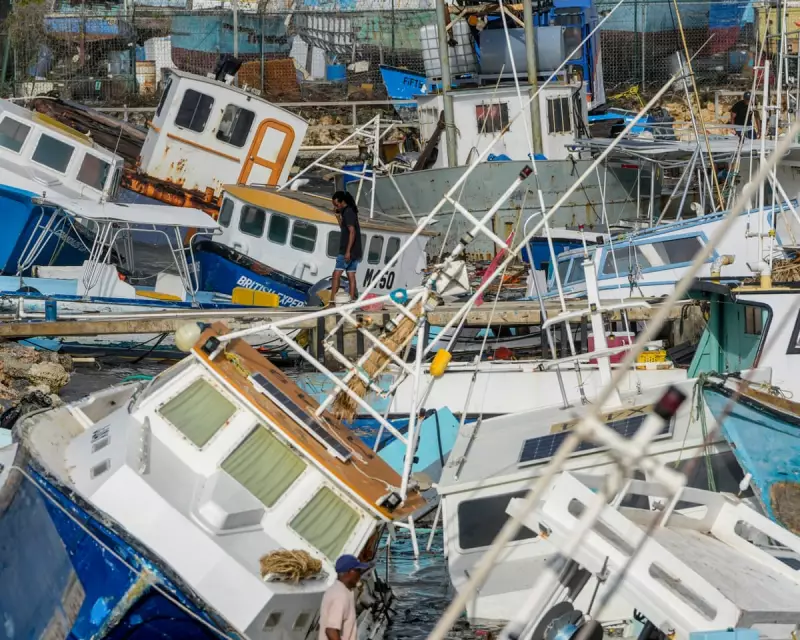
As Barbados assesses the damage to its Bridgetown Fisheries from Hurricane Beryl in July 2024, its Prime Minister has issued a stark warning to the world. Mia Mottley argues the storm's impact underscores a critical moment for climate action, demanding a legally binding international agreement to slash methane emissions, starting with the oil and gas sector.
A Climate Guardrail Shattered
The call comes amid alarming new data. The three-year average temperature is now set to exceed the Paris Agreement's crucial 1.5C guardrail for the first time. According to the Copernicus Climate Change Service, 2025 will join 2023 and 2024 as the three warmest years since the Industrial Revolution, signalling an accelerating crisis.
Mottley warns that with rising ocean temperatures fuelling more powerful hurricanes like Beryl, the planet is approaching irreversible tipping points. The first has already passed: the progressive loss of warm-water coral reefs, vital to nearly a billion people and a quarter of marine life. Others, including Amazon dieback and ice sheet collapse, loom dangerously close.

Methane: The Fastest Lever to Pull
The Prime Minister identifies cutting methane emissions as the swiftest, most effective way to slow near-term warming. While reducing CO2 remains essential, its full impact unfolds over decades. In contrast, eliminating avoidable methane emissions, particularly from oil and gas, could avoid nearly 0.3C of warming by the 2040s.
Combined with a global tripling of renewables and doubled energy efficiency, this could halve the rate of warming by 2040, keeping the 1.5C goal within reach. Yet current voluntary pledges are failing. The UN reports that even fully implemented, existing measures would cut methane emissions by just 8% by 2030, far short of the needed 30%.
Blueprint for a Binding Agreement
Mottley, supported by leaders from Micronesia, Tuvalu, and France's Emmanuel Macron, insists the time for voluntary action is over. She points to promising foundations for a binding pact. At COP28, companies representing 40% of global oil and gas production pledged to end routine flaring and limit leaks to 'near zero' by 2030.
Furthermore, the EU's binding methane regulation, which bans flaring and will soon prohibit leaks, sets a robust template for measurement and verification. Mottley proposes a roadmap, inspired by the successful 1987 Montreal Protocol, which tackled ozone depletion and incidentally averted massive warming.
The plan is to convene willing nations in 2026 to develop binding measures, aiming to start formal negotiations in early 2027. Such an agreement would prevent energy waste, buy crucial time for resilience-building and technology scaling, and help finance the Global South's path to net zero. For island nations on the front line, like Barbados, it is an urgent matter of survival and justice.