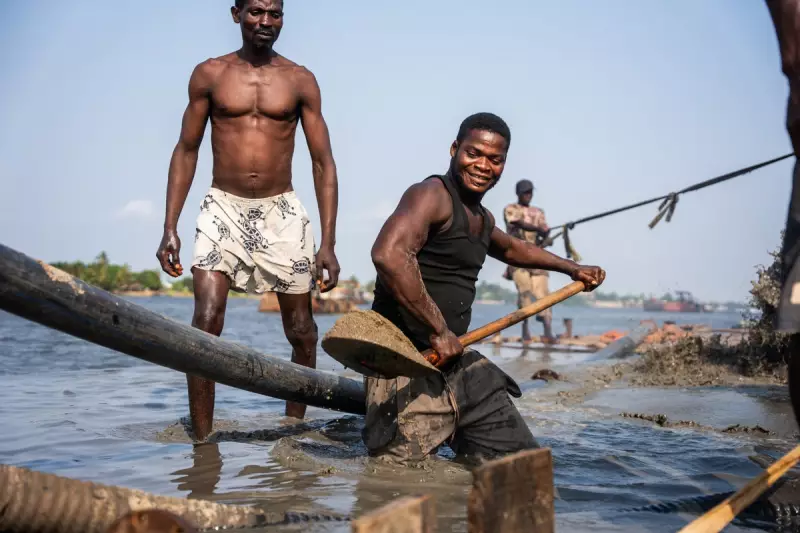
Beneath the roar of an eight-lane expressway in Lagos, a quieter but profoundly destructive industry is at work. Men stand waist-deep in the murky waters of the Lagos Lagoon, hauling up bucket after bucket of sand. This relentless extraction is physically reshaping the coastline of Africa's largest megacity, with devastating consequences for both the environment and some of Nigeria's most vulnerable communities.
The Human Cost of Coastal Reshaping
Not far from the Third Mainland Bridge, wooden boats are loaded with dredged sand. Among the thousands of informal workers is Akeem Sossu, 34, who dives beneath the surface for 15-second intervals, hauling up sand destined for Lagos's insatiable construction sites. He told reporters he and a partner earn roughly 12,000 naira (about $8) per boatload, selling to a middleman. A former tailor, Sossu now depends on this dangerous work to support his family, starting his day as early as 5 a.m. with the tides.
The demand for sand, a crucial component for concrete, has skyrocketed alongside Lagos's breakneck development. A standard 30-ton truckload of 'sharp sand' now sells for approximately 290,000 naira ($202). This demand is transforming the lagoon that buffers the city of an estimated 17 million people. Open water is now fragmented by emerging sandy patches, narrowing channels and altering currents essential for aquatic life.

The transformation is starkly visible near Makoko, one of Lagos's historic stilt-house fishing communities. Dredging barges operate perilously close to homes, while reclaimed land and upscale beachfront developments encroach from all sides. Residents report that this activity has decimated traditional fishing grounds, pushing many out of work.
Ecological Damage and Scientific Warnings
Fishermen in Makoko wait for dredging to pause, noting that even a brief halt allows some fish to return. Baale Semede Emmanuel, a community leader, states plainly: "Dredgers have spoiled the entire waters." He explains that the noise and disturbance drive fish away and destroy shallow spawning grounds, with fish sometimes being sucked directly into dredging pipes.
Scientific research corroborates these observations. Peer-reviewed studies along the Ajah–Addo-Badore corridor, a major dredging zone, have found water turbidity levels far exceeding national safety standards. This muddy water disrupts fish feeding, reproduction, and migration. Researchers also documented unstable, erosion-prone seabeds at dredging sites and warned that the practice reduces the lagoon's natural capacity to absorb floodwaters, increasing long-term climate risks for the megacity.
The human impact is severe. With catches shrinking, fishermen must voyage further offshore, raising fuel costs and risks. Joshua Monday, a former fisherman, has largely parked his two boats and now works as a mechanic. He cites crippling expenses, where a single trip can cost over 150,000 naira ($104) with no guarantee of a catch. "Big men are stressing us," he said, referring to wealthy developers reclaiming land. "When they come, you have no option. You pack your things and leave."
Weak Regulation and a Cycle of Enforcement
Despite repeated pledges from officials like Governor Babajide Sanwo-Olu to clamp down on illegal dredging blamed for flooding and erosion, enforcement remains inconsistent. Dredging operator Joshua Alex described a system of informal payments, or "dues," to authorities like the Marine Police and the National Inland Waterways Authority (NIWA) to keep working. Environmental advocates say this blurs the line between legal and illegal operations, allowing activities to resume quickly after any official action.
Community leader Emmanuel accuses the government of prioritising revenue and private development over the survival of fishing communities. "The government has the power, not us," he lamented. The Lagos State Ministry of Waterfront Infrastructure Development did not respond to requests for comment on these allegations.

As Lagos continues its relentless expansion, built literally on sand, the tension between development and sustainability reaches a critical point. The dredging that fuels the city's growth is simultaneously eroding its ecological foundations and the livelihoods of those who have depended on its waters for generations.