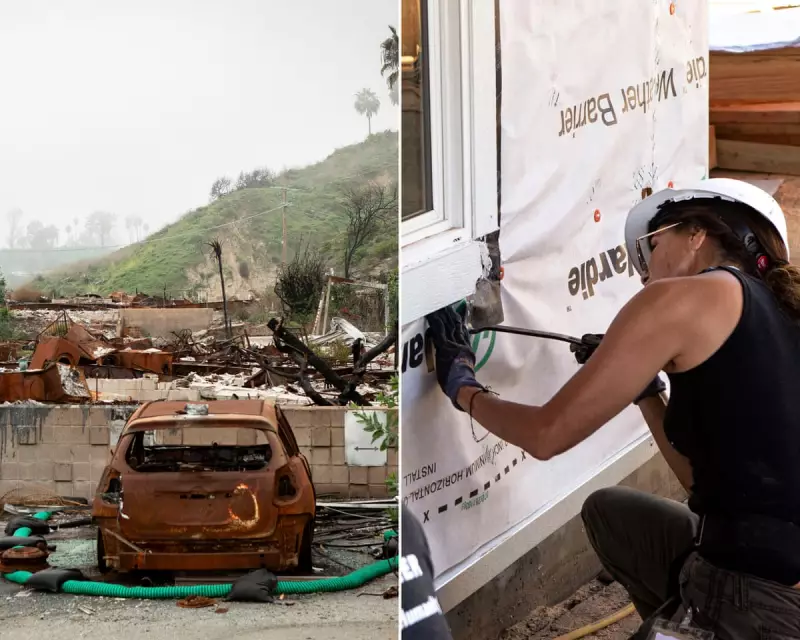
A year has passed since unprecedented wildfires tore through the hillsides and suburbs of Los Angeles, leaving a trail of devastation that claimed 31 lives and reduced more than 16,000 structures to ash. Today, the monumental effort to rebuild what was lost is underway, but progress is painfully slow, exposing deep inequities and raising urgent questions about the city's preparedness for the next climate-fuelled catastrophe.
The Arduous Path to Recovery
In the once-vibrant community of Pacific Palisades, melted newsstands and blackened foundations stand as stark reminders of the inferno. Weeds now paint the empty lots with swaths of green. Despite initial promises from leaders to rebuild faster and stronger, the reality has been a complex and costly slog. While crews performed a mammoth cleanup, removing 2.5 million tons of toxic debris, the reconstruction phase has dramatically slowed.
By early January, only about 41% of the applications to rebuild had been granted permits. Construction was visibly underway on just 511 homes in the Eaton fire footprint and 370 in the Palisades. The patchwork progress highlights a sharp divide: those with resources and developers are leading the charge, while many survivors remain tangled in insurance shortfalls, bureaucratic mazes, and the sheer financial impossibility of rebuilding in one of America's most expensive housing markets.

"It is predominantly the wealthy who are rebuilding," observed Dr Thomas Chandler of Columbia University's National Center for Disaster Preparedness. The strain is pushing long-time residents out. In Altadena, research shows outside investors purchased roughly two-thirds of the lots sold in the first nine months post-fire, threatening the diverse character of the community.
Unpacking a 'Perfect Storm' of Failure
Investigations into the disaster have termed it a "perfect storm" of extreme conditions: exceptionally wet years seeding flammable brush, followed by a record dry winter, and finally, winds gusting up to 90mph. This confluence overwhelmed municipal systems.
Critical failures emerged at every level. Evacuation alerts failed to reach thousands in time; in West Altadena, electronic orders were sent hours after flames had arrived. The chaos of evacuation was compounded by winding canyon roads that turned into gridlocked traps. Most tragically, a report found that 27 of the 31 victims were over 65 or had a disability, many with no means of escape despite being aware of the danger.
Analysis by the Insurance Institute for Business & Home Safety revealed that the fires became an urban conflagration, with structures themselves acting as fuel. Wind-blown embers ignited wooden fencing, entered vents, and spread from house to house. "This wasn't a wildfire. These are fires that moved through the air," explained UCLA researcher Dr Edith de Guzman.
Building Resilience for an Uncertain Future
As recovery crawls forward, community-led initiatives are pioneering models for a more resilient and equitable rebuild. In Altadena, architects Cynthia Sigler and Alex Athenson launched the Foothill Catalog, a modern take on catalogue homes that offers pre-approved, fire-resilient designs to streamline the process for residents.
"Resiliency is most effective at the community scale," Sigler stated, highlighting their goal to restore the area's unique character. Meanwhile, organisations like MySafe:LA are fostering neighbourhood preparedness councils across the city, recognising that the risks are far from over. With over 115 million Americans living in similar vulnerable zones, the lessons from LA are national in scope.
From the rebirth of Altadena's community garden to the hard questions about "home hardening" and evacuation planning, the path forward is twofold. The immediate challenge is to support displaced Angelenos through a just recovery. The enduring one, as garden president Joe Nagy put it, is to figure out "how to prevent it" from happening again. The metropolis must now navigate the arduous climb out from under this catastrophe while fortifying itself against a future where such extreme events are no longer rare, but an escalating threat.