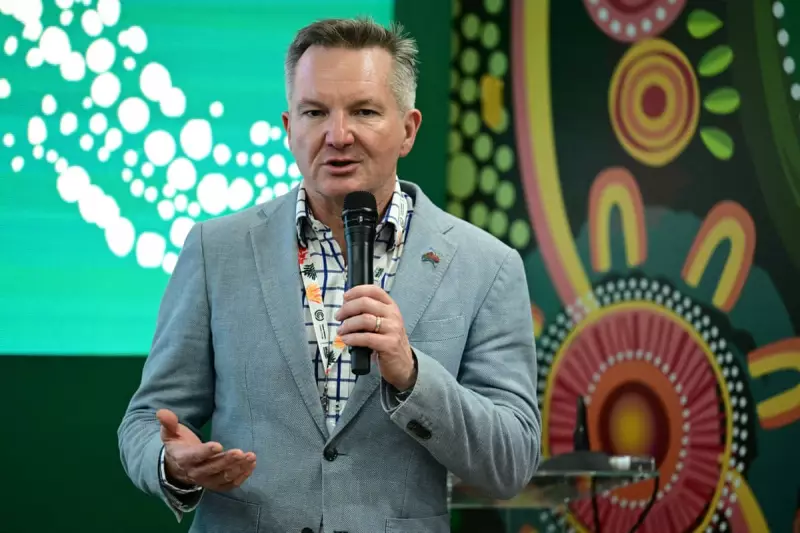
Australia's lead climate minister, Chris Bowen, has revealed an assertive strategy for his pivotal role as the world's chief climate negotiator at the upcoming Cop31 summit. His central mission will be to directly confront and persuade major fossil fuel-producing nations, which have historically obstructed progress, to agree to a global phaseout.
Engagement Over Isolation: Bowen's Cop31 Strategy
Appointed as the 'president of negotiations' for Cop31 under a deal that awarded Turkey the hosting rights, Bowen told Guardian Australia that success hinges on relentless dialogue with traditional opponents. 'Engagement, engagement, engagement' will be his mantra, focusing on countries 'with whom we don't traditionally agree'.
He singled out Saudi Arabia, the oil-rich Gulf state frequently accused of derailing efforts at UN summits to accelerate the end of fossil fuels. Bowen argued that simply preaching to the converted is ineffective. 'We won't get anywhere if we just have a jamboree of the willing,' he stated, emphasising the need for a summit that bridges deep divides.

Leveraging Australia's Credibility as a Major Exporter
Bowen believes Australia's status as a major exporter of fossil fuels like coal and gas grants it unique credibility when lobbying other petrostates. This position, he suggests, allows for a more pragmatic and understanding form of diplomacy aimed at shifting entrenched positions.
His approach follows a direct appeal from former US Secretary of State John Kerry for Australia to actively push the world's biggest emitters—including China, Russia, the US, and India—to develop a concrete roadmap to end the fossil fuel era. With the US largely absent from UN climate talks under the Trump administration, Bowen's role becomes even more critical.
Building on Dubai and Moving Beyond Belém
The urgency of this mission was underscored at the recent Cop30 summit in Brazil, which concluded with a deal that omitted any direct mention of fossil fuels after opposition from Saudi Arabia and its allies. In response, over 80 countries, including Australia, signed a separate 'Belém declaration' committing to a 'just, orderly and equitable' phaseout.
Bowen aims to secure a 'meaningful step forward' from the 2023 Dubai agreement, where nations agreed for the first time to begin phasing out fossil fuels. As part of the Australia-Turkey hosting agreement, a pre-conference event will be held in the Pacific to spotlight small island nations facing existential threats from climate change, applying moral pressure on negotiators.
Domestic Policy and the Road to 2035
While managing his international duties, Bowen must also oversee Australia's domestic energy transition. He described progress on cutting pollution as 'good, a lot done, but a lot more to do'. Current projections show Australia is on track for its 2030 target but will need significantly stronger policies to meet its new 2035 goal of reducing emissions by 62% to 70% below 2005 levels.
Key upcoming reviews of the safeguard mechanism (covering 219 major industrial sites) and the national vehicle efficiency standard present early opportunities to accelerate action. However, Bowen cautioned that simply expanding the number of businesses covered by the safeguard scheme was 'not a sort of slam dunk', warning of a balancing act to ensure real emissions reductions.
Despite Australia's failed bid to fully host Cop31, Bowen views the negotiation presidency as a 'remarkable opportunity' to shape a decisive global moment in the fight against climate change, combining Pacific advocacy with hard-nosed diplomacy.