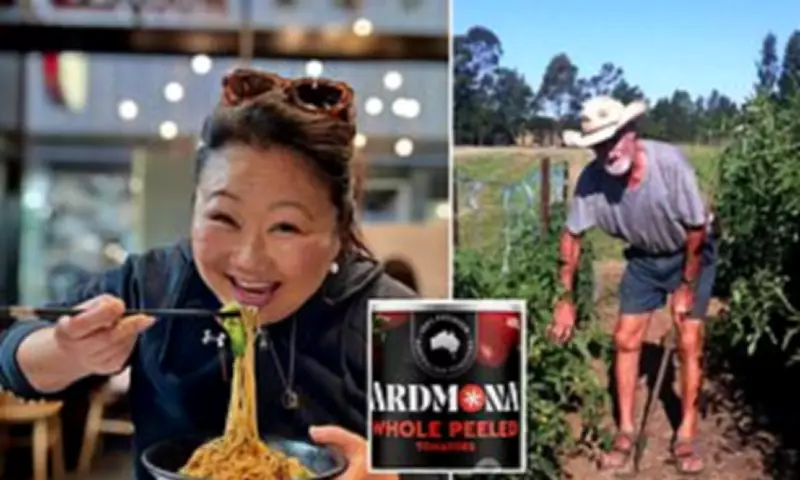
RecipeTinEats Star Unleashes Scathing Critique on Australian Tomato Quality
Nagi Maehashi, the culinary powerhouse behind the wildly popular RecipeTinEats platform, has delivered a blistering assessment of Australia's locally-grown tomatoes. In a recent interview, she branded them as fundamentally tasteless, unpleasantly sour, and disappointingly substandard. Her candid remarks have ignited a fierce debate about agricultural standards and consumer choices in the nation's food industry.
Veteran Farmer Confirms Culinary Queen's Damning Verdict
Industry stalwart Austie Breiner, with decades of tomato farming experience, has corroborated Maehashi's harsh critique. He attributes the poor quality directly to the rigorous specifications imposed by major supermarket chains. "They ARE substandard," Breiner stated unequivocally. "They are hard, devoid of flavour, tough, and often display unappetising white segments. These tomatoes are cultivated specifically to endure mechanical harvesting and survive journeys exceeding 1,000 kilometres to reach supermarket shelves."
Maehashi elaborated on her position during a conversation with Nine Newspapers, asserting there is simply "no contest" when comparing Australian tomatoes to their Italian tinned counterparts. "Australian tomatoes are so poor," she told Good Weekend magazine. "Even fresh tomatoes in Australia are hopeless." She revealed that she exclusively opts for Italian varieties when preparing spaghetti bolognese and explicitly advises adding sugar to counteract the sourness if using Australian tomatoes in her recipes.

The Supermarket Squeeze and the Demise of Delicate Varieties
Breiner explained that the economic pressures from retail giants have systematically eradicated smaller growers who specialised in more delicate, flavourful varieties like the Italian San Marzano. "Little growers of tasty, more delicate varieties can't make a living and have gone out of business," he lamented. "We've gone the wrong route because with the giants Coles and Woolworths, you can't compete, and the result is tasteless tomatoes."
Maehashi, whose empire was built on accessible "one-pot/one-pan" recipes, acknowledged that budget-conscious families might still choose Australian tomatoes due to perceived cost savings. However, a price comparison at Woolworths reveals a surprising reality: Italian tomatoes can be cheaper or similarly priced. For instance, a 400g tin of Annalisa Italian Diced Tomatoes costs $1.35, whereas Ardmona 100% Australian Whole Peeled Tomatoes are $2.10 for the same size.
The Italian Model: Quality Over Mass Production
Breiner highlighted the contrasting approach of the Italian tomato industry, which focuses on numerous small-scale growers supplying local markets, thereby preserving superior quality and robust flavour. Now 87, he still cultivates tomatoes on his Hunter Valley property but no longer commercially. He noted that tomato growers in regions like Far North Queensland, with ideal ripening climates similar to Italy's, have disappeared because they cannot earn a sustainable income.
"It's the same with tomatoes grown for canning," Breiner explained. "They are bred to mature simultaneously for cheaper harvesting, rather than having progressive flowering and fruiting, and being picked when perfectly ripe and flavoursome." He believes Australia has followed the "mechanised and mass-produced" model of the United States, which he considers a misguided path.
A Legacy of Flavour Versus Modern Demands
Breiner's father, Richard, pioneered the cultivation of the European Grosse Lisse variety in Australia in 1938 from seeds sent by a German refugee. "I still have plants descended from that first crop; they are beautiful and passed the taste test," Breiner shared. "But if you harvested them mechanically and transported them long distances, they'd arrive as liquid."

Meanwhile, Italian brands like Mutti demonstrate an unwavering commitment to quality, even hosting the prestigious Pomodorino D'Oro awards—an "Oscars" for tomato growers. The principal Australian grower and canner, SPC, which markets tomatoes under the Ardmona brand, stated in 2019 that it collaborates with seed producers and farmers to enhance the flavour of the 40,000 tonnes of tomatoes it processes annually. The ongoing conversation raises a critical question for Australian consumers and producers alike: Is the nation sacrificing essential flavour for mere convenience and corporate profit in its staple foods?