Invasive Species Pose Dual Threat to Louisiana's Agricultural Heartland
Farmers across Louisiana are confronting a formidable agricultural crisis as two invasive species—giant apple snails and tiny delphacid insects—wreak havoc on the state's vital rice and crawfish industries. These pests are causing significant economic damage, forcing farmers to adapt their practices while scientists race to understand their spread.
The Snail Invasion: Crawfish Harvests Under Siege
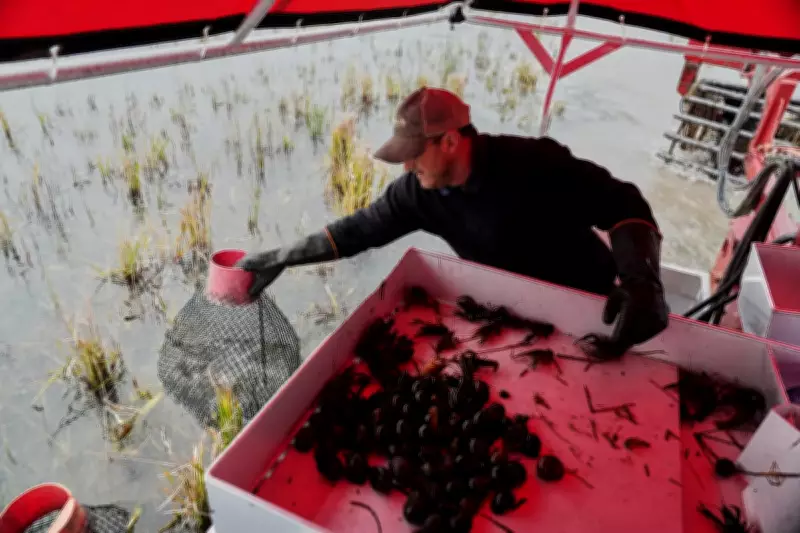
For Josh Courville, a lifelong crawfish harvester, the daily catch has taken an alarming turn. Where he once sorted through traps filled with crawfish, he now finds himself battling baseball-sized apple snails that outnumber his intended harvest three or four to one.
"It's very disheartening," Courville admitted. "The most discouraging part is not having much control over it."

These resilient snails, capable of surviving diverse weather conditions in fields, pipes, and drainage ditches, lay thousands of bubblegum-colored eggs monthly. Louisiana State University researchers estimate approximately 78 square miles of the state now regularly experience snail infestations.
Christian Richard, a sixth-generation rice farmer who employs Courville, first noticed the snails after devastating floods in 2016. "It was like this science fiction movie," Richard recalled, describing how the snails emerged from wet ground, creating miniature whirlpools as they devoured tender rice plants.
The Insect Menace: Delphacids Devastate Rice Crops
While farmers battle snails, a second threat has emerged: rice delphacids, tiny insects that pierce rice plants, extract sap, and transmit damaging viruses. Entomologists consider this resurgence one of the most significant pest events in U.S. rice production since the 1950s.
Tyler Musgrove, a rice extension specialist at Louisiana State University AgCenter, reported that by September and October of last year, nearly all Louisiana rice fields contained delphacids. The insects have already demonstrated their destructive potential in neighboring Texas, where yields dropped by up to 50% in second rice crops.
"The rice delphacid this past year was probably one of the most significant entomological events to occur in U.S. rice since the '50s when it first appeared," Musgrove emphasized.
Economic Consequences and Farming Adaptations
The dual pest invasion creates substantial challenges for Louisiana's agricultural economy:
- Increased production costs: Farmers must implement expensive planting methods, including delayed field flooding to protect young rice plants
- Limited pesticide options: Chemicals that might control snails often harm crawfish, creating difficult choices for farmers
- Labor intensification: Harvesters like Cecilia Gallegos report significantly longer workdays separating snails from crawfish
- Market pressures: In an already challenging rice market, pest-related losses could translate to higher consumer prices
Steve Linscombe, director of The Rice Foundation, warned that "losses to pests could mean higher rice prices for U.S. consumers," highlighting the broader economic implications.
Climate Change and Scientific Challenges
Researchers are investigating multiple factors driving the pests' spread, including farming methods, pesticide use, global shipping patterns, and extreme weather events. While the precise role of climate change remains uncertain, scientists note that warming temperatures generally facilitate pest expansion.
Hannah Burrack, professor and chair of Michigan State University's entomology department, explained that "we are going to have more bugs that are happier to live here if it stays warmer here longer." She added that climate change complicates predictive modeling, making it harder for farmers to plan around pest populations.
Adam Famoso, director of Louisiana State University's Rice Research Station, acknowledged the complexity of the challenge: "I think everyone agrees, it's not going to be a silver bullet approach."

Looking Forward: Research and Resilience
Scientists are in early stages of developing management strategies that don't rely on costly or crawfish-harming pesticides. Research priorities include:
- Understanding whether rice-crawfish rotation systems experience different pest impacts than rice-only cultivation
- Investigating the pests' potential to establish permanent winter habitats in the United States
- Developing integrated pest management approaches combining biological, cultural, and chemical controls
With delphacids now identified in four of six rice-producing states—Texas, Louisiana, Arkansas, and Mississippi—the agricultural community faces an urgent need for solutions that protect both crops and the farmers who depend on them.