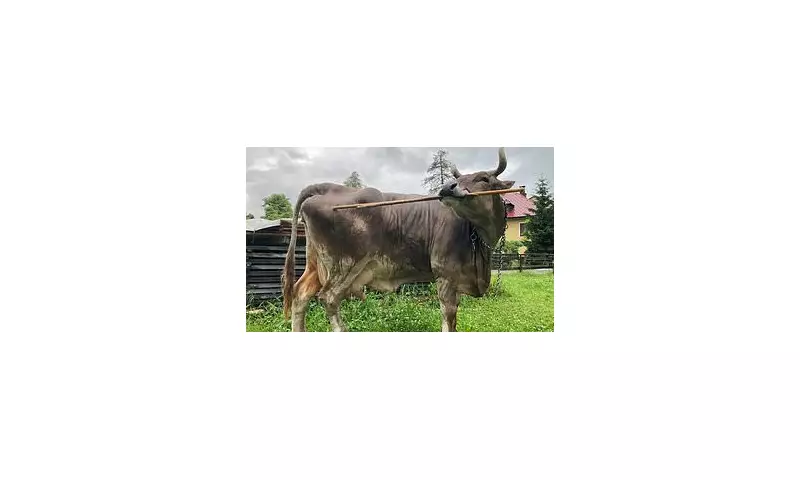
A remarkable brown Swiss cow from Austria has compelled scientists to radically reconsider the intellectual capabilities of cattle, following the first ever documented case of a bovine using a tool.
A Clever Cow's Scratching Solution
The cow, named Veronika, lives as a pet with organic farmer and baker Witgar Wiegele in the Carinthian village of Carinthia. Over more than a decade, Wiegele observed Veronika beginning to play with wooden sticks using her mouth, behaviour which eventually evolved into her using a stick to scratch her own body. The findings were formally published in the journal Current Biology on January 19, marking a significant milestone in animal cognition research.
"I was naturally amazed by her extraordinary intelligence," said Wiegele, reflecting on his long-term companion. He added that her behaviour prompted him to think about "how much we could learn from animals: patience, calmness, contentment, and gentleness." Beyond her tool use, Veronika also demonstrates advanced social cognition, recognising family members' voices and hurrying to meet them when called.

Scientific Scrutiny and Controlled Tests
The behaviour captured scientific attention when footage was shared with Dr Alice Auersperg, a cognitive biologist at the University of Veterinary Medicine, Vienna. "When I saw the footage, it was immediately clear that this was not accidental," Dr Auersperg stated. She and colleague Antonio Osuna-Mascaró then visited Veronika to conduct formal tests.
In a series of controlled trials, the researchers placed a deck brush on the ground in random orientations. They meticulously recorded which end of the brush Veronika selected and which part of her body she targeted. The results were consistent and revealing. Veronika displayed flexible, multi-purpose tool use, employing different parts of the same object for different needs.
"Veronika is not just using an object to scratch herself," explained Osuna-Mascaró. "She uses different parts of the same tool for different purposes, and she applies different techniques depending on the function of the tool and the body region." For broad, firm areas like her back, she typically chose the bristled end. For softer, more sensitive lower-body areas, she skilfully switched to using the smooth handle, adjusting her movements to be slower and more controlled.
Challenging Assumptions About Livestock
This behaviour meets the scientific definition of tool use—manipulating an external object to achieve a goal—and goes further by demonstrating notable flexibility. Such sophisticated, self-directed tool use is documented in relatively few species outside of humans, with great apes like chimpanzees being the most advanced examples.
Dr Auersperg suggests that common assumptions about livestock intelligence may reflect a gap in observation rather than a genuine cognitive limit. The researchers believe Veronika's unique life circumstances—her long lifespan, daily human contact, and access to a varied environment—likely provided the conditions necessary for this exploratory behaviour to develop, conditions most farmed cattle do not experience.
The team is now keen to hear from other farmers and observers to understand how widespread such abilities might be in cattle. "We invite readers who have observed cows or bulls using sticks or other handheld objects for purposeful actions to contact us," said Osuna-Mascaró, suspecting the ability may be more common than currently known.
The study even references Gary Larson's famous 1982 Far Side cartoon, "Cow Tools," which humorously depicted crudely made bovine implements. The researchers had a message for Larson: "Veronika did not fashion tools like the cow in Gary Larson's cartoon, but she selected, adjusted, and used one with notable dexterity and flexibility. Perhaps the real absurdity lies not in imagining a tool-using cow, but in assuming such a thing could never exist."