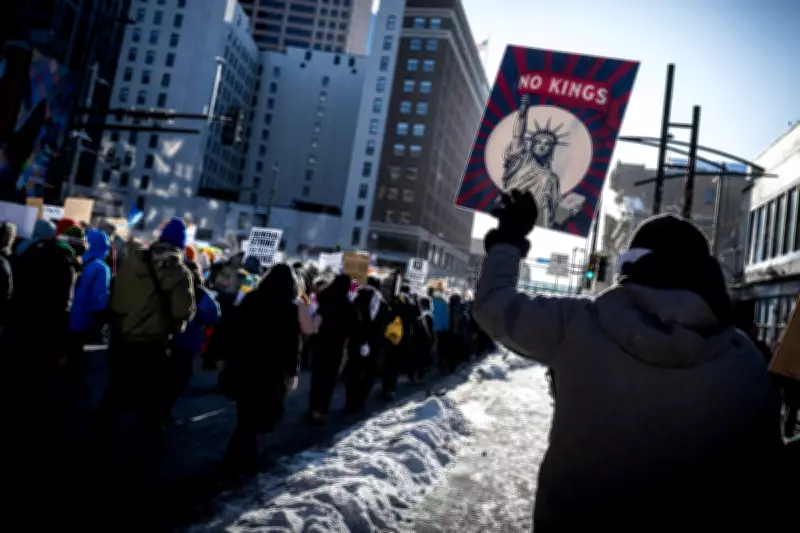
Third 'No Kings' Protest Scheduled for March in Response to ICE Actions
Organisers have declared that a third 'No Kings' protest will take place on 28 March, with demonstrations planned across the United States. The flagship event is set for Minnesota's Twin Cities, encompassing Minneapolis and St Paul, where federal immigration agents recently fatally shot two residents, Alex Pretti and Renee Nicole Good, during escalated operations in the area.
Growing Outrage and Coalition Efforts
Ezra Levin, co-founder of Indivisible and a key coordinator of the No Kings movement, stated that this protest aims to be "the biggest protest in American history." He attributed the mobilisation to mounting public anger over what he described as Immigration and Customs Enforcement (ICE) and the Department of Homeland Security's (DHS) "reign of terror" affecting communities nationwide. The No Kings Coalition, which includes groups like Indivisible, 50501, labour unions, the American Civil Liberties Union, and the Movement for Black Lives, has been actively organising since summer 2025 in response to perceived authoritarianism under President Trump.
Following Good's death, the coalition hosted a "weekend of action" with over 1,000 protests, vigils, and events. Recent YouGov polling indicates that more Americans now support abolishing ICE than oppose it, highlighting shifting public sentiment.

Safety and Nonviolence Emphasised
In their announcement, the No Kings Coalition stressed a commitment to safety and nonviolence. Organisers are trained in de-escalation techniques and are collaborating with local partners to ensure protests remain lawful and peaceful. Levin expressed hope that the event will be "a raucous, joyful and nonviolent but powerful display of what America's all about," regardless of whether ICE agents are present in Minneapolis on the day.
The previous No Kings protests in October recorded approximately 7 million attendees, and the coalition is targeting 9 million participants for the upcoming rally. This growth reflects the movement's expanding reach and influence.
Broader Protest Strategies and Historical Context
Experts note that protests can significantly impact policy and public opinion. In the first year of Trump's second term, Americans have adopted diverse protest tactics against ICE, such as using bullhorns and music in Los Angeles, banging pots and pans in Washington DC, and employing whistles to alert communities of agent presence. A Guardian analysis of Crowd Counting Consortium data reveals that protest numbers last year exceeded those in the initial year of Trump's first term.
Erica Chenoweth, a protest researcher, commented on the historic scale of current mobilisations, stating, "It is a very historic time, in the sense that people are mobilizing where they live in ways that I don't think I have seen before in my lifetime."
Future Actions and Movement Goals
Levin emphasised that the two-month lead-up to the protest does not signify inactivity. The coalition is conducting online trainings for safely documenting ICE agents, with one session already viewed by over 200,000 people and another scheduled for 5 February. Additionally, Levin is urging pressure on elected officials, including House Minority Leader Hakeem Jeffries and Senate Minority Leader Chuck Schumer, to call for the resignation of DHS Secretary Kristi Noem.
He clarified that No Kings 3 is not the culmination of the movement, noting, "Authoritarians typically do not give up power willingly ... you need to develop the muscle and the sophistication of your pro-democracy movement." The aim is to foster sustained engagement beyond large-scale protests, encouraging widespread participation akin to the efforts seen in the Twin Cities.