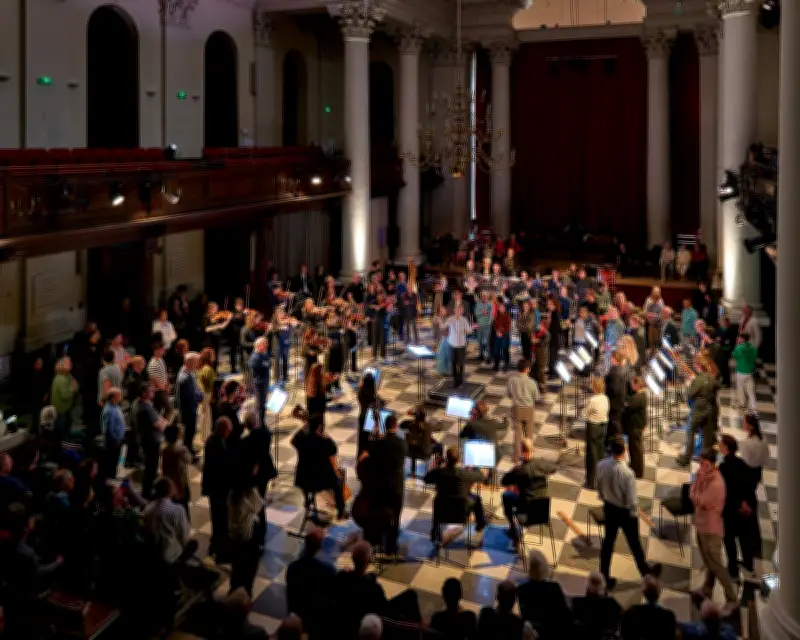
'None of us quite know what's going to happen!' … The Mahler Experiment at Sinfonia Smith Square, London. Photograph: Sophie Oliver
Review: The Mahler Experiment review – physical drama comes at a musical cost in choreographed symphony. Sinfonia Smith Square, London. Tom Morris's staged take on Mahler's first symphony is valiantly performed by Stephanie Childress and Sinfonia Smith Square, but the result feels more like R&D than a finished product.
If you're Macbeth, a moving forest generally isn't a good thing. But what if you're Mahler? The instrumentalists of Sinfonia Smith Square, conductor Stephanie Childress, and director Tom Morris decided to test the result in The Mahler Experiment. As Morris declared cheerfully at the outset: 'None of us quite know what's going to happen!'
The composer's First Symphony conjures a shifting landscape of bird calls and blooming flowers, town bands and hunting parties, spring's rebirth and man's death and funeral procession. You can see the temptation to turn a sonic journey into a physical one, especially when you're working with a space as flexible as Smith Square Hall.
The trend for getting orchestras and audiences up on their feet in 'spatialised' performances is an interesting one. For good or ill, it turns a work of art into a playground: first and second violins toss a tune to and fro over your head; timpani rolls set your body vibrating; a clarinet entry jumps out from behind you. It's fun, especially if you're someone who wants to count the rests in the horn part, or marvel at the semiquavers in the violins. But is it more than that?
Turning a work of art into a playground … conductor Stephanie Childress for The Mahler Experiment at Sinfonia Smith Square, London. Photograph: Sophie Oliver
You can see the possibility here, but this first outing was, as advertised, very much an experiment: R&D rather than the finished product. The Sinfonia's recent music-college graduates coped brilliantly with Morris's choreography, frequently separated from their music, playing on the move. But the physical drama came at a musical cost. Tuning wavered, violins busked and smudged runs and entries juddered across the space. And the challenges forced Childress into safe choices, too often a traffic cop rather than a conductor.
There were some lovely moments, mostly in the third movement where you could chase the eerie 'Frère Jacques' theme around the orchestra in Yoon Jae Lee's efficient reduction, but also in the engulfing power of the finale (though you had to be careful not to get stuck in the brass oom-pahs when there was a lovely string melody going on). But it felt like a warm-up. A second half of Mahler as Mahler intended – the composer's balance and orchestration supplying the professional guided tour after our amateur wanderings – might have turned an experiment into the finished product.