Russell Meyer: The Unapologetic Godfather of Sexploitation Cinema
With his trademark cigar perpetually clenched between his teeth and a camera forever focused on improbably voluptuous leading ladies, Russell Meyer built an entire career upon defiantly doing precisely what polite society instructed him not to. In an era when Hollywood still clung to prudish production codes and whispered euphemisms, Meyer charged into the film industry like a cultural wrecking ball. He constructed a cult film empire founded on bare flesh, outrageous behaviour, and a gleeful, deliberate disregard for conventional good taste.
A Career Built on Defiance and Provocation
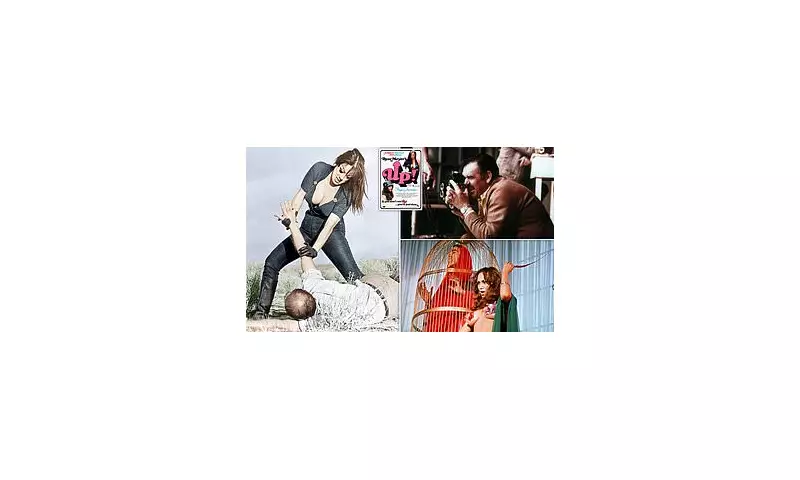
Best remembered as the undisputed godfather of so-called 'sexploitation' cinema, Meyer's filmography—including notorious titles like Faster, Pussycat! Kill! Kill!, Vixen!, and Beyond the Valley of the Dolls—was lurid, loud, and unapologetically obscene. They were also, much to the chagrin of his many critics, enormously influential and commercially successful. Meyer's lifelong, unabashed fixation on large breasts became his most famous directorial signature, prominently featuring in every one of his cinematic creations.
His discoveries of actresses like Kitten Natividad, Erica Gavin, Lorna Maitland, Tura Satana, and Uschi Digard became legendary. The majority of these performers were naturally large-breasted, and Meyer occasionally cast women in their first trimester of pregnancy, believing it enhanced their bust size even further. 'I love big-breasted women with wasp waists,' he would tell interviewers repeatedly, as if announcing a profound artistic revelation.

From Combat Cameraman to Cult King
Born in San Leandro, California, in 1922, Meyer's obsession with photography began in his youth, encouraged by a fiercely protective mother who bought him his first camera. This maternal influence would loom large throughout his life, with many commentators suggesting it partly explained his cinematic fixation on dominant, aggressive women with impossibly exaggerated curves. After serving as a combat cameraman during the Second World War, where he filmed the brutal realities of the front line, Meyer returned to America with a hardened edge and a powerful taste for creative independence.
Disillusioned with the traditional Hollywood studio system, he decided to forge his own path, personally funding, directing, shooting, and editing his own films. What followed was a parade of public scandals and legal battles. Meyer's movies consistently skirted—and frequently smashed straight through—contemporary censorship laws, landing him in courtrooms, on official banning lists, and directly in the firing line of outraged moral crusaders.
Scandal, Success, and Lasting Influence
Religious groups branded him a corrupter of youth. Prominent feminists accused him of blatantly objectifying women. Mainstream film critics dismissed his work as crude, childish, and exploitative. Yet, his loyal audiences could simply not get enough. His breakout hit, The Immoral Mr. Teas in 1959—a near-silent comedic romp about a man who suddenly sees women naked wherever he goes—reportedly cost just $24,000 to produce and earned millions at the box office. This success cemented Meyer's reputation as a one-man hit factory who knew exactly how to push societal buttons.
He became known as the 'King of Nudies', as The Immoral Mr. Teas is widely considered the groundbreaking first 'nudie-cutie' film—an erotic feature that openly contained female nudity without the pretext of a naturist context. The film is also regarded as the first pornographic feature not confined to under-the-counter distribution. Meyer followed this with other nudie-cuties like Wild Gals of the Naked West and Eve the Handyman, before moving into more narrative-driven, yet equally provocative, filmmaking.

Pushing Boundaries with Major Studios
Perhaps his most famous mainstream chapter came in 1970 when 20th Century Fox hired Meyer to direct Beyond the Valley of the Dolls, a sequel in name only to the studio's earlier hit. Co-written by famed film critic Roger Ebert, the movie descended into an outrageous carnival of sex, drugs, cults, and sudden violence. Fox executives were reportedly horrified; the film was slapped with an X-rating and savaged by many contemporary reviewers. Yet, it quietly went on to become a defining cult classic, earning $9 million at the US box office against a modest $2.9 million budget.
Despite the controversial reception, Fox was delighted with the commercial success and signed Meyer to a contract for three more films. 'We've discovered that he's very talented and cost-conscious,' said executive Richard Zanuck at the time. 'He can put his finger on the commercial ingredients of a film and do it exceedingly well. We feel he can do more than undress people.'
A Complex Legacy and Personal Life
Behind the camera, Meyer was a complex and often difficult figure. He was married six times, often to actresses from his own films, and colleagues described him as controlling, volatile, and obsessively driven. Former partners spoke of explosive rows and emotional manipulation. His singular aesthetic vision remained consistent, with critics joking that his camera seemed physically incapable of framing anything other than exaggerated female curves.
By the 1980s, cultural tastes had shifted dramatically. Hardcore pornography had moved into the mainstream, making Meyer's cheeky, soft-focus provocations seem almost quaint by comparison. His output slowed, and his influence faded from the mainstream, though it endured powerfully in underground and cult cinema circles. In his later years, Meyer worked obsessively on a massive three-volume autobiography titled A Clean Breast, finally published in 2000.
Diagnosed with Alzheimer's disease that same year, his care was managed by his secretary and estate executor, Janice Cowart. With no wife or children to claim his wealth, Meyer willed the majority of his estate to the Memorial Sloan Kettering Cancer Center in honour of his late mother. Russell Meyer died at his home in the Hollywood Hills from complications of pneumonia on September 18, 2004, at the age of 82. He was buried at Stockton Rural Cemetery in San Joaquin County, California, leaving behind a legacy as one of cinema's most defiant, controversial, and unforgettable iconoclasts.