BBC One's Lord of the Flies: A Gripping Adaptation of Golding's Classic Novel
BBC One's thrilling and engrossing new adaptation of Lord of the Flies presents a faithful reimagining of William Golding's seminal 1954 novel. Starring an extraordinary cast comprised entirely of schoolboys, this four-part serial delves into the dark allegory of civilisation's collapse and the inherent depravity of humanity when stripped of societal constraints.
The Striking Absence of Modern Language
Almost immediately, viewers are struck by the most pronounced difference from contemporary times: the complete absence of modern profanity. As young British evacuees find themselves stranded on a deserted tropical island following a plane crash, their language reveals a vast gulf between their era and ours. There are no F-words, no rapper swagger, and no four-letter insults. The closest approximation to trash-talk occurs during a playful water fight, when one boy laughingly calls his friend a 'rotter'. This linguistic purity makes the eventual descent into brutality all the more shocking and poignant.
An Unpretentious Allegory of Original Sin
Lord of the Flies functions as an unpretentious allegory where the island represents the Garden of Eden and the boys embody humanity before the Fall. The narrative, as audiences familiar with the source material will anticipate, is doomed to end horribly. Since the novel's publication, young readers have consistently been shocked by the story's brutality. However, in recent decades, the crudeness and cruelty of adult life have begun affecting children much earlier, a phenomenon that has accelerated catastrophically over the past ten years with the onslaught of social media and easily accessible explicit content online.

Jack Thorne's Dramatisation and Exploration of Evil
Writer Jack Thorne, who dramatised the story for this serial, brings particular insight to these themes. Thorne, co-creator of the Netflix mini-series Adolescence which exposed the toxic influence of the internet on children, now probes an opposite source of evil. Whether theologians term it 'original sin' or psychologists call it 'innate depravity', this inherent darkness requires the firm rule of law and order to be repressed. Thorne's adaptation thoughtfully explores this central conflict through the young characters' struggles.
David McKenna's Exceptional Portrayal of Piggy
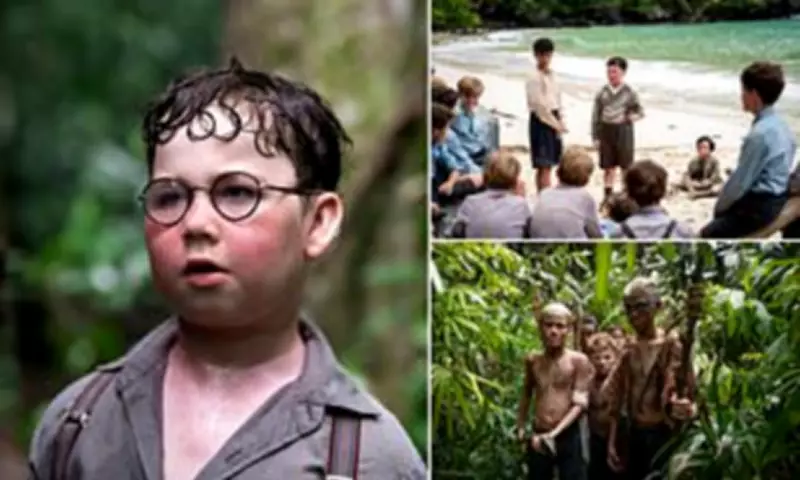
David McKenna, the Belfast schoolboy who plays Piggy, delivers an exceptional performance that captures the character's complex personality. Piggy, the bespectacled and serious-minded boy first encountered on the island, represents the voice of reason and order. He is the only survivor who truly grasps the necessity for societal structure, while the others display varying degrees of egotism, timidity, laziness, or youthful ignorance.
It is Piggy who, stumbling from the jungle onto the beach, ingeniously uses a conch shell as a trumpet to gather all the scattered children after their plane crashes. He advocates for a committee of leaders, proper latrines, organized food distribution, and adequate shelter. Though no more than twelve years old, Piggy possesses the soul of a district councillor with a matching fondness for municipal procedures. When the first disaster strikes, his instinct is to reproach himself for not having drawn up a complete roll call of boys sooner.
McKenna's portrayal extends beyond Piggy's organizational tendencies to reveal the character's inner loneliness and tendency toward hero-worship. The young actor's own remarkable health battles—born with organ failure and receiving two kidney donations, one from each parent—likely contributed to his convincing depiction of Piggy's health struggles. He convincingly shrugs off asthma attacks while displaying paralyzing panic when his glasses, essential for his vision and symbolic of his rationality, are taken from him.

Supporting Characters and Future Episodes
Future episodes promise to focus more extensively on the charismatic but shallow Ralph, portrayed by Winston Sawyers, and the sly, bullying Jack, played by Lox Pratt. As head chorister of a group of choir boys, Jack regards himself as the natural chieftain of the tribe because, as he declares, 'I can sing high C sharp.' Viewers have already glimpsed the nastiness at Jack's core when he took sadistic glee in tipping the corpse of their plane's pilot over a cliff, declaring, 'He made a mistake. A better pilot, a better man, would not have made such a mistake.'
Jack's hunger for power makes him a familiar character in children's literature—JK Rowling's villainous Draco Malfoy might as well be his twin brother. Ralph, though instantly likeable, proves to be no Harry Potter. A weakness in his character hurts viewers whenever it reveals itself, such as when he laughs aloud at the nickname 'Piggy' before revealing it to the other boys.
Production Elements and Atmospheric Mastery
Filmed on a Malaysian island, director Marc Munden's version masterfully evokes the surreal quality of a dream turning to nightmare. This atmosphere is magnified by the discordant score composed by Cristobal Tapia de Veer and Hans Zimmer with Kara Talve, which incorporates 1950s echoes of British composers like Benjamin Britten and Sir William Walton. Flashes of crackling white noise suggest some distant cataclysm—perhaps a Third World War or nuclear holocaust—while the sun blazes with such intensity that the edges of the picture appear to be melting.
Scenes are intercut with close-ups of tropical creatures including crabs, caterpillars, and salamanders, alarming in their alien appearance because they so obviously belong in the jungle while the boys do not. These creatures click their claws and wriggle their feelers as if to communicate that, long after human attempts at civilisation have burned up in the sun, the creepy-crawlies will still endure.
For many viewers who read Lord of the Flies during their school years, long after the details of the story have faded, the novel's atmosphere—its heat-haze of unease—remains vividly memorable. BBC One's adaptation successfully captures this haunting quality while offering fresh perspectives through its talented young cast and thoughtful production choices.