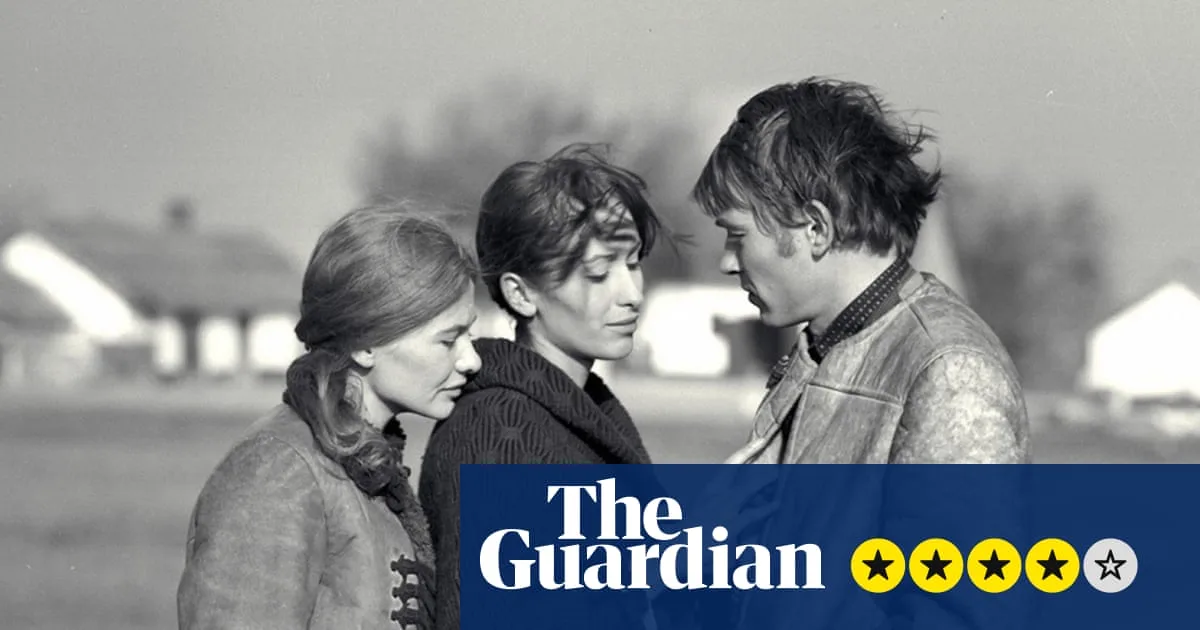
Miklós Jancsó's 1968 film Silence and Cry is a deeply strange somnambulist ballet that meditates on Hungary's political history. Set after the fall of the 1919 Hungarian Soviet republic, the film implicitly juxtaposes the brutality of anti-Communist powers with the postwar Soviet present, in which Czechoslovakia and Hungary have been crushed. The result is an impenetrable psychological trauma with weird erotic overtones, like an absurdist bad dream transcribed by Kafka.
The scene is the vast Hungarian plain, with a desolate wind always blowing, on which characters perform their roles as if on a gigantic stage. Jancsó's sinuous camerawork glides and swoops in long unbroken takes, with figures gradually arriving from impossibly far away and dwindling to dots in the distance. The film's unitary space appears to extend to the far horizon in all directions.
After the first world war, blurred archive photographs allude to the nationalist government that overturned the Hungarian Soviet republic and now pursues an anti-Communist manhunt. István (András Kozák) is a fugitive hiding on a farm owned by two sisters, Teréz (Mari Töröcsik) and Anna (Andrea Drahota). Driven perhaps mad by tension and isolation, they are secretly poisoning Teréz's husband Károly (József Madaras) and his elderly mother. An army officer, Kémeri (Zoltán Latinovits), is aware of István but turns a blind eye in return for implied sexual favours and admiration for István's war record.

Ultimately, István is appalled by the women's secret homicidal activities and must decide how to bring them to justice without endangering himself. But the central dramatic point is the miasma of fear and horror that settles on the landscape. Soldiers, led by a secret-police commandant, menace locals. Houses are torn down as collective punishment, and wrongdoers are made to stand in yards or do 'rabbit jumps'. The commandant forces Károly and others to inspect two dead bodies, touch the corpses, and handle their personal effects, then hold up their hands to an official photographer as if to confirm fingerprints. This bizarre ritual humiliates and degrades, acquainting them intimately with fear and underlining their fellowship with the defeated dead. In this film, the silence and the cry are the same thing.