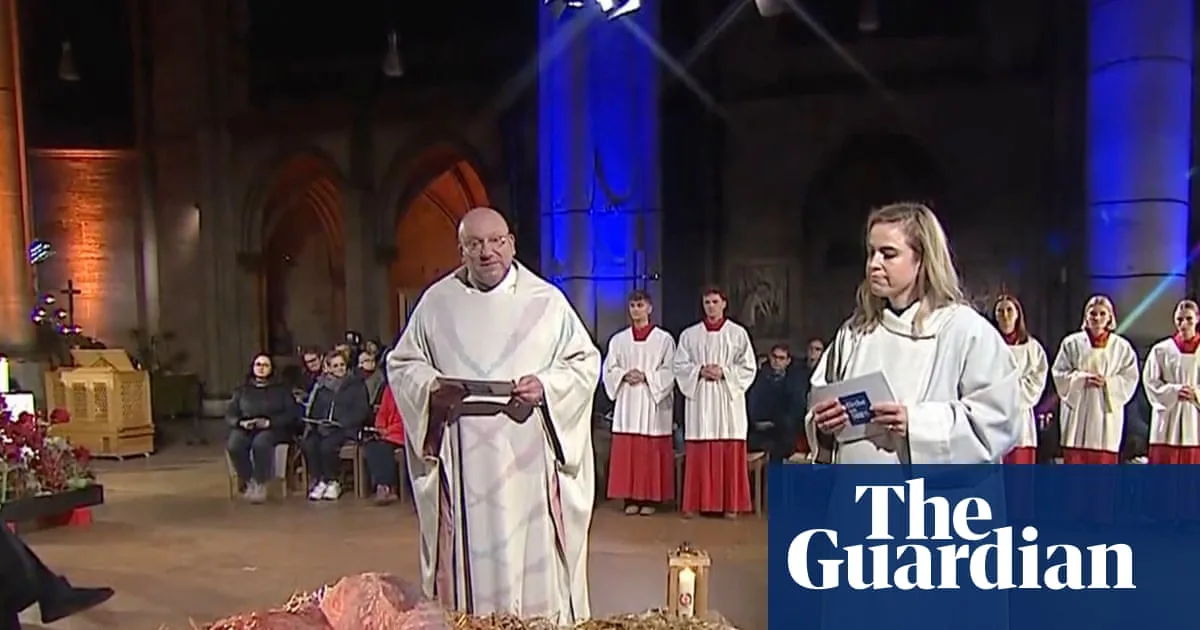
A Roman Catholic diocese in Germany has expressed regret over a televised Christmas Eve mass that featured a performance artist portraying the newborn Christ covered in sticky rice paper, which critics dubbed 'slime Jesus'. The broadcast on ARD from St Mary's in Stuttgart showed the artist, identified as Eleni Sismanidou, huddled in a foetal position and writhing slowly in the paper, intended to represent vernix.
The officiating priest, Thomas Steiger, said during the service: 'The nativity scene shows a real human being, lying there miserable, naked and exposed.' He added: 'This is how radically God becomes human: close, touchable, without distance, real.' The scene was designed by Milena Lorek, who described it as 'a moment of uncertainty between safety and distress'.
Right-wing media outlets, including Bild, which ran the headline 'ARD shows Christmas mass with slime Jesus', condemned the portrayal as disrespectful. SWR, the regional public broadcaster, said it had received over 1,400 comments, many critical. Klaus Nopper, a CDU member of Stuttgart city council, called it 'disgusting' and accused the church of allowing 'wokeness' to hijack the Christmas story.

After nearly three weeks of criticism, the Rottenburg-Stuttgart diocese acknowledged on Monday that religious feelings had been hurt. In a statement, it said the Catholic broadcasting service at SWR 'deeply regret this and emphasise that at no time was it their intention to provoke or disparage central tenets of faith'. The diocese admitted to cutting corners in the traditional Christmas liturgy for the television format, calling these 'deviations' incorrect and promising a review of future broadcasts.