Alphabet Lane Review: Tree-Change Couple Invent Fake Neighbours in Unsettling Drama
James Litchfield's dark, well-paced film about an isolated pair's imaginary friend blends genres and emotional registers with a deft touch. The official synopsis of the writer-director's darkly playful black comedy and relationship drama informs us that Alphabet Lane centres on a couple who "lose control of a joke about imaginary friends". When first encountering this premise, one might wonder: how can such a concept be fleshed out into a feature-length film?
A Premise That Gathers Momentum
Litchfield has made a very good fist of this challenge, pushing language and characterisation into intriguingly off-centre territory. He uses an innocuous dinner-table invention as a kind of conversational MacGuffin that sparks a story about a made-up conceit. This fictional creation gathers momentum, takes on a life of its own, and ultimately slips beyond the grasp of its creators, who become both liberated and entangled by their web of fabrications.
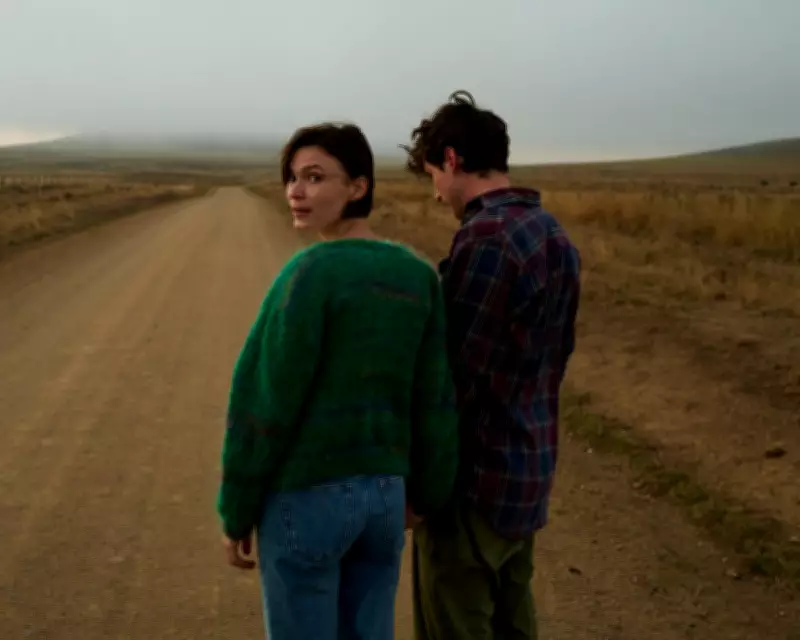
The couple in question – Jack (Nicholas Denton) and Anna (Tilda Cobham-Hervey) – have moved from the city to the country and face the common challenge of finding new friends. Their solution is simple: just make them up! One evening Jack jokes that he met a farmer named Joe on the way home, then pretends to call him and invite him for dinner. Anna happily indulges in the fib, asking follow-up questions and soon claiming to have met Joe's wife, Michelle.

The Evolution of Shared Fiction
This leads to an exchange of letters, beginning with Anna writing to Joe, which she knows will be read by Jack. This gives the couple a new, almost confessional-like space to share emotions and fill a communicative hole in their relationship. Anna notes how hard it is to "be somewhere so isolated," revealing deeper truths through their fictional correspondence.
These interactions are staged with a playful, mysterious touch; as their correspondence intensifies, it becomes unclear whether viewers should laugh or be genuinely concerned about the characters' welfare. About halfway through, one might wonder whether Alphabet Lane – shot for less than $1 million around the southern New South Wales town of Cooma – might have been inspired by Who's Afraid of Virginia Woolf?
Parallels with Classic Drama
In Edward Albee's legendary play and Mike Nichols' classic 1966 film adaptation, George and Martha, the sparring couple at its centre, are famously revealed to have invented their son. This figure hangs over everything despite not really existing: a shared fiction perhaps devised to ward off loneliness and emotional seclusion.
Litchfield's lean, well-paced feature debut raises similar questions about the responsibilities we bear towards shared fictions once others begin to invest in them emotionally. Sharing their secret, invented offspring was a big deal for George – who was livid when Martha mentions their "son" to other people – but it's not an issue for Anna and Jack.
They happily mention Joe and Michelle to visiting friends, which gets awkward when these friends mention them to a longtime local who knows everybody in the area. This creates tension between their private fantasy and public reality.
Direction and Performances
Litchfield's elegantly immersive direction resists visual pop and overt aesthetic embellishments, keeping viewers focused on the dialogue and performances where the film's real texture lies. Denton and Cobham-Hervey have excellent, lived-in chemistry and are beautifully in sync, their performances as much about distance as closeness.
Both project carefully defined characters who are gradually revealing themselves while hiding in plain sight. Their emotions are outsourced to some extent to their own creations, though their feelings remain real even when scenarios are invented.
Genre-Blending Final Act
While some aspects of the film's final act might leave viewers in two minds, a satisfying finale in narrative terms was probably always going to be challenging given the slippery nature of its central conceit. What stands out is how Alphabet Lane blends genres as well as emotional registers, always with a gentle twang – sometimes quietly uplifting, sometimes quietly unsettling, and always with an undercurrent of melancholy.

The film showcases the excellent chemistry between Tilda Cobham-Hervey and Nicholas Denton in this Australian production shot in the Snowy Mountains region of New South Wales. Their performances anchor a story that explores isolation, communication, and the boundaries between reality and fiction in relationships.