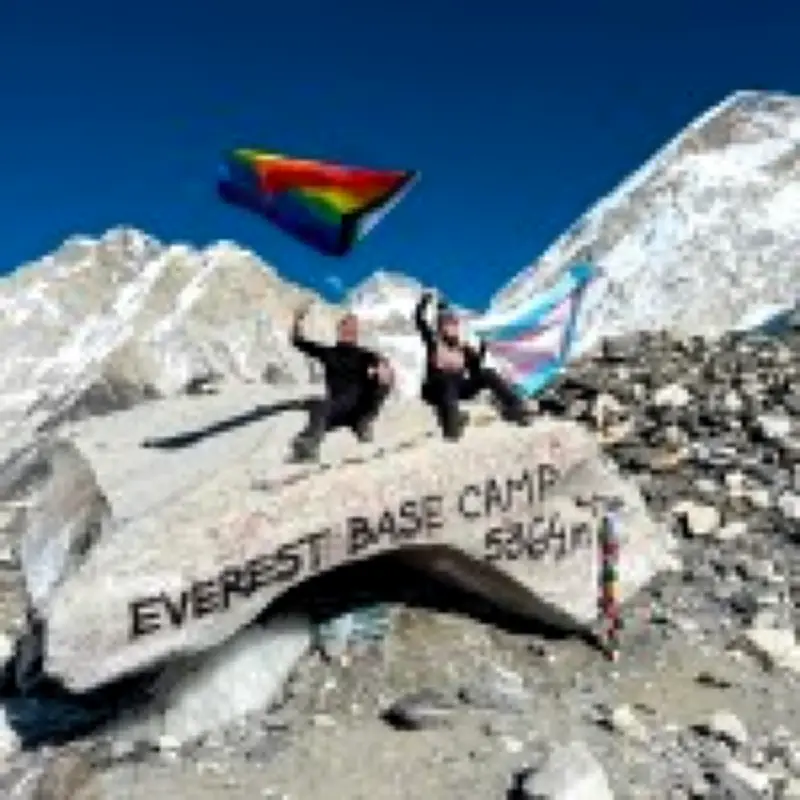
Exhausted and frozen, the biting wind tears at our faces as we approach 5,364 metres. At the top of the world, my quest to discover Pride across the globe finally concludes. Seven continents, 15 countries, 20 events, and countless memories that will last a lifetime. Scaling the boulder at Everest Base Camp, I stand beside my trans best friend, waving our flags proudly, thinking of the trans woman who inspired this extraordinary 15-day journey.
Inspiration from the Summit
Her name is Nilam Poudel, and she recently became the first trans woman to summit Everest. Reaching the 8,849-metre peak at dawn on May 23, 2026, the Nepali climber is an inspiration to trans people worldwide. We were fortunate to meet her in Kathmandu and hear firsthand how she undertook one of the most challenging hikes on Earth.
'They told me the peak was too high, the journey too hard, the dream too bold for someone like me,' Nilam said. 'But with every step, I carried not just my own weight, but the weight of countless voices unheard. I climbed not to plant a flag, but to make space – for every transgender person told they don't belong, for every woman told she is less, for every soul who's been silenced. At the summit, I wasn't just Nilam, I was proof that visibility is power, and representation is survival.'
Community and Resilience
Listening to her words was all the inspiration we needed. The essence of Pride is community, and nothing exemplifies that more than trekking to Mount Everest with my closest friend. Luxeria Celes, a transgender photographer and travel creator, saw this as another opportunity to show the world that trans people are just as capable as anyone else.
Doing it in Nepal held special meaning. Historically considered a regional leader in LGBTQ+ rights, Nepal garnered widespread praise after recognizing trans people's rights based on self-identification in 2007. However, the process for legal gender change was never specified, leaving many vulnerable to local officials and social pressure, as Human Rights Watch has warned. Earlier this year, Nepali authorities stopped processing applications for legal gender changes, regressing years of progress. So it was crucial for both Luxeria and me to keep the flag flying when it's needed most.
Challenges of Trans Travel
Even getting to Nepal was a challenge. Booking.com's Travel Proud research shows that 61% of transgender travellers modify their appearance and behaviour to avoid potential discrimination. In recent years, trans people have faced harm while travelling, from violent crime to detention in countries with anti-LGBT+ laws. We flew a more expensive route to avoid connecting in any country where Luxeria's identity is considered criminal.
'There's an extra level of anxiety when travelling as a trans person,' she explains. 'Some destinations have declared that simply existing as a trans person is spreading an ideology that is harmful to society and thus requires punishment. This means there are parts of the world that my photography will never be able to touch. Even with 'safe' destinations, it becomes exhausting having to double and triple check how sudden changes in law might prevent my ability to see the world.'
It's not just about legislation. As we planned our trek, we took extra time to ensure the experience was trans inclusive. We would spend 15 intimate days with our travel companions, so we had to ensure no invasive questions or uncomfortable situations, like open showers or placing her in a single-sex dorm. These are just some of the extra barriers trans people face when travelling.
Luckily, we booked with G Adventures, an ethical and LGBT+ inclusive tour operator, who assured us they were experienced with trans guests. I knew we'd be in good hands because I'd travelled with them to Jordan. They ensured our safety and comfort at every step. We brought Pride to the banks of the Dead Sea, the lowest point on earth, and now they were helping us do the same at the highest point.
The Trek
The journey wasn't easy; on our coldest day, temperatures plummeted to -27°C, and with oxygen at just 50% of sea level, even small tasks became a challenge. 'Why on earth did you invite me to do this?' Luxeria said on the eighth day. We laughed because we were out of breath putting on our shoes, and the laughter made it even harder to breathe.
Every day above 4,000 metres altitude became increasingly difficult as our bodies starved of oxygen. But it was worth it. It wasn't just about making it to basecamp: it was about the incredible sights along the way. The Tengboche Monastery, where we witnessed Tibetan monks chanting; the colourful Sherpa villages that offered us shelter; and the stunning landscapes and wildlife that punctuated the climb.
We even found LGBT+ life in the Himalayas. We encountered fellow rainbow travellers on the trail, and one teahouse we stayed at was run by a queer Sherpa. Our Sherpa guide, though not part of the community, was knowledgeable about local LGBT+ history, teaching us about queer life in the Himalayas, Nepal, and wider South Asia.
I was fascinated to learn about the gender diverse communities across the country. Meti, hijra, kothi, mai babu, fulmul, and marnu – the language used to communicate different trans identities is diverse and complex, often deriving from indigenous communities dating back centuries. In different parts of society, gender diverse people are even considered to possess immense spiritual power and have traditionally been invited to bless weddings and newborns.
However, with colonisation, many of these identities have been stigmatised and pushed to the sidelines, solidifying the need for modern trans Pride celebrations. This makes it all the more meaningful to have one of my transgender friends with me to close out this year of Pride. When we finally made it to Everest Base Camp, there was no greater feeling than standing beside her in triumph.
We were the last to be picked in PE – and yet here we are, showing the world that we're just as capable as anyone. Next to Antarctica, the Himalayas is considered the most remote place on Earth. I'm so proud that through this project, I've gotten to show that Pride can be found in both. In fact, it exists everywhere. Through every Pride I've visited, I've found queer people not just living, but thriving.
From the desert to the arctic, from tropical islands to mountain summits, from thriving urban cities to quiet countryside villages. Across all seven continents. In every corner of the world. They have taught me so much, shown resilience in the most unlikely of places, and most importantly, given me a tremendous sense of pride. I'll continue to carry that with me everywhere I go.
Nepal beyond Pride
Getting there
Turkish Airlines flies from London Heathrow to Kathmandu via Istanbul. We found this the safest route for LGBT+ travellers. Prices start at £595 return.
Taking on the Everest trek
A 15-day trek to Everest Base Camp with G Adventures starts at £884 per person based on two people sharing a room. This includes internal flights, trekking permits, all guides and porters, 2 nights of accommodation in Kathmandu, and 12 nights accommodation on the trail.
Where to stay in Kathmandu
- Hotel Nepalaya (£)
- Thamel Boutique Hotel (££)
- Ramada Encore Thamel (£££)
These hotels all proudly display the Travel Proud badge after completing Booking.com's LGBT+ inclusivity training.
What to do in Kathmandu
- Homo Momo: This LGBT+ cooking class teaches you how to make rainbow momos (Nepalese dumplings) while learning about queer life in Kathmandu.
- The Monkey Temple: Swayambhunath is a 2,000-year-old Buddhist stupa with incredible views over Kathmandu. It's famous for its hundreds of resident monkeys, but even if you're not an animal lover, the architecture makes it worth a visit.
- Shopping in Thamel: Whether heading into the Himalayas or just hunting for souvenirs, Thamel is bustling with stores selling everything you could need.