Norwegian Monarchy Rocked by Dual Scandals and Existential Threat
The Norwegian royal family, already besieged by the Jeffrey Epstein scandal and separate criminal accusations, now confronts an even more alarming challenge that strikes at the very heart of its legitimacy. A forthcoming historical investigation threatens to unravel a 120-year-old secret that could fundamentally question the royal lineage's claim to the throne.
Epstein Connections and Criminal Trial Amplify Pressure
Princess Mette-Marit, wife of Crown Prince Haakon, faces severe scrutiny after revelations emerged concerning her extensive communication with the convicted sex offender Jeffrey Epstein. Documents show the 52-year-old princess exchanged over 100 emails with Epstein and secretly stayed at his Florida mansion for four days when he was absent. Damningly, Epstein later described the blonde royal, whose husband is heir to the throne, as 'twisted'.
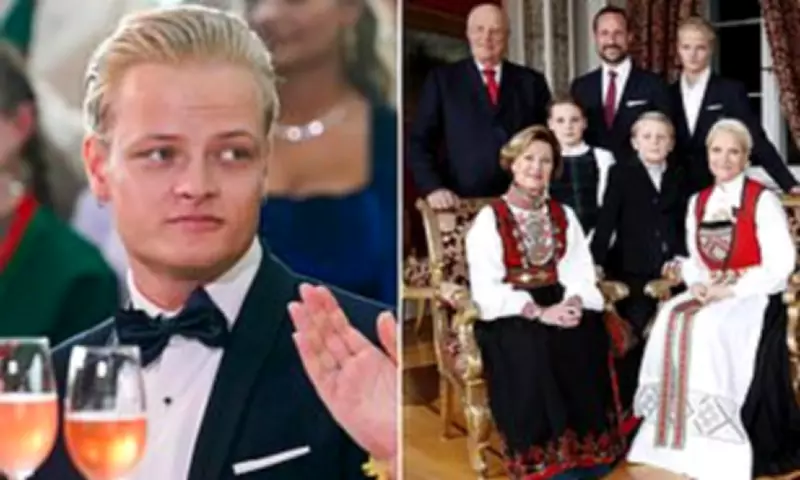
Compounding the crisis, Mette-Marit's son from a previous relationship, Marius Borg Hoiby, is currently standing trial in Oslo facing 38 criminal counts, including four charges of rape. These developments have triggered a dramatic collapse in public support for the monarchy in this traditionally staunch monarchist nation, with approval plummeting from 70 percent to just 53 percent. Remarkably, one-third of Norwegians now advocate for transitioning to a republic.

Historical Bombshell: Questioning Royal Bloodlines
All these contemporary troubles precede the publication later this year of a book that investigates whether the Norwegian royals have any legitimate right to occupy the throne. The explosive allegation centers on events in 1902, when Princess Maud of Wales—married to the future King Haakon VII—reportedly employed a sperm donor to produce a son and heir for the Norwegian monarchy.
That son, Prince Olav, was born in 1903 at Appleton House in Sandringham and eventually succeeded to the throne as King Olav V in 1957. Following his death in 1991, his son King Harald, now 88, assumed the crown. However, photographs published several years ago revealed an eerie resemblance between Crown Prince Olav at a young age and Guy Francis Laking, a British ex-public schoolboy.
The Sperm Donor Theory Gains Credibility
Scandinavian historian Tor Bomann-Larssen has meticulously unraveled this controversial narrative. According to his research, after nearly seven years of marriage without pregnancy, Princess Maud—approaching her 33rd birthday—faced immense pressure to secure Norway's line of succession. Bomann-Larssen asserts that King Haakon was infertile and unable to produce an heir, necessitating alternative measures.
The historian alleges that Maud traveled to London in October 1902 and underwent pioneering sperm-donor treatment administered by Sir Francis Laking, the royal physician to King Edward VII. The donor was reportedly Sir Francis's son, Guy. Nine months later, Prince Olav was born, and as he matured, the striking similarity between the future king and the English commoner became increasingly apparent.
Revealing Evidence Emerges from Royal Archives
While Bomann-Larssen's theory has faced angry questioning from pro-monarchy supporters in Norway, startling new evidence uncovered by the Daily Mail points directly toward Laking likely being King Olav's biological father. Two months after Queen Maud's alleged artificial insemination, her brother King George V issued his first end-of-year Honours List.
Buried within the Royal Victorian Order section—an award specifically 'for personal service to the sovereign'—appeared the name of Guy Francis Laking. Crucially, every other recipient that year had served the king during his recent eight-month tour of the British Empire aboard HMS Ophir. Laking, then an armoury expert working for Christie's auction house with no special connection to Buckingham Palace, stood out conspicuously among the older, well-connected recipients.

Royal Rewards for Secret Services
The unexplained elevation raised eyebrows within royal circles, suggesting this might have been King George's discreet method of thanking Laking for his secret services to his sister Maud and the Norwegian crown. This honor proved merely the beginning of substantial rewards for what required minimal effort. As a playboy and spendthrift whose Christie's earnings failed to cover his expenses, Laking received a specially created position as Keeper of the King's Armoury at Windsor Castle.
Once established at Windsor, Laking acquired status beyond his station and began flexing his newfound influence. He successfully promoted the creation of a Museum of London under royal patronage, housed in Kensington Palace's State Apartments. King George V and his family, including the future King George VI, attended the opening night, cementing Laking's royal connections and enabling him to purchase a large mansion in Regent's Park.
Monarchy's Future Hangs in the Balance
Whether Laking ever met Queen Maud, the mother of his alleged child, remains unrecorded. Maud, daughter of Edward VII raised in England, agreed to become queen consort in Norway only with the understanding she could spend two months annually at Appleton House and attend Buckingham Palace parties. She fulfilled her duty by producing Norway's heir but had no further children before her death in London in 1938.
Guy Laking, the supposed commoner father of a king, died from a heart attack at age 44. If confirmed that he fathered King Olav, both Haakon's reign and that of his son Harald, the current monarch, would be rendered invalid. With the Norwegian royal family already under immense public pressure, this historical revelation could potentially signal a swift end to the monarchy in the snowy Scandinavian nation.
Historian Arnhild Skre's forthcoming biography of Queen Maud, researched through extensive travel between Norway, Britain, and other locations, may finally settle this century-old mystery. For now, Skre remains tight-lipped about her findings, leaving Norway's royal future hanging precariously in the balance.