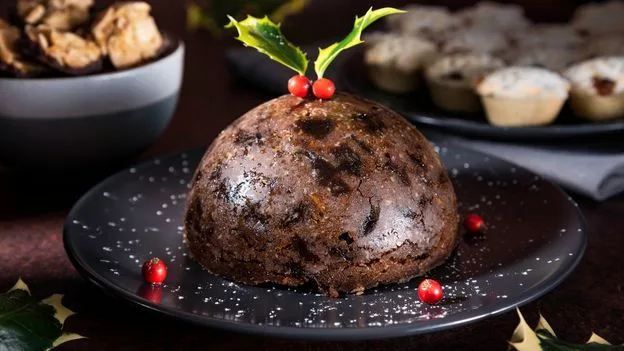
Loved and hated in equal measure, Christmas pudding's cultural and political clout have extended far beyond the dining table. It has been called a 'gastronomic paradox' – the most British of all dishes largely made from non-British ingredients. Starting out as an affordable gruel enjoyed by the British working class, by the first half of the 20th century Christmas pudding had become a call to arms – a potent propaganda tool and a boastful symbol of British imperialism.
Containing such exotic fare as candied orange peel from South Africa, raisins from Australia and spices from India and Zanzibar, the dish was sent into economic battle by the state and used to promote the empire’s family of nations with a simple message: just look at the wonders we can achieve when we all pull together. While the origins of Christmas pudding extend back to the Middle Ages, modern business terms such as globalisation and free trade were not common then, when a working man's meal might include frumenty, a savoury oat porridge thickened with breadcrumbs and perhaps dotted with scraps of mutton or beef.
By the 16th Century, English merchants were active in the spice trade and importing exciting new foodstuffs from Africa, India and Southeast Asia, and this previously unappetising gruel might now include prunes, currants and raisins instead of gristle. Frumenty was the ancestor of plum pudding, according to Fortnum & Mason, with plum once being a generic term for any dried dark fruit. Then, in the 17th Century, Brits began wrapping doughs in cloths and boiling them to make more solid puddings.
Large-scale sugar production was introduced to the Caribbean islands in the 1640s, with the establishment of massive cane plantations worked by enslaved people from Africa. These were crucial to pudding becoming a sweet rather than a savoury dish. 'Sugar becomes widespread by the early 18th Century,' said historian Lizzie Collingham. 'Now the [British] poor could afford sugar, or at least treacle, or molasses – the residue that remains when refining sugar.'
Plum pudding finally became key to Christmas tradition during the Victorian era, in no small part thanks to Charles Dickens' 1843 literary blockbuster A Christmas Carol. The culinary treat of the warm-hearted Cratchit family came to symbolise irrepressible cheer in the face of hardship. This was the time of what Collingham calls 'the invention of Christmas [as a] cosy celebration of Englishness', with the arrival of the Christmas tree, Christmas cards and 'Stir-up Sunday'. Meanwhile, the British hunger for better grub was quietly shaping agricultural policies of nations across the planet.