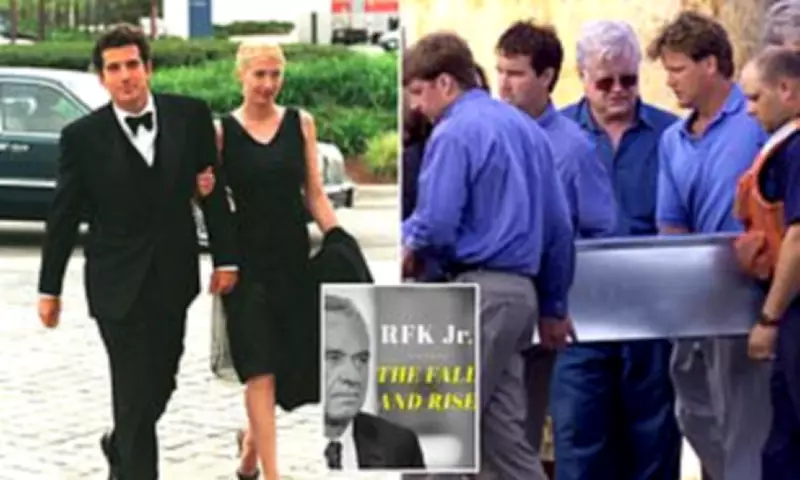
A bitter family feud erupted just hours after John F Kennedy Jr, his wife Carolyn Bessette, and her sister Lauren Bessette were killed in a tragic plane crash in July 1999, according to explosive revelations in a new book. The dispute began before their bodies had even been recovered from the Atlantic Ocean, creating lasting tensions within the famous political dynasty.
Immediate Conflict Over Burial Arrangements
In the immediate aftermath of the devastating crash, relatives began to bicker over where the couple should be laid to rest. Carolyn Bessette's family urged that she be buried in her hometown of Greenwich, Connecticut, while the Kennedy family pushed back against this suggestion. This bitter standoff ultimately resulted in the decision to scatter all three victims' ashes at sea during an emotional ceremony.
Diary Revelations From Robert F Kennedy Jr
The extraordinary details come from the private diaries of Robert F Kennedy Jr, revealed in journalist Isabel Vincent's new book, RFK Jr: The Fall and Rise. Among the most explosive allegations are claims that Edwin Schlossberg, Caroline Kennedy's husband, behaved as a 'bully' who made Bessette's mother 'miserable' because he despised her daughter.

According to the diaries, Schlossberg rejected a request for RFK Jr to eulogize Carolyn and John with the withering putdown: 'Kennedys do not eulogize non-Kennedys.' Lisa Bessette, the surviving sister, was reportedly so furious with Schlossberg that she 'slammed down the phone' during a tense conference call with the whole family.
The Tragic Crash That Stunned America
JFK Jr and Carolyn Bessette were one of the most photographed couples of the 1990s before their tragic deaths on July 16, 1999. The Kennedy heir was heading to Martha's Vineyard to attend his cousin Rory's wedding aboard a Piper Saratoga he had purchased just three months earlier.
Although Kennedy had been taking flying lessons for nearly two decades, he lacked significant experience flying at night using only his instruments. Approximately 7.5 miles west of Martha's Vineyard, the plane crashed nose-first into the ocean, killing all three occupants instantly.
Search and Recovery Efforts
The disappearance of Kennedy's plane triggered one of the largest search operations in US history. RFK Jr wrote in his diary that he initially wasn't worried, noting 'anything can happen with John.' However, concern grew quickly, and the Coast Guard was alerted to begin searching.
By 3am, RFK Jr was awoken by his sister Kerry with news that the plane was missing. He wrote: 'I knew then that John was dead. I looked out of the window of Carolyn's house from which I could see the lights on in John's front porch and I felt empty, sad.'
Family Tensions Explode
'The bickering over the bodies began the following day even though they hadn't yet been recovered,' the author writes. Carolyn's mother, Ann Freeman, was 'very upset' about where the bodies would be buried and wanted her daughters close in Greenwich, Connecticut.
RFK Jr wrote in his diary that Freeman was 'terrified that they (the Kennedys) will try to spirit (Carolyn) to Brookline or Martha's Vineyard... because both of them loved it there.' He noted that burying John Kennedy in Greenwich would be 'an impossibility' because 'he had no connection' to the area.
Failed Mediation Attempt
RFK Jr attempted to broker a meeting between the Bessette family and John's sister, Caroline, in New York the next day. However, the meeting went off the rails when Caroline did not show up and instead sent her husband Edwin Schlossberg, who reportedly 'hated' Bessette.
According to the diaries, Schlossberg 'did everything in his power to make her (Freeman's) life miserable' and bullied the 'shattered' mother, who was deep in grief for her two daughters.
Recovery and Final Arrangements
The bodies were finally recovered on July 21, five days after the plane went down. RFK Jr wrote: 'Coast Guard found John's body and fuselage at 2.30am and found the girls soon after.' He noted that Ted Kennedy and his sons took a helicopter to be present for the recovery, and that 'Teddy was shaken afterwards' because 'the bodies were in bad shape.'

On July 22, 1999, the bodies were cremated and the ashes scattered at sea during an emotional ceremony. The entire family boarded a US Navy cutter to meet the destroyer USS Briscoe a mile off the coast, then traveled 20 miles further to Gay Head, approximately one mile from the crash site.
Emotional Sea Burial
RFK Jr described how Freeman and her second husband Richard 'climbed over the landing and scattered the girls' ashes one at a time,' followed by John's ashes. 'The water had more jellyfish in it than anyone had ever seen,' he wrote. 'When they let go of the ashes, the plume erupted and settled in the water and passed by in the green current like a ghost.'
Family members tossed flowers and letters from friends into the water while a navy band played melancholy music. RFK Jr noted they all 'cried like babies' during the poignant ceremony.
Continued Tensions and Legacy
The memorial services continued the next day, but family tensions flared again during another conference call. When Lisa Bessette suggested that RFK Jr should eulogize the couple, Schlossberg strongly objected with his now-infamous statement about Kennedys not eulogizing non-Kennedys.
Carole Radziwill, wife of John's best friend and cousin Anthony Radziwill, was reportedly so offended by Schlossberg's behavior that she suggested starting an 'I hate Ed club.' RFK Jr agreed in his diary that 'there would be many members and that John Jr and Carolyn would certainly have applied.'
The revelations suggest that the real-life drama surrounding Carolyn and John's death was even greater than that portrayed in fictional accounts, highlighting how tragedy can expose and exacerbate existing family tensions even among America's most prominent political dynasties.