Royal Liverpool Philharmonic Concert Review: A Clash of Musical Worlds
The Royal Liverpool Philharmonic Orchestra, under the baton of conductor Daniela Candillari, presented a concert of stark contrasts at Philharmonic Hall in Liverpool. The programme juxtaposed Edward Elgar's genteel Serenade for Strings with Mark Simpson's tumultuous oratorio The Immortal, followed by Jean Sibelius's Second Symphony. This musical journey spanned from Victorian salon politeness to occult-inspired cataclysm, yet left some listeners feeling suspended between extremes.
Elgar's Serenade: A Polite Prelude
Elgar's much-loved Serenade for Strings opened the evening with what one might describe as bone-china delicacy. Originally premiered unofficially in 1892 by the Worcester Ladies' Orchestral Class, this piece represents perfect salon Victoriana. The performance was intimate to a fault, with gentle, dainty phrasing that rendered even the viola's typically nagging rhythm more like a bumblebee than a wasp. It served as an ideal more-tea-vicar scene-setter, establishing a mood of refined English countryside before the storm to come.
Simpson's The Immortal: An Orchestral Seance
Mark Simpson's 2015 oratorio The Immortal provided a dramatic shift in tone. Inspired by Victorian occultism, the work invites audiences to a musical seance, setting texts collated by Melanie Challenger that represent the scattered anxieties, pleas, and nonsense of automatic writing from mediums of the era. These are contrasted with words from Frederic Myers, founder of the Society for Psychical Research, who became obsessed with the afterlife after his childhood sweetheart's suicide.

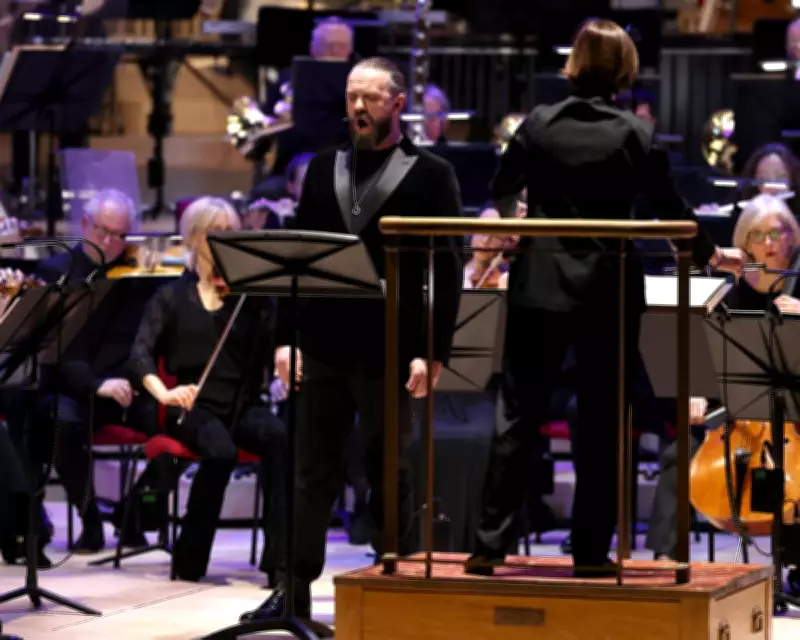
Whereas nineteenth-century mediums relied on concealed wires and ectoplasm for atmosphere, Simpson deploys a full orchestra with harp and percussion, plus choir and solo baritone. Although the texture has been thinned since its premiere a decade ago, the work remains impossibly dense and deliberately impenetrable, creating apocalyptic textures where individual instrumental sounds blur into an overwhelming mix.
Conductor Daniela Candillari, making her Royal Liverpool Philharmonic debut, maintained control throughout. However, between the amplified howls and shrieks of vocal ensemble Exaudi and the excellent but unnecessarily amplified soloist Rory Musgrave, the piece offered few handholds. It unfolded as a sequence of self-contained episodes that neither developed narratively nor musically, leaving listeners adrift in its sonic cataclysm.
Sibelius's Second Symphony: Smoothed-Out Fells
The concert concluded with Sibelius's Second Symphony, where Candillari's moderate approach proved more problematic. Her interpretation smoothed the craggy Finnish fells into something resembling the rolling Malvern Hills, providing a climactic payoff but lacking the necessary buildup from the symphony's good-natured, pastoral beginning. The Allegretto movement displayed a lovely translucent quality, glacier-clear in the first half, but the ominous timpani rumble launching the second movement brought no clouding-over, and the scherzo offered speed without real tension.
Ultimately, this was a concert that promised explorations of life and death through music but left audiences hovering earth-bound in between. The extreme contrast between Elgar's prim Victoriana and Simpson's occult eruptions was intellectually stimulating, yet the overall execution sometimes sacrificed dramatic arc for controlled moderation, particularly in the Sibelius. The Royal Liverpool Philharmonic demonstrated technical prowess, but the programming's bold contrasts highlighted interpretive challenges in bridging such divergent musical worlds.