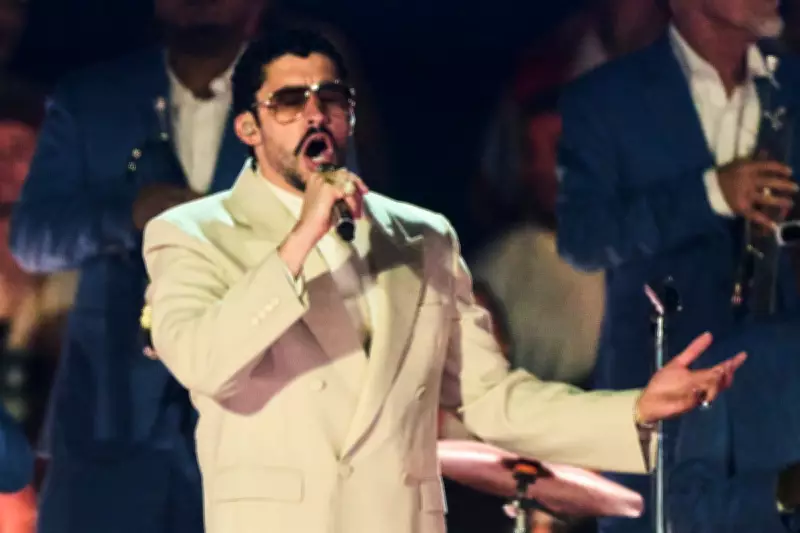
Bad Bunny's monumental global ascent is finally making significant inroads in Brazil, a market historically dominated by national artists and notoriously difficult for foreign stars to penetrate. This shift, which began with his Grammy-winning album "Debí Tirar Más Fotos," is expected to accelerate dramatically following his inaugural performances in Sao Paulo on Friday and Saturday.
Arriving at the Peak of Global Fame
The Puerto Rican artist, born Benito Antonio Martínez Ocasio, arrives in Brazil at the zenith of his career, riding an immense wave of hype generated by his recent Super Bowl halftime show performance. For years, Bad Bunny has ranked among the most-streamed artists worldwide, yet his presence in Brazil's music consumption has remained comparatively modest.
A Market Devoted to Domestic Sounds
Brazil's musical landscape, rich with samba, funk, bossa nova, choro, sertanejo, forro, and pagode, exhibits a profound loyalty to homegrown talent. According to Luminate's 2025 midyear music report, a staggering 75% of streaming consumption in Brazil focuses on national artists, making it the country that most listens to its own music. Last year, neither Bad Bunny, his album, nor his individual songs ranked among the most played on Spotify in Brazil, where the platform's top-streamed artists were exclusively Brazilian.

Sold-Out Shows and Soaring Demand
The fever surrounding Bad Bunny, particularly since his latest album, has begun to permeate the Brazilian market. Initially, only one performance was scheduled at the Allianz Parque arena, but it sold out with such rapidity that an extra date was promptly added, which also sold out completely.
By mid-afternoon on Friday, extensive queues had formed, comprising not only Brazilian fans but also attendees from El Salvador, Colombia, and Venezuela. Many arrived adorned in straw hats, a signature accessory for Bad Bunny that pays homage to traditional jíbaros, the rural farmers of Puerto Rico.
While official tickets via Ticketmaster ranged from $50 to $210, resellers were offering tickets for the same evening at prices exceeding $830—more than 2.5 times Brazil's minimum monthly wage, underscoring the intense demand.
Piercing Cultural Perceptions
Flávia Durante, a Sao Paulo-based DJ specializing in Latin American music, noted that some Brazilians have historically viewed Spanish-language music as somewhat corny, often associating it with Mexican telenovelas. However, Bad Bunny's latest album has successfully pierced this cultural bubble.
"Nowadays everyone knows all the songs, they sing along and really get into it. I normally play him at the peak of the night. People request him, even at rock or 80s pop themed parties," Durante observed.
Post-Super Bowl Streaming Surge
Since his Super Bowl halftime performance, Bad Bunny's popularity in Brazil has skyrocketed. His average streams on Spotify in Brazil surged by 426% in the week following the show compared to the previous week. Several tracks experienced massive increases, with "Yo Perreo Sola" leading the charge with an extraordinary 2,536% growth in streams.
Embracing Latino Identity and Resistance
During Brazil's recent Carnival celebrations, Bad Bunny-themed costumes became a fixture in Rio de Janeiro's vibrant street parties. Nicole Froio, a Colombian Brazilian writer specializing in Latin American cultural issues, participated while dressed in a straw hat and plastic tropical plants, echoing the aesthetic of his latest album. This marked the third consecutive Carnival where Froio, who sports two Bad Bunny tattoos with a third planned, wore attire inspired by the artist.
Froio, who has waited six years to see him perform live, believes Bad Bunny "represents a Latino resistance." She highlighted that while other Latin American superstars like Anitta, Shakira, and Ricky Martin have recorded full songs in other languages, Bad Bunny has maintained his music almost entirely in Spanish.
"For me, there’s a great authenticity in his sound that inspires me to be who I am and let everyone else deal with it," Froio stated.

Challenging Preconceptions and Unifying Audiences
Froio also pointed out that Brazilians often struggle to identify as Latino, and there has been considerable prejudice against Hispanic music, including preconceptions about Bad Bunny's Puerto Rican accent. Felipe Maia, an ethnomusicologist pursuing a doctoral degree on popular music and digital technologies at Paris Nanterre University, explained that Brazil's Latino identity is diffuse and complex, given the country's continental size and diversity. However, Bad Bunny effectively emphasizes this identity, particularly in cosmopolitan hubs like Sao Paulo and Rio de Janeiro.
At his Super Bowl halftime show, Bad Bunny notably listed Brazil among other American countries, reminding the global audience that "America" encompasses two continents, not just the United States. This gesture resonated deeply with fans like 22-year-old Diogo da Luz, a longtime admirer attending Friday's concert.
"He reinforces that we are one people and that we’re very united," da Luz remarked, adding that Bad Bunny's success "reinforces that we’re part of this—that we belong."
As Bad Bunny takes the stage in Brazil for the first time, his performances are not merely concerts but pivotal moments that could solidify his presence in one of the world's most challenging and musically devoted markets, potentially reshaping streaming trends and cultural perceptions for years to come.