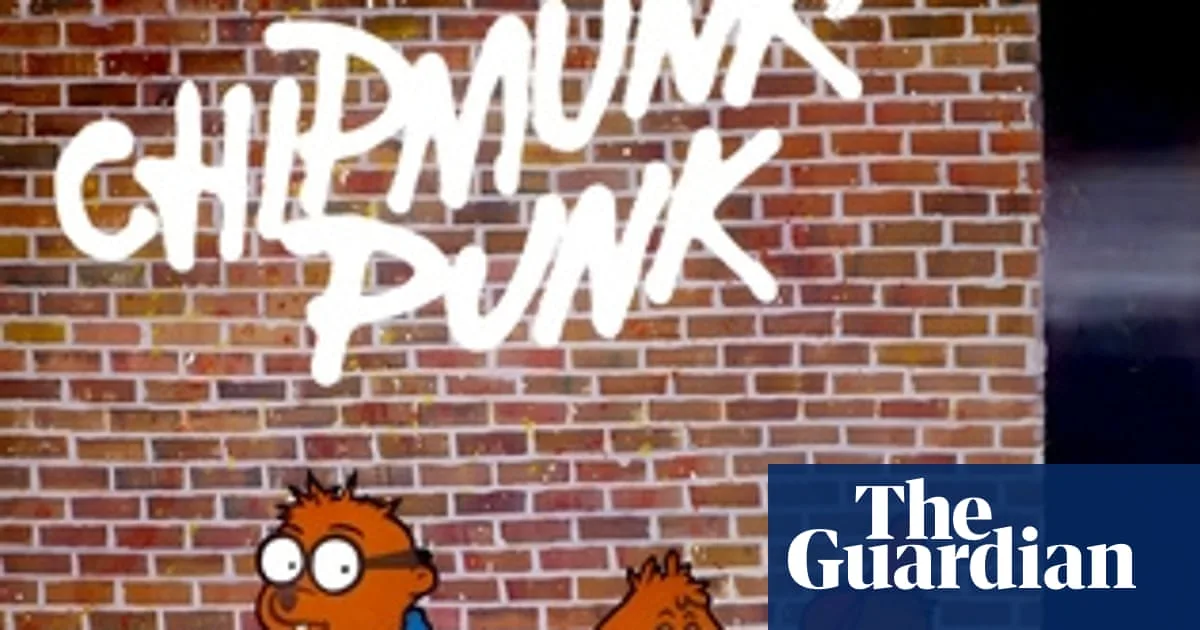
From squeaky to sublime … Chipmunk Punk. Illustration: Mercury
The best album I have heard so far this year is not from this year at all. It dates back to 2015, though its recordings were made decades earlier, and it is a collection of sludgy, doomy covers of late-70s punk, new wave and pop perennials such as My Sharona, Call Me, and Walk Like an Egyptian. The guitars on this mysterious tribute album have been tuned down to a low, thick squelch, the drum beats are slow and punishingly thudding, and the vocals, while sung in a sweet tenor, have a strange, almost lobotomised quality to them. The most peculiar aspect, however, is who is performing: Alvin, Simon, and Theodore.
The Origin of Chipmunks on 16 Speed
Just over ten years ago, Canadian musician Brian Borcherdt, best known as one half of experimental noise duo Holy Fuck, purchased an old 16rpm turntable designed for playing slow-speed records such as spoken-word albums. Naturally, Borcherdt began experimenting by playing normal 45rpm records on the turntable, which slowed them to a disorienting crawl. After trying out several albums, he landed on his masterwork: the Chipmunks album Chipmunk Punk, a cynical 1980 attempt by the creators of the squeaky-voiced cartoon rodents to capitalise on the ascendant punk genre, while not sounding remotely punk at all.
When played at 16rpm, the album’s high, pitch-shifted vocals are returned to something like the register they were recorded in, but the instruments, which were not shifted to a higher pitch like the vocals, become glacially, gelatinously slow. Borcherdt captured some of Chipmunk Punk’s slowed-down tracks, along with other Chipmunk covers and originals, and released them on SoundCloud and later Bandcamp under the project name Chipmunks on 16 Speed, a groan-worthy pun on the 2000s electroclash group Chicks on Speed. In the decade since, the project has attained cult status, periodically going viral on TikTok and Twitter, and amassing a small army of fans who, in YouTube and Reddit comments, reimagine the Chipmunks as doomed, hell-raising rock stars.
The Appeal of Slowed-Down Music
Listening to Chipmunks on 16 Speed, one can understand the adoration. In their decelerated form, the songs are both menacing and beguiling in a manner their original performers could never have anticipated. At points, things get genuinely gnarly – doom metal bands have spent decades fruitlessly seeking a guitar tone as nasty as the one heard on the cover of Pat Benatar’s Heartbreaker. But there is also a haunted, found-in-an-old-tape-deck quality to the songs that reminds me of Cindy Lee’s great 2024 album Diamond Jubilee, or Panda Bear at his most spectral. At points they are disarmingly beautiful: Heaven is a Place On Earth transformed into a Beach Boys spiritual; the chorus of Jessie’s Girl emerging from the sludge in a sunburst of harmony.

Slowing music down is certainly not a new phenomenon. In the early 2010s, there was a vogue for stretching out tracks by artists like Justin Bieber to 10 or 20 times their length, transforming them into ambient soundscapes. While those versions maintained the songs’ original pitches, they were superseded later in the decade by “slowed + reverb”, an internet microgenre that slows down the rpm of rap and R&B tracks, deepening the vocals and adding lashings of reverb, giving the songs a woozy and slightly mournful quality.
This trend has proved remarkably enduring and wide-reaching. Anyone with a passing interest in football, for example, will have almost certainly encountered a “slowed + reverb” remix via a compilation clip of a known “baller”. “Slowed + reverb” has run in parallel with the also unkillable trope of soundtracking movie trailers with sad, slowed-down versions of usually upbeat songs. Just a few days ago, Warner Bros released the teaser for their new DC superhero horror movie Clayface, set to a glum reimagining of The Flaming Lips’ Do You Realize??.
Why We Crave Slowness
So what is the appeal of this molasses-slow music? By reducing songs to a crawl, these reimaginings seem to capture something: a sort of woozy, alienating, downbeat register that feels both a reflection on and rejection of our overstimulated age. An achievement that the Chipmunks and their session musicians were likely not aiming for when they sat down to make cash-in covers of pop hits more than 40 years ago.