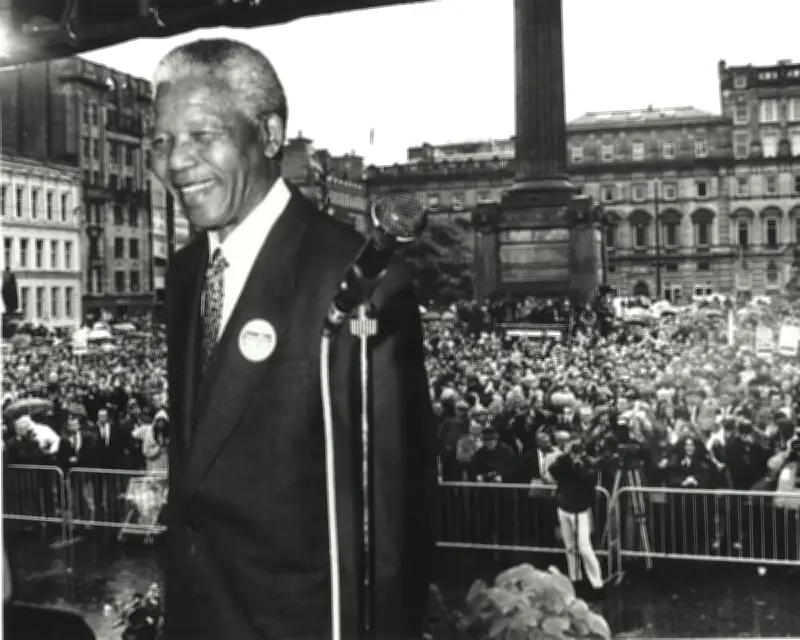
A new documentary series, Free Nelson Mandela, delves into the three decades of campaigning that led to Mandela's release in 1990 and his election as South Africa's president four years later. The series serves as an inspiring reminder of the power of resistance and resilience, highlighting the immense sacrifices made by many.
Peter Hain Recalls the Struggle
Peter Hain, the activist who later became a senior Labour minister, reflects on the campaign to end apartheid. 'We tend to look back at it as one of the great success stories of protests, and Nelson Mandela as a global icon, and rightly so. But Mandela was considered the devil incarnate. He was denounced as a terrorist by Margaret Thatcher only a few years before his release. We were vilified.' Hain stresses that while the challenges he faced were nothing compared to what Black people in South Africa endured, he was still targeted. A letter bomb was sent to him, and he was framed for a bank theft. 'It was a hard struggle, a bitter struggle,' he says.
Dali Tambo's Childhood Amid Threats
Dali Tambo grew up expecting the worst for his father, Oliver Tambo, the ANC president in exile. Other activists who had left South Africa were assassinated, including Ruth First, known to Tambo as 'Auntie Ruth', and later Dulcie September. In London, the ANC offices were bombed. Tambo remembers his parents calling in help from the Algerian embassy to sweep their house for bugs. 'Two out of three times they found them.' When he was about 14, he discovered a man hiding in the cellar; in the ensuing struggle, the man kicked Tambo through a glass door and jumped the back fence.

The Role of Sports and Culture
Hain led protests against the 1969 Springbok rugby tour of Britain and Ireland, successfully getting the South African cricket tour cancelled the following year. 'The sports campaign brought to millions of sports fans a sudden awareness: what's apartheid about?' Hain later became an MP, cabinet minister, and now sits in the House of Lords. The arts also played a crucial role. A 1983 concert at London's Alexandra Palace inspired Jerry Dammers of the Specials to write the anthem 'Free Nelson Mandela'. In 1986, Tambo and Dammers formed Artists Against Apartheid, embraced by numerous British artists. 'If George Michael or UB40 or Sting are on your wall, and they say we're anti-apartheid, you've got to ask yourself, as a young person, what is apartheid, why are they anti-it?' says Tambo.
Game-Changing Concerts
A huge march in June 1986, then the world's biggest anti-apartheid demonstration, led to a free concert in London's Clapham Common featuring stars including Gil Scott-Heron, Boy George, and Sting. A concert at Wembley Stadium two years later, starring Whitney Houston, Stevie Wonder, and Dire Straits, was broadcast on the BBC and reached an audience of about 600 million people. Oliver Tambo told his son after the concert, 'I could give 1,000 speeches and it wouldn't be as powerful as what I've seen here today.' Hain says that concert 'was a gamechanger,' reaching an audience politicians don't normally reach.
Mandela's Personal Touch
Hain met Mandela after his release, and later escorted him to the 2000 Labour party conference. In the hotel lift, Mandela asked about Hain's family. When Hain mentioned his mother was in hospital after a fall, Mandela insisted on speaking to her. 'The thing that distinguishes him from all the other prominent people I've ever met is he was a people's person,' Hain says. Tambo adds that Mandela had a folkloric status during his childhood. 'Your Uncle Nelson's in prison, and once a year my mother and Aunt Winnie would find a way to talk, but most of it was through telegrams or letters smuggled out. So he was mysterious.' When they finally spoke by phone, Mandela seemed to know so much about him. 'He was a revelation. And just Uncle.'
Free Nelson Mandela airs on Channel 4 on 14 June at 9pm.