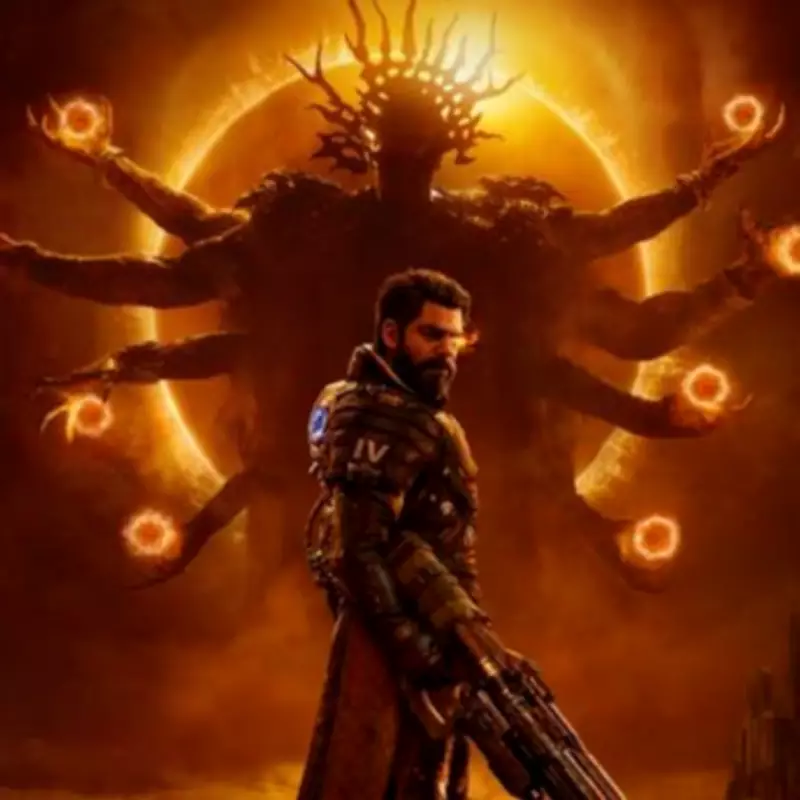
Players with a thirst for third-person shooting nirvana will find that and so much more in Housemarque's blindingly good follow-up to Returnal. The first major PS5 exclusive of 2026 is a balls-to-the-wall blast that learns all the lessons established by Returnal and applies them to a similar but effective gameplay loop.
If Returnal was Housemarque's coming out party for the magic it can muster with a AAA-scale shooter, then Saros is just plain showing off. The two titles might seem similar upon first glance - an endless loop, a dangerous planet to survive on, a headstrong protagonist at its centre - but the rules have changed. And it's in this slight tweaking of the ruleset that Saros quickly reveals itself as a more ambitious, though equally as satisfying descent into bullet hell survival of the repeatable variety.
True, this spiritual successor is a more accessible interpretation of Housemarque's 2021 PS5 debut, but don't mistake accessibility and persistent progression for a lack of challenge. Saros is prone to test and beat you during every new cycle you embark on. The result is one of the tightest-feeling, most rewarding roguelite shooters you'll play on Sony's platform, elevating a familiar structure using an engaging story and a satisfying suite of sci-fi weaponry and bosses.

Gameplay and Story
For the most part, your goal in Saros remains the same as it was in Returnal: fight through countless biomes on an alien planet in search of answers. Though not a complete retooling of what came before, Housemarque uses this returning framework to great and surprising effect. Whereas Atropos was a world purposely portrayed as dank, dark, and shrouded in a bid to enhance the mystery, the planet of Carcosa does all that while plunging your spray-and-pray exploits directly out in the blinding daylight. Even the way the sun routinely operates as a built-in gameplay mechanic can make or break a run. It's up to you, therefore, to prepare accordingly for as much as the randomised upgrades you acquire will allow.
One of the biggest ways Saros differentiates itself from Returnal before it is the much larger emphasis on story and characters. Yes, plural. Shoving you into the boots of Arjun Devraj, Enforcer for the shady Soltari corporation, it's your job as part of the fourth rescue team sent to Carcosa to try and unearth what happened to the previous three military squads and the initial colonists they themselves were searching for in the first place. As a narrative premise it's a relatively simple one for Saros to build upon, yet the way it begins to evolve and twist alongside Arjun himself is enough to keep most players hooked, ready to dive back into the next cycle in the inevitable instance enemies cut your mission short. If you found Selene's consistent monologuing in Returnal tiring, Arjun and the way he interacts with his Soltari cohorts is sure to satisfy.
Combat and Controls
Of course, for most people, story was always going to take a backseat in a game of this type - where the third-person gunplay is intended to feel incredible. And boy does it… Once again, Housemarque proves its mastery of the DualSense controller by having you squeeze and tap it in ways other high-budget shooters would only dream of, with each weapon's alternate fire requiring you to hold down L2 halfway, with a full press allowing Arjun to unleash a devastating, chargeable Power attack designed to get you out of a pinch whenever alien foes and their illuminated shots start to swarm. Whether it's the humble pistol you start with or the laser-spewing crossbow able to shoot in a wide spread, weapons in Saros always give you the means to control each biome's tense firefights providing you're willing to master them and do the work.

Like any roguelite, your success in pushing through Saros' campaign is often determined by the whim of RNGesus. This time it comes in the form of scattered-around plinths that will grant you a unique type of artefact when destroyed, each of which is designed to positively (and sometimes negatively) impact Arjun's health, shields, power and efficiency in acquiring Carcosa's currency of choice, Lucenite. Artefacts pop up regularly enough in a run that you always feel like you're making progress and forming Arjun into a gradually more powerful build. Not always in the way you want or that best suits your playstyle, admittedly, but it's in adapting to these randomised nuances where Saros' true challenge and difficulty curve shows itself.
Key Differences from Returnal
Surviving a run in Saros for a respectable time also means getting your head around Arjun's shield, which is another major differentiator from Returnal. You see, whereas Selene was always forced to bob and weave around enemy shots, here Arjun has the power to, in a sense, get stuck into them. In fact, taking the risk to absorb blue projectiles into the shield (while avoiding yellow ones that apply corruption and red ones that can't be blocked or dashed through) serves as the fastest way to charge your Power weapon. It's a small but substantive shakeup to the already great decadent dance of third-person shooter ballet Housemarque has already perfected - one that frequently had me running into the throes of a firefight as opposed to running away.
The shield, ability to re-roll artefact upgrades at a certain point, and the dedicated skill tree accessed back at your hub all combine to make Saros a much more approachable prospect than Returnal ever was. That said, there are plenty of opportunities to increase the challenge should players want to, most obviously when the eclipse hits the planet, which occurs within each dedicated biome at the same structural point, yet nearly always at a time where you can technically skip to the boss required to push on. Choosing more biome than boss, however, will see you face even harder enemies, with the extra reward for this optional risk being the chance to scoop up even more temporary artefact upgrades. Even then, though, these come packing negative effects in addition to the good, leaving it up to you to decide whether the trade-off is worth it. All I know is that, when that eclipse hits, Arjun is in for a rougher ride.
Criticisms
If there's one area where Saros is a bit of a letdown it's in the bosses that tend to bookend each new biome. All will have you dodging, blocking, and absorbing attacks in new ways I didn't expect beforehand, sure, yet none were ever truly as menacing as I wanted. Then there's the total absence of isolation, which in Returnal was such a major factor in adding to that game's sense of lonely mystery. By nature of giving you a group of comrades to interact with back at base nothing of the sort exists for Arjun, despite the fact that runs where you're roaming by yourself can last upwards (and sometimes even over) an hour depending on your goal for that specific cycle. Fortunately, Arjun's personal motivation to push deeper into Carcosa's mysteries mostly delivers, encouraging you to keep getting back into the fight in a way Selene's mission never quite was able to.
Conclusion
At a time when truly innovative PS5 exclusive games seem few and far between, Saros is an undeniably epic and hypnotising third-person roguelite shooter that takes the bones of Returnal and dials it up to 11. True, this means sacrificing an overarching sense of isolation and mystery, but it's worth it for all the ways Saros doubles down on a surprisingly cinematic story, weapons and abilities that encourage you to play more aggressively, and a new world begging to be poked and picked away at. "Come back stronger," has been pitched as the core ethos Saros wants to instil within you - and Housemarque absolutely did.
Rating: 5/5. Saros is set to release exclusively on PS5 on Thursday, April 30.