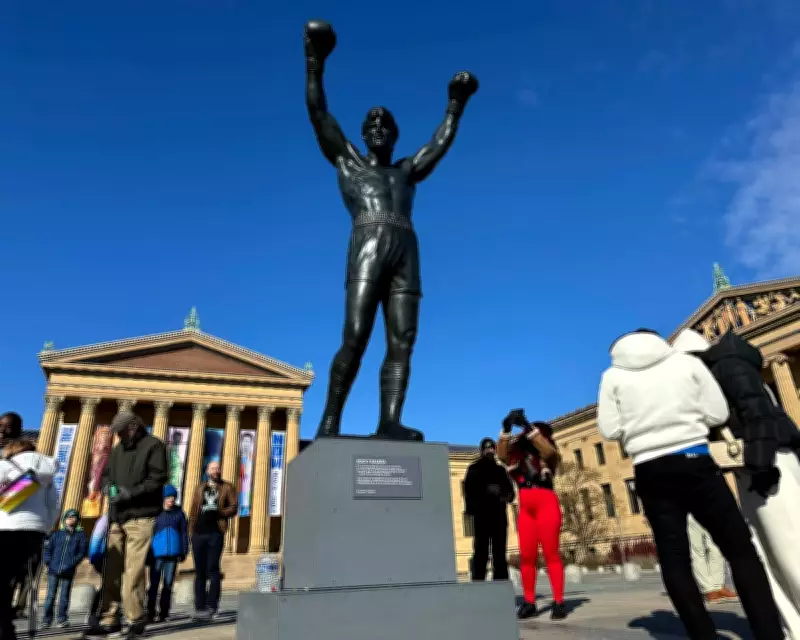
A statue of Sylvester Stallone's fictional boxer Rocky Balboa takes center stage in a new exhibition at the Philadelphia Museum of Art that examines the power of monuments. Opening this weekend, the show spans two millennia of boxing and celebrity culture.
The Rocky Statue as a Cultural Icon
Placed on the museum's "Rocky Steps" in 1982, six years after the 1976 film Rocky launched Stallone to stardom, the statue has become one of Philadelphia's most popular tourist attractions. Approximately 4 million people visit it each year. For curator Paul Farber, co-founder of the nonprofit public art organization Monument Lab, Rocky represents a deeply personal narrative of an underdog rising from a struggling club fighter to challenge the heavyweight champion.
Farber noted that he had previously taken the statue for granted until he observed the constant queues of visitors waiting to photograph it. "No matter what time of day or time of year there's a queue," he told ArtNews. "I started to research it five years ago and found as many people visit the Rocky statue as visit the Statue of Liberty – more than visit the Liberty Bell here in Philly." He described the site as a "cultural meeting ground" and a "global pilgrimage" for those seeking inspiration through adversity. However, he also highlighted the irony that the most iconic Philadelphian is a fictional white boxer, while many real Black Philadelphia boxers have been significant community figures.

Exhibition Details and Historical Context
The exhibition, titled Rising Up: Rocky and the Making of Monuments, coincides with the 50th anniversary of the Rocky franchise. It aims to answer why millions of people worldwide visit the statue amid broader debates about monuments and their meanings. To do so, it draws on ancient sculptures such as the Hellenistic Seated Boxer, 19th-century European art, images from boxing's golden age in the US including Jack Johnson, and works by contemporary artists like Andy Warhol, Keith Haring, Jean-Michel Basquiat, and Glenn Ligon. The centerpiece is the bronze statue from the 1982 film Rocky III.
Louis Marchesano, the museum's deputy director of curatorial affairs and conservation, told the New York Times that the museum once had a "fraught relationship" with the statue, which began as a movie prop, and had vigorously sought its removal. Stallone himself left the curator a series of voicemails, describing the museum steps as "like a magical area, an intellectual bastion that I would only look at from afar, like another city, the Acropolis or some incredible monument." He explained that the steps define Rocky's journey from poverty to success.
The bronze statue was commissioned from Colorado sculptor A Thomas Schomberg, whose work is featured in several US museums. Farber noted that even Schomberg grappled with whether the Rocky statue constitutes art or a movie prop. "I spent a lot of time with the artist, whose work is renowned, but is plagued by that question, and it haunted me," Farber said. "I spent time in his studio and looked at his process and understood the other work he made … they could have asked for a styrofoam prop. But he worked with an artist who works in bronze."