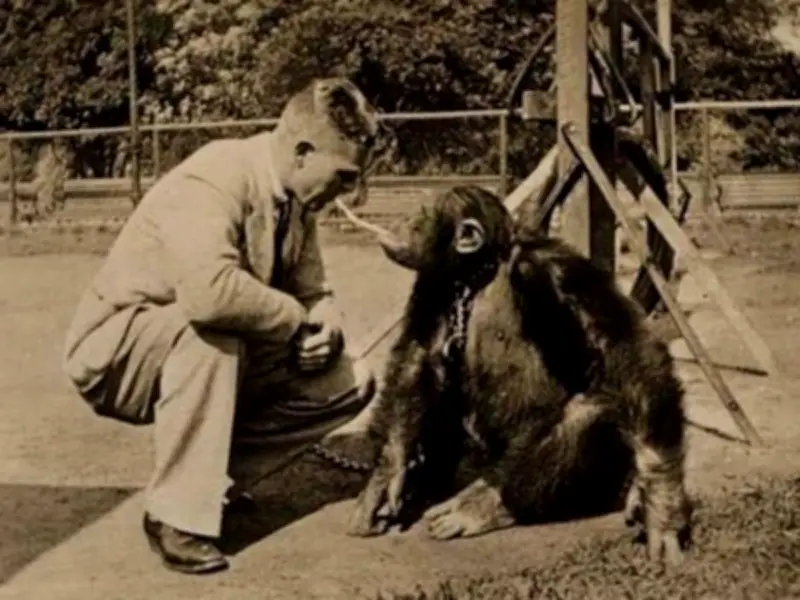
Long before housing estates and university buildings became familiar in south Liverpool, part of Mossley Hill was home to a short-lived but extraordinary attraction: the Liverpool Zoological Park. Located on Elmswood Road, the zoo opened in May 1932 and operated until 1938. Despite its brief existence, it became one of the city's most unusual attractions, drawing visitors from across Liverpool and beyond.
The Zoo and Its Star
The park was situated on the grounds of the former Rosemont estate and housed a wide range of exotic animals. According to a Liverpool ECHO report from May 2, 1932, ahead of the zoo's opening, it featured “over 600” monkeys, kangaroos, elephants, lions, bears, storks, snakes, alligators, birds of prey, and tropical birds. The report stated: “One of the finest collections of animals, reptiles, and birds in the country is now to be on view to the public in one of Liverpool’s most charming private estates.”
However, its most famous resident was Mickey, a 14-year-old chimpanzee who quickly became the star attraction. Mickey was marketed as “the world's cleverest chimp” and attracted crowds eager to witness his antics. The zoo was open daily from 10am until 8pm and offered elephant and llama rides to children. On April 17, 1935, the Liverpool ECHO described Mickey as the “funniest and most human chimpanzee in the world”. Another report from August 4, 1933, described him as “the chimpanzee who creates roars of laughter with his repertoire of funny tricks”.
Mickey's Smoking Habit and Escapes
Mickey was famously known for his habit of lighting and smoking cigarettes. Yet beneath this peculiar behaviour lay a formidable creature weighing 15 stone and strong enough to regularly escape his enclosure. It is said that Mickey escaped four times from the zoo before a final breakout in 1938 ensured it would be his last.
One escape in 1937 was reported as a light-hearted affair. The day after his escape, on page five of the Liverpool ECHO dated May 6, 1937, the story was headlined “Chimp's adventure”. Mickey, described as “bigger than a man and all muscle”, is reported to have enjoyed “three hours of crowded and glorious life” on the run. During his escapade, the chimp knocked over a lion tamer, bit a 75-year-old travelling circus proprietor, Mr Arnold Bailey, jumped an eight-foot wall, and climbed a tree to watch children coming home from school. A coal cart driver who challenged Mickey with a shovel was thrown across the road. The chimp then “kissed a woman who greeted him by name, and accompanied her down the road with his arm around her”. Eventually, he “succumbed to the temptations of an orange” and was led back to his compound.
The Tragic Final Escape
The following year, Mickey went AWOL again, but this time it resulted in a tragic end. In the Liverpool ECHO on March 24, 1938, the dramatic events leading to Mickey's death were recounted. Mickey was discovered on the loose after Mr J Wardle, the zoo's manager, found the chimp had broken an iron bar to his cage and escaped. Out of his cage, Mickey broke into the zoo manager's house, smashing through a door “like matchwood”. He pushed over the zoo manager's wife before fleeing, but not before several zoo staff had armed themselves with revolvers and rifles.
A shot was fired as Mickey left the zoo compound, wounding him, but he carried on and headed to Sudley Road School. A large group of children were in the playground as the wounded chimp arrived. A young teacher, Mr A Gall, heard a yell from a group of boys as Mickey ran towards them. The teacher tried to usher the children inside, but Mickey had already grabbed one of the boys by his ankle. Bravely, Mr Gill ran towards Mickey to save the boy. The teacher later said: “I know very little of what followed. I must have been just picked up and thrown about, to judge from the scratches on my shoes and my torn clothes. I lost consciousness, and when I came to a little later I was lying on the asphalt and heard someone shouting to me to run indoors. The chimpanzee was still only a few yards away from me. I picked myself up and made for the gate, slamming it behind me. I had a vague vision of the chimpanzee jumping over it after me, but I got indoors safely and here I am.” The teacher would later receive an award for his bravery, acknowledged as likely saving the lives of several children.
Mickey then made his way to Lugard Road next to the school and climbed onto a roof. Police officers from Aigburth, Allerton, and Garston were at the scene, along with keepers. Following the rampage, in which six people were hurt including three children, the decision was made to shoot Mickey. The ECHO reports that 13 shots were fired at Mickey on the rooftop before he fell into the back yard of 29 Lugard Road, whose tenant was a Mrs Todd. One neighbour, Mr Rogers, said people living near the zoo were frightened of Mickey after his escape the previous year.
Aftermath and Legacy
Several months later, Mickey was stuffed and put back on display at the zoo. After the zoo's closure, the stuffed chimp was reportedly displayed at Lewis's department store until it was bombed in the 1941 Blitz, and later at Sudley House museum during the 1950s and 1960s. Today, the site of the former zoo is occupied by housing estates and university accommodation, but the memory of Mickey the smoking chimp lives on as a bizarre chapter in Liverpool's history.