V&A East Museum: A Honey-Coloured Treasure Trove of Human Ingenuity
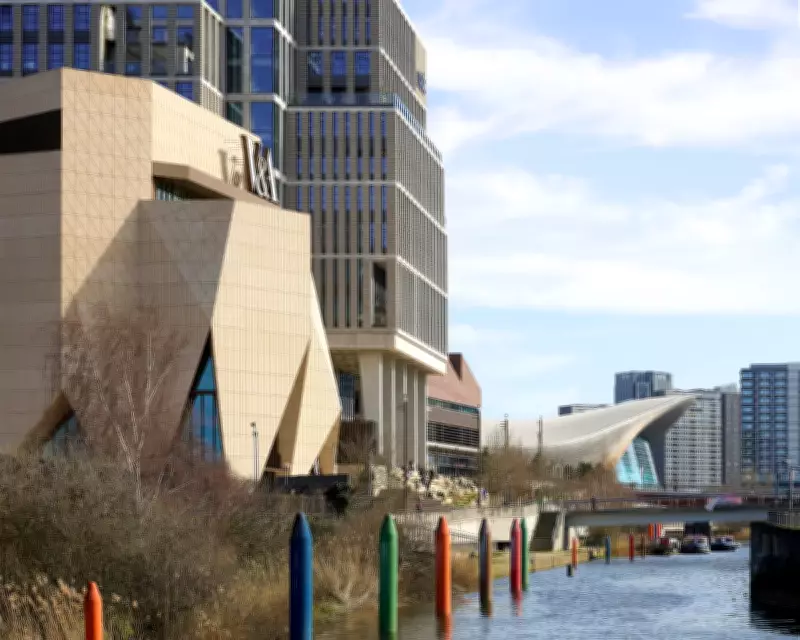
The V&A East Museum, a stunning new addition to London's Olympic Park, stands as a testament to architectural brilliance and creative vision. Designed by the acclaimed Dublin-based architects O'Donnell+Tuomey, this pavilion-like structure has quickly become a landmark in Stratford's evolving skyline. Its bold lines and simple interiors provide a welcoming home for the art, people, and creativity it celebrates, making it a must-visit destination for culture enthusiasts.
Architectural Inspiration and Design
The design of V&A East draws from a rich tapestry of influences, blending art, fashion, and urbanism. John Tuomey of O'Donnell+Tuomey explains that the initial spark came from a sleeve in a Vermeer painting at the National Gallery of Ireland. "I was trying to work with the folds," says Tuomey, "which became the first iteration of the building. I started thinking about the fabric that clothes you, the body that's sheltered, but also the space in between." This concept of draping and concealment was further inspired by Spanish couturier Cristóbal Balenciaga, whose work was featured in a 2017 V&A retrospective.
The building itself resembles a protective jacket or a futuristic outerwear piece, crafted from chunky precast concrete panels in a warm honey hue. "We wanted it to be pigmented so as not to be reminiscent of industrial grey concrete," Tuomey adds. "We wanted it to feel like it was formed out of stuff of the earth." Each panel was meticulously calibrated and assembled like a 3D jigsaw, supported by a steel structure that echoes the boning in haute couture garments.

Interior Spaces and Collections
Inside, V&A East is an armature for activity and encounter, spanning five storeys with flexible gallery spaces that host a dazzle of changing displays. The main staircase, cranked like a German expressionist film set, invites visitors to sit and socialise, while the rooftop terrace offers panoramic views of London. "As soon as you're inside, you should feel as though you have the whole building at your disposal," says Tuomey.
The museum's permanent galleries, headlined Why We Make, offer topical and subversive perspectives on the V&A's vast collections. Curated by Jen McLachlan, these spaces juxtapose practitioners and disciplines in innovative ways. For instance, Leigh Bowery's pink sequined codpiece is displayed as part of a glittering ensemble from a 1987 ballet, paired with video footage to contextualise the 1980s counterculture. "Each section is populated with multiple objects that haven't been brought together before to spark new dialogues," McLachlan notes.
Integration with East Bank and Community
V&A East is a key component of the East Bank, a cultural quarter in east London that includes outposts of the BBC, London College of Fashion, and Sadler's Wells. This constellation of institutions brings a new kind of industry to the area, strengthening creative ties with local communities and shifting London's cultural centre of gravity eastwards. The museum's design facilitates connections with its neighbours, with carefully positioned windows and terraces offering glimpses of the Olympic Park and Westfield.
Display systems within the museum, designed by Jayden Ali of JA Projects, draw inspiration from London's markets and high streets. Showcases with illuminated fascias echo shopfronts, and cabinetry uses salvaged London plane trees. "They're inspired by how people display things in markets and high streets, which are so important to London," explains Ali. The V&A East Youth Collective contributed bespoke typography and signage, channelling the city's electric nightscape to guide visitors.

Future Exhibitions and Cultural Impact
Beyond its permanent galleries, V&A East will host a dynamic programme of temporary exhibitions, starting with an inaugural show on the history and impact of Black British music. Creative commissions and live events will platform emerging artists and ideas, with artworks displayed across the museum's two sites. A specially commissioned sculpture, A Place Beyond by Thomas J Price, stands on the waterfront promenade, depicting a fictionalised young woman scanning the horizon. "I want this sculpture to become an extension of the people who inhabit the museum," says Price.
This museum represents a convulsive change for east London, transforming former industrial lands into a vibrant cultural hub. As Price reflects, "When I was discovering the old V&A, this site would have been tangled industrial acres. And now look at it." V&A East is not just a building; it's a beacon of creativity and innovation, inviting all to explore the treasures of human ingenuity.