Liss Fenwick's The Colony: Termites Rewrite Colonial Narratives in New Photobook
Australian artist Liss Fenwick has created a remarkable photobook titled The Colony, published by Perimeter Editions, that explores the fascinating intersection of colonial literature, indigenous land, and insect intelligence. The project documents a unique artistic process where termites were fed historical settler novels, resulting in a powerful visual dialogue about authority, knowledge, and transformation.
The Artistic Process: Feeding Books to Termites
Fenwick's journey began on Larrakia land in the Northern Territory, where a colony of Mastotermes darwiniensis (giant northern termites) had already consumed a shed near their childhood home. Concerned the insects might target the house next, Fenwick made an unconventional decision: they began feeding the termites volumes from The Australians series, historical novels that belonged to their father.
These books, written under the pen name William Stuart Long and published between 1979 and 1990, presented what Fenwick describes as "settler fan fiction" - narratives that reinforced heroic myths of exploration, endurance, and nation-building in Australia. By surrendering these texts to the termites, Fenwick initiated a collaborative process with nonhuman intelligence.

Transformation Through Destruction
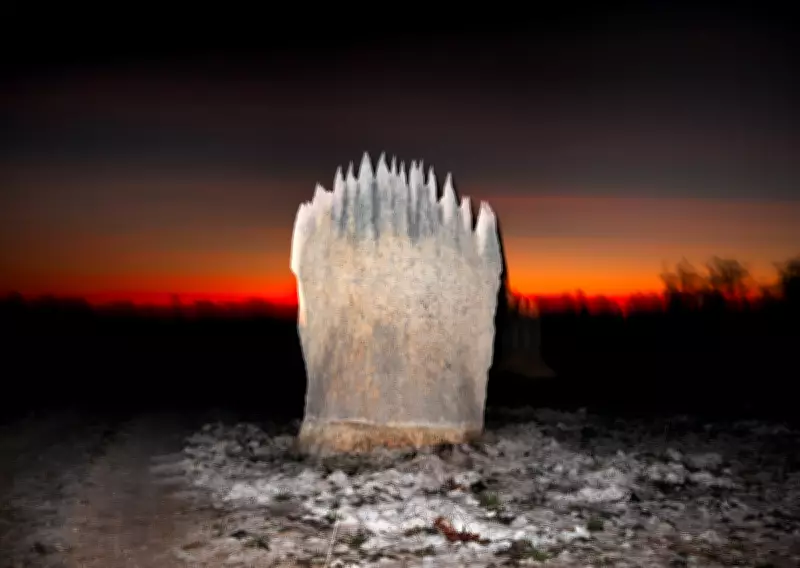
The termites' consumption of these books became a generative act of transformation. What might appear as simple destruction revealed itself as a profound reshaping of cultural artefacts. The insects carried pages underground to feed their colony, leaving behind intricate external structures that Fenwick meticulously photographed.
These images reveal what the artist calls "the language of the termites" - dense sculptural forms of tunnels, cavities, and clay scaffolds that mirror the architectural precision of termite mounds found in the surrounding landscape. The magnetic termites of the region construct remarkable "compass" mounds aligned precisely on a north-south axis to regulate temperature and airflow, demonstrating their own sophisticated intelligence.
Colonial Narratives Hollowed Out
Fenwick's photographs document how the colonial fantasy embedded in these books becomes gradually hollowed out from within. The termites' intervention transforms the volumes, sometimes consuming them almost entirely, sometimes leaving only fragile shells. This process mirrors what Fenwick sees as the uneasy persistence of colonial histories that continue to "eat away at the present."
The artist recalls growing up in Humpty Doo surrounded by books that carried ready-made notions of how Australia should be understood, imposing hierarchies from distant centers of power. Meanwhile, Aboriginal systems of knowledge endured in story, memory, and land across immense time - living memory palaces that existed long before these colonial texts arrived.
Photography as Witness and Collaborator
In The Colony, photography serves as both witness and collaborator in this transformative process. Fenwick's images prioritize organic process over the logic of control, allowing collapse and digestion to reshape authority. The photobook becomes a book about books - and what happens when their authority is quietly and actively undone.
The project includes references to specific volumes that highlight the colonial context. One photograph references the Borroloola library, established in 1919 with funding from the Carnegie Corporation of New York as part of a "civilising" drive. A copy of The Imitation of Christ from this library had been eaten by termites by the time David Attenborough visited while filming The Hermits of Borroloola.
A Dialogue Between Architectures
Throughout The Colony, termite mounds and hollowed books mirror each other as two architectures shaped by collective intelligence. One exists above ground, the other below, suggesting a profound dialogue between human and nonhuman forms of knowledge. The termites' work becomes a counterpoint to the heroic narratives presented in The Australians series, which carried taglines like "A magnificent saga celebrating the settling of Australia."

Fenwick's project reveals how the books, after the insects' intervention, enter a second life - transformed from cultural artefacts into organic forms, tracing a passage from printed narrative to soil. This process demonstrates how certainty can be dismantled, knowledge returned to the earth, and new possibilities emerge from what initially appears as annihilation.
The Colony stands as a powerful meditation on colonial history, indigenous knowledge systems, and the intelligent processes of the natural world. Through this unique artistic collaboration with termites, Fenwick has created a work that challenges conventional understandings of authority, narrative, and transformation in the Australian context.