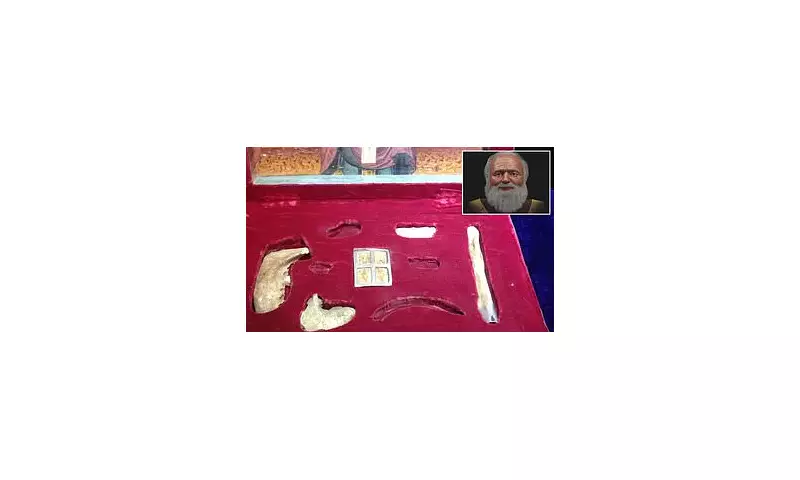
For nearly 1,700 years, the mortal remains of Saint Nicholas – the fourth-century bishop who inspired the legend of Santa Claus – have been the source of both profound devotion and enduring mystery. Housed in the Basilica di San Nicola in Bari, Italy, the collection of bones, including his skull and numerous fragments, is said to produce a miraculous, aromatic liquid with reputed healing powers.
The Tomb and the Mysterious Fluid
Saint Nicholas died around 343 AD in Myra, in what is now modern-day Turkey. His reputation for secret generosity, such as leaving coins in shoes or providing dowries for impoverished girls, laid the foundation for the Santa Claus myth. Centuries later, in 1087, Italian sailors reportedly stole his bones from Myra to protect them from invading forces, bringing them to Bari in what historian Adam English calls "essentially a holy robbery." Some fragments were left behind and later taken to Venice.
The central enigma revolves around the 'manna' of Saint Nicholas. This is a sweet-smelling liquid that has, for centuries, been reported to exude from his relics. Believers have long used it, applied to the sick or added to a drink, in the hope of miraculous healings. The phenomenon was first noted centuries ago at his original tomb in Myra and continued after the translation of his remains to Bari.

A Remarkable Preservation
In the 1950s, during renovations, the saint's tomb in Bari was opened for the first time since 1089. The bones, which had lain undisturbed for 866 years, were found scattered. Investigators discovered clear liquid at the bottom of the tomb, with moisture still present in the marrow cavities of the bones themselves. Church officials saw this as a remarkable sign of preservation that authenticated the relics.
Father Gerardo Cioffari, director of the Centro Studi Nicolaiani, describes the annual ritual that continues today. "On the evening of May 9th, the Feast of the Translation of Saint Nicholas from Myra to Bari, the stone sarcophagus is opened," he explains. "The Archbishop extracts one or two glasses of the water that has formed around the bones over the year." This liquid is then diluted in large containers of blessed water and bottled for pilgrims.
Science, Skepticism, and Unwavering Faith
Scientific analysis has attempted to demystify the manna. In 1925, tests at the University of Bari determined the fluid was essentially water. Skeptics suggest it could be condensation forming naturally within the sealed crypt. However, devotees counter this, pointing to the 1954 exhumation where the bones themselves seemed to 'perspire' the fluid, and the linen wrapping them was found damp.
Intriguingly, while the relics in Bari continue to produce the manna, the fragments housed in the Church of St. Nicholas on the Lido in Venice do not. This discrepancy adds another layer to the mystery.
The connection to Father Christmas solidified much later, particularly by the 16th century in Holland, where his feast day on December 6th is still celebrated. His acts of secret gift-giving directly inspired the modern Santa Claus tradition.
The Search for the Original Resting Place
The story of Saint Nicholas's remains may yet have another chapter. Recent archaeological excavations from 2022 to 2024 at the St Nicholas Church in Demre, Turkey, uncovered the original church floor and a well-preserved limestone sarcophagus. This could potentially be his untouched original tomb, though findings are not yet definitive.
Whether viewed as a divine miracle or a fascinating historical and scientific curiosity, the ritual endures. From 1980 onward, the formal extraction of the manna has been performed every year. The combination of ancient history, cherished legend, and an inexplicable phenomenon ensures that the relics of Saint Nicholas remain a powerful source of global fascination, seamlessly linking an early Christian bishop to one of the world's most beloved cultural icons.