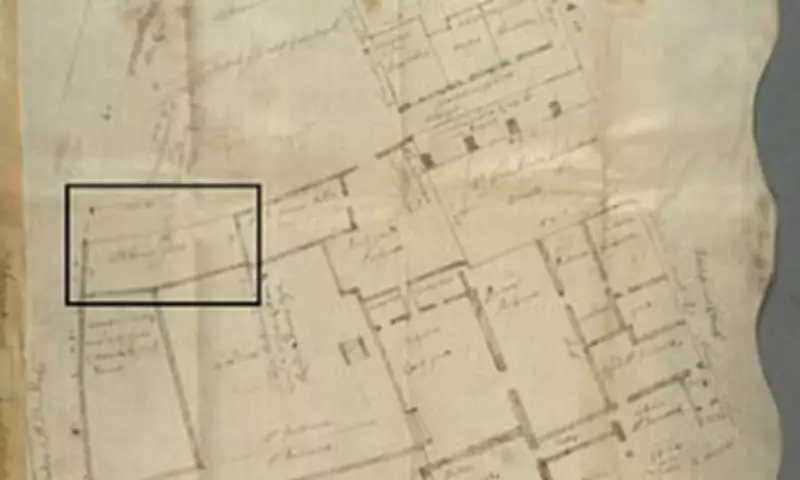
A key riddle in the mysterious life of William Shakespeare has been solved, thanks to a newly discovered historic floorplan that precisely locates The Bard's only property in London.
Uncovering Shakespeare's London Dwelling
Found in the London Archives, the document reveals the property was at 5 St Andrew's Hill in Blackfriars, a quiet street near his workplace at the theatre and within easy reach of a pub. The discovery, made by Shakespeare expert Professor Lucy Munro from King's College London, also details the layout and size of the dwelling, which Shakespeare purchased in 1613.
Professor Munro explained it was a 'relatively substantial dwelling', large enough to later be divided into two houses. This finding paints a different picture of where Shakespeare may have spent some of his final years, challenging the long-held belief that he simply retired to Stratford-upon-Avon.

Rethinking Shakespeare's Later Life
'This discovery throws into question the narrative that Shakespeare simply retired to Stratford and spent no more time in the city,' Professor Munro said. 'It encourages us to rethink our assumptions about Shakespeare's relationship with London in the later part of his life.'
The property covered what is now the eastern end of Ireland Yard, the bottom of Burgon Street, and parts of late-nineteenth-century buildings at 5 Burgon Street and 5 St Andrew's Hill. This sheds light on a mystery that has puzzled academics since the 18th century.
Historical Documents and Precise Location
It has long been known that Shakespeare owned a property in Blackfriars in his later years, thought to be part of 'the Great Gate' over the entrance to the Blackfriars precinct. A dark blue City of London plaque on a building in the area reads: 'On 10th March 1613 William Shakespeare purchased lodgings in the Blackfriars Gatehouse located near this site.' However, the phrase 'near this site' indicated uncertainty about the exact whereabouts.
Professor Munro uncovered three documents – two from The London Archives and one from The National Archives – to pinpoint the location. One document is a plan of part of the Blackfriars precinct drawn up in 1668 after the Great Fire of London. Records show that William Iles, whose name overlies the property, was a tenant of the person Shakespeare's granddaughter sold the house to.
Now, it can be said with confidence that the blue plaque on 5 St Andrew's Hill marks the precise spot of his London home. For the first time, Professor Munro's research provides a clear picture of where this property was, its layout, and the surrounding buildings.
Life in Blackfriars and Professional Connections
Perhaps Shakespeare would have had a drink in the neighbouring tavern at the 'Sign of the Cock' or viewed the converted friary buildings from a window, Professor Munro suggested. The map doesn't show the internal layout, but given its size and location in a relatively prestigious area, it would have been 'above average' in value for a London house of that size.
'It's less than five minutes' walk from the second Blackfriars playhouse, where Shakespeare's plays were being performed in 1613,' she told the Daily Mail. 'The plan shows a tennis court to the north-west of the house, and we know that there were also bowling alleys and other entertainment venues in the Blackfriars district.'
She explained that Shakespeare co-authored 'Two Noble Kinsmen' with John Fletcher late in 1613. 'It is not inconceivable that some of it may have been written in this very property,' she said. 'We also know that Shakespeare was visiting London in November 1614 – is it not likely that he stayed in his own house?'
Professor Munro added: 'He obviously didn't know that he was going to die in 1616 when he bought the house in March 1613. Together with his activities as a playwright that year, during which he wrote two plays with John Fletcher, the purchase suggests that he had an ongoing financial and professional investment in London.'

Property History and Legacy
The two other documents she unearthed confirmed the house was sold by Shakespeare's granddaughter in 1665. One year later, it was destroyed in the Great Fire of London. Over the past century, occupants of the buildings on the site have included printing companies, manufacturers of printing inks, the National Book Association, a firm of builders, carpet wholesalers, and, more recently, chartered surveyors, investment managers, and residents of apartment conversions.
Dr Will Tosh, Director of Education at Shakespeare's Globe, said: 'Professor Munro's fantastic discovery proves there's no replacement for human graft in the archive, and our reward for her hard work is a dazzling new sense of Shakespeare the London writer. She's helped us to understand how much the city meant to our greatest ever dramatist, as a professional and personal home.'
In light of the findings, Professor Munro said it 'would be nice' to bring the blue plaque up to date. William Shakespeare, baptised April 26, 1564, and died April 23, 1616, was an English playwright, poet, and actor widely regarded as the greatest dramatist of all time. He is credited with 39 plays, 154 sonnets, and three long poems, with works like Romeo and Juliet, Hamlet, and Othello performed globally.
Shakespeare was born in Stratford-upon-Avon, married Anne Hathaway, and had three children. He began a career in London as an actor and writer, co-owning the Lord Chamberlain's Men, who built the Globe Theatre. At age 49, he is believed to have retired to Stratford, but scant records of his private life leave much to speculation.