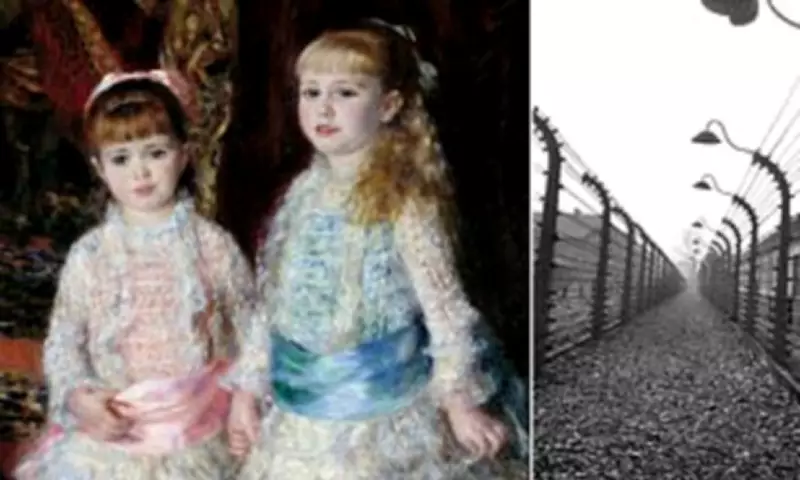
Pierre-Auguste Renoir's exquisite 1881 portrait, affectionately known as Pink and Blue, captures two young French sisters in a moment of pure childhood innocence. Displayed at the Sao Paulo Museum of Art, this beloved painting represents what author Catherine Ostler describes in her powerful new book as the epitome of 'Belle Époque loveliness'.
The Portrait of Privilege
The subjects were Elisabeth and Alice Cahen d'Anvers, daughters of a prominent Jewish banking family. Seven-year-old Elisabeth wears the blue sash while five-year-old Alice sports the pink one. Their radiant complexions, bright eyes, and meticulously styled appearance—from ribbon hairbands to lacy dresses and buckled shoes—reflect the privileged world they inhabited. Renoir himself defended his idealized approach by stating, 'There are enough unpleasant things in the world without us producing more.'
Ironically, the girls' parents, Louis and Louise Cahen d'Anvers, showed little appreciation for the masterpiece. They delayed payment to Renoir and relegated the painting to the sixth floor of their Paris mansion. The artist's frustration manifested in casual anti-Semitism when he remarked, 'I really give up with the Jews,' while pursuing his fee.

A Family's Rise and Fall
The Cahen d'Anvers family co-founded what would become Paribas bank and thrived within Parisian high society, attending balls, races, and polo matches while collecting Impressionist art. Yet beneath this glittering surface simmered growing resentment toward their wealth and success. This anti-Semitism erupted publicly during the Dreyfus Affair of 1894 and would later explode with unimaginable brutality under the Vichy regime.
Ostler's research reveals how the family actively sought assimilation through patriotic gestures and cultural contributions. The sisters' elder sibling, Irene, married Jewish banker Moise de Camondo, whose son Nissim died fighting for France in World War I. In his memory, Moise bequeathed his Paris home to become a museum for the nation. Similarly, the girls' brother Charles donated the family's Chateau Champs-de-Marne to France between the wars.
The Path to Perdition
Alice escaped the worst horrors by marrying Englishman Charles Townshend, becoming a British Army wife. When Germany invaded France in 1940, she managed to secure passage for her half-French grandchildren on the last freighter departing Bordeaux.
Elisabeth's fate proved tragically different. Despite converting to Catholicism in 1897 and marrying non-Jewish husbands twice, she meticulously documented her Jewish ancestry on wartime registration forms. 'My father and mother were attached to the Jewish religion, as well as their respective parents,' she wrote—a sentence Ostler identifies as sealing her destiny.
The mayor of Juigne-sur-Sarthe, where Elisabeth lived during the early war years, was a fervent Pétainiste collaborator eager to assist Nazi authorities. In contrast, Irene survived by falsely claiming Catholic ancestry for her maternal grandparents—a decision some family members later interpreted as collaboration.
The Final Journey
On January 26, 1944, Gestapo agents arrested 69-year-old Elisabeth, who suffered from debilitating rheumatoid arthritis. She was transported to Drancy internment camp, where she joined a grim procession of deportees. Her journey occurred shortly after Irene's daughter Beatrice and Beatrice's children Fanny and Leon had been sent to Auschwitz.
Elisabeth boarded Convoy 70—one of 77 transports that carried approximately 77,000 French Jews to extermination camps. Packed into windowless cattle cars with 100 other prisoners, she endured a 57-hour journey toward almost certain death. As one survivor recalled, 'The last vision of a civilised world vanished at Bobigny station. Hell began.'
Ostler's narrative masterfully connects Renoir's vision of 'peachy softness' with the unimaginable brutality that awaited one of his subjects six decades later. The story exposes how France betrayed some of its most loyal citizens and reveals how family resentments over wartime choices continue to simmer generations later.