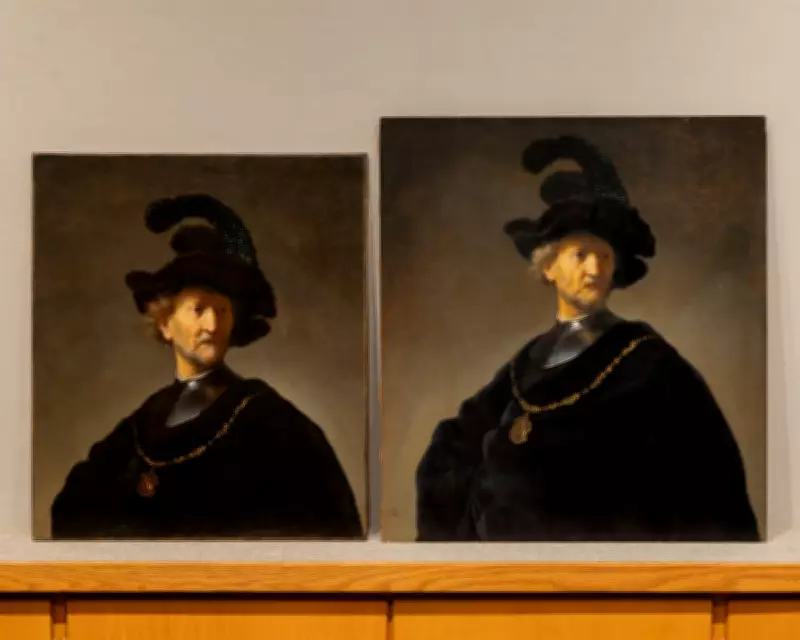
Rembrandt Scholar Authenticates UK Portrait as Genuine Masterpiece
A portrait held in a private UK collection, which has for decades been dismissed as a mere workshop copy of a Rembrandt painting, has now been declared an authentic work by the 17th-century Dutch master himself. This groundbreaking revelation comes from the esteemed Rembrandt scholar Gary Schwartz, who has meticulously analysed the artwork.
Reunion of Two Masterpieces in Chicago
For the first time in nearly four centuries, two nearly identical paintings titled Old Man with a Gold Chain, dating to the early 1630s, have been reunited. The Art Institute of Chicago owns the undisputed version, painted on panel, while the contested portrait, slightly smaller and on canvas, is on loan from Sir Francis Newman, a Cambridge-based entrepreneur. Previously labelled as a copy by an artist in Rembrandt's workshop, Schwartz's findings challenge this long-held assumption.
Gary Schwartz argued that the quality of brushwork in the UK version aligns with Rembrandt's own hand. He pointed out that many Dutch artists of the period created replicas of their own works, a practice noted by a French contemporary in 1699. Schwartz emphasised that if Rembrandt had a customer requesting a replica, it would be more logical for the master to recreate it himself rather than delegate to a pupil, as the painting shows no signs of corrections typically seen in apprentice work.

Scientific Analysis and Historical Context
X-ray and infrared imaging of the Chicago painting revealed underdrawing with adjustments to the man's costume, absent in the canvas version. Schwartz noted that this precision suggests it was not a pupil's copy. Additionally, research from the Hamilton Kerr Institute at the University of Cambridge found that the UK version's canvas and pigments match those used by Rembrandt and his studio, with a similar oil-bound, double-ground layer found in eight Rembrandt paintings from 1632-1633.
Sir Francis Newman's great-grandfather purchased the painting as a Rembrandt in 1898 from the London gallery Agnews for a substantial sum. However, when the other painting emerged in 1912, German art historian Wilhelm Bode dismissed it as a clever reproduction, an assessment Schwartz criticises as lacking serious reasoning. The UK version has only been exhibited once before, in 1952 at the Royal Academy in London, where it was initially catalogued as a Rembrandt original before being downgraded by experts.
Ongoing Debate and Future Implications
While the Art Institute of Chicago, after reviewing scans and pigment analysis, suggested the UK version might be a workshop reproduction, they acknowledged that the conversation about its authorship continues to evolve. Schwartz's authentication opens up new possibilities for re-evaluating other paintings attributed to Rembrandt's workshop.
Sir Francis Newman expressed that the mystery surrounding the painting's origins has been part of its appeal, allowing him to enjoy it without the burden of its potential importance. He indicated that if confirmed as a Rembrandt, the portrait would likely be donated to a museum, ensuring its preservation for future generations.
This discovery not only enriches the legacy of Rembrandt but also highlights the dynamic nature of art historical research, where technological advancements and scholarly insights can reshape our understanding of cultural heritage.