National Gallery's 'Dear America' Exhibition Offers Critical 250th Birthday Reflection
The National Gallery of Art in Washington DC has launched a thought-provoking exhibition titled 'Dear America: Artists Explore the American Experience', marking America's approaching 250th anniversary. This ambitious showcase features almost one hundred artists and positions itself as "an open letter to the nation", presenting a nuanced perspective far removed from conventional patriotic celebrations.
A Departure from Traditional Patriotism
Visitors entering the exhibition immediately encounter reinterpretations of iconic American symbols. The Statue of Liberty appears not in its familiar form but through Zanele Muholi's powerful photograph of a Black woman and Roy Lichtenstein's geometric screenprint featuring diagonal purple stripes. Similarly, the Oval Office is rendered in Lichtenstein's distinctive cartoon-like blues, whites, and yellows, while the Lincoln Memorial features Carrie Mae Weems' haunting 2014 photograph paying tribute to Black contralto Marian Anderson.
Gordon Parks' seminal American Gothic portrait of government worker Ella Watson, flanked by her cleaning tools against the Stars and Stripes, establishes the exhibition's critical tone from the outset. This opening room serves as a powerful reminder of America's capacity for self-critique alongside its tradition of monumental self-celebration.

Curatorial Vision and Structure
E Carmen Ramos, the gallery's chief curatorial and conservation officer, explains that the exhibition was "years in the making" and draws almost exclusively from the institution's permanent collection of over 160,000 works. "We wanted to present an exhibition that explores how artists in the United States have explored the American experience across different moments in time," Ramos states, emphasizing the goal of capturing "the fullness of the American experience."
The exhibition is organized around three thematic sections: Land, Community, and Freedom. These categories facilitate provocative dialogues across centuries, artistic disciplines, and demographic perspectives, creating a multifaceted exploration of national identity.
Exploring Land and Development
The Land section juxtaposes Thomas Moran's idealized 19th-century watercolors of the American West with Thomas H Johnson's stark 1860s photograph of Waymart, Pennsylvania, where cleared landscapes reveal the environmental costs of industrialization. This contrast highlights the tension between America's natural majesty and its relentless development drive.
Further comparisons include Thomas Hart Benton's 1939 lithograph Departure of the Joads alongside Arthur Rothstein's devastating 1936 photograph of Oklahomans fleeing dust storms, and Edward Ruscha's vibrant depiction of Route 66's "car culture" architecture. These pairings create a complex narrative about the American landscape and its transformation.
Community and Contrasting Portraits
The Community section opens with Richard Avedon's massive 1976 work The Family, featuring 69 uniform black-and-white portraits of the bicentennial era's political and corporate elite, including future president Ronald Reagan. Displayed opposite is John Wilson's Young Americans, a series of tender 1970s sketches capturing teenagers in casual domestic settings, rendered in charcoal and crayon with striking confidence.
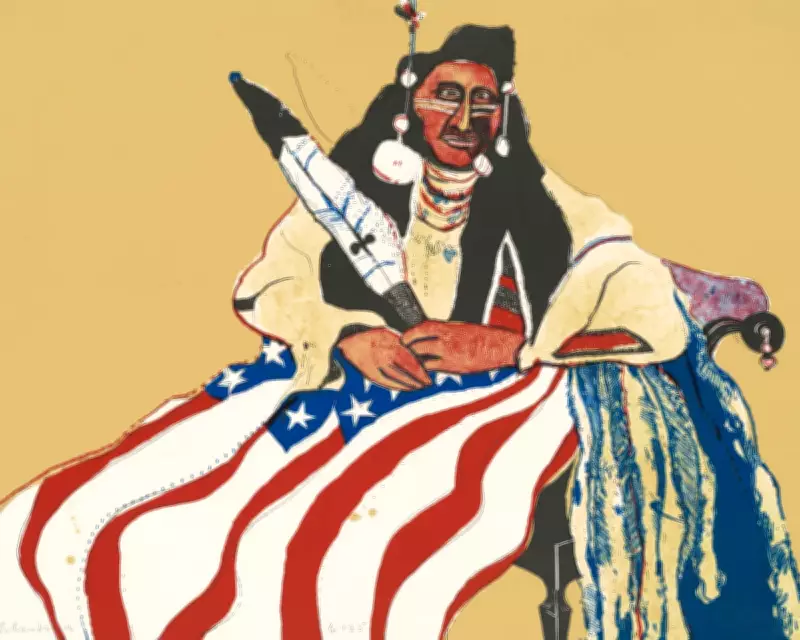
Ramos particularly appreciates this juxtaposition: "I love the way it showed these people from different walks of life – political and cultural figures on one side and then ordinary young people on the other." This section also features Tom Jones' 2002 mixed-media piece Dear America, which inspired the exhibition's title. Jones, an artist of the Ho-Chunk Nation, overlays historic images of Indigenous people with patriotic lyrics, interrogating Native American representation in popular culture.

Freedom and Historical Legacy
The final section examines freedom through historical and contemporary lenses. It includes Paul Revere's 1770 print of the Boston Massacre, portraits of Frederick Douglass and Sojourner Truth, and Faith Ringgold's 2007 screenprints illustrating Martin Luther King's Letter from Birmingham Jail. Gordon Parks' 1963 photograph of a Harlem rally shows hands raised in gestures bridging political and religious expression.
Kara Walker's cut-paper silhouettes expose slavery's enduring traumas, while Martha Rosler's photomontage series House Beautiful: Bringing the War Home splices Vietnam War imagery into pristine magazine spreads of American interiors. The exhibition concludes with Robert Indiana's 1976 screenprint Liberty '76, which Ramos says creates "a slippage between 1776 and 1976, speaking to the ongoing pursuit of freedom."
'Dear America: Artists Explore the American Experience' will remain on view in the National Gallery's West Building until September 20th, offering visitors a comprehensive and critical reflection on American identity as the nation approaches its 250th anniversary.