Henry Moore's Renovated Sheep Barn Gallery Reopens with Shelter Drawings Exhibition
The pastoral estate of Henry Moore in Perry Green, Hertfordshire, has unveiled a major transformation of its Sheep Field Barn gallery, marking the occasion with a poignant exhibition of his Shelter Drawings from the Second World War. This reopening represents a significant chapter in the preservation and celebration of the sculptor's enduring legacy.
From Wartime Refuge to Artistic Sanctuary
In September 1940, Henry Moore and his wife Irina fled London to escape the Blitz, finding temporary refuge in the bucolic hamlet of Perry Green. What began as a wartime sanctuary evolved into their permanent home, with Hoglands becoming the heart of Moore's creative universe. Today, the estate functions as a multifaceted cultural ecosystem, encompassing his preserved home, multiple studios, a sculpture park, and one of the world's largest archives dedicated to a single artist, all managed by the Henry Moore Foundation established in 1977.
Moore's life was profoundly shaped by conflict. As the son of a Yorkshire coalminer and the seventh of eight children, he experienced childhood poverty before volunteering for military service at age eighteen. Injured in a gas attack during the 1917 Battle of Cambrai, he developed a deep despair towards warfare, later writing that "the sight of a khaki uniform began to mean everything in life that was wrong and wasteful and anti-life."

The Shelter Drawings: Art Born from Conflict
During the Second World War, Moore served as a war artist, descending nightly into London's underground stations to document civilians sheltering from bombings. These powerful Shelter Drawings, created shortly after his arrival in Perry Green, captured moments of collective vulnerability and resilience, establishing his reputation and becoming central to understanding his artistic response to human conflict.
"He was so sensitive, he didn't want to take photographs or sketch people," explains Lesley Wake of the Henry Moore Foundation. "He literally took notes and drew from them. He created people, but he was drawing sculptures. And all this came out of seeing people sheltering in the shadows."
Architectural Transformation of the Sheep Field Barn
The newly renovated Sheep Field Barn, originally a 1970s steel-frame structure used by Moore for storing materials and sheep fodder, has undergone a thoughtful redesign by London architects DSDHA. The brief sought to balance historical authenticity with contemporary visitor expectations, resulting in an elegant transformation that respects Moore's legacy while enhancing functionality.
Director David Hills notes that "an important aspect of the brief was this dichotomy of wanting it to feel like it did when Moore was here, but also recognising that today's visitors have different expectations." The redesign adds new spaces to the north and east sides beneath a sloping roof that diminishes the building's monolithic presence despite its enlarged footprint. A reclaimed silver spruce timber cladding softens the exterior, while the interior now includes dedicated areas for permanent displays, changing exhibitions, and enhanced educational facilities.
Moore's Creative Spaces and Educational Legacy
Across the estate, Moore's various studios remain preserved as he left them, each serving distinct creative purposes. His maquette studio particularly embodies his improvisational spirit, filled with models, stones, wood, feathers, bones, and even an elephant skull that inspired his forms. This ethos of creative reuse informs the barn's redesign, which incorporates sustainable features like sheep's wool insulation, triple-glazed windows, solar panels, and ground source heat pumps, reducing energy consumption by half despite doubling the building's size.
The foundation's educational commitment continues through programs serving over 2,000 schoolchildren annually. "Children go out, they find stuff, bring it back in, and we go, 'What does that look like to you?'" says Wake. "What can you make it into? They use that to inspire work. So they're doing exactly what Moore did, on the same site."

Sheep, Sculpture, and Sensory Experience
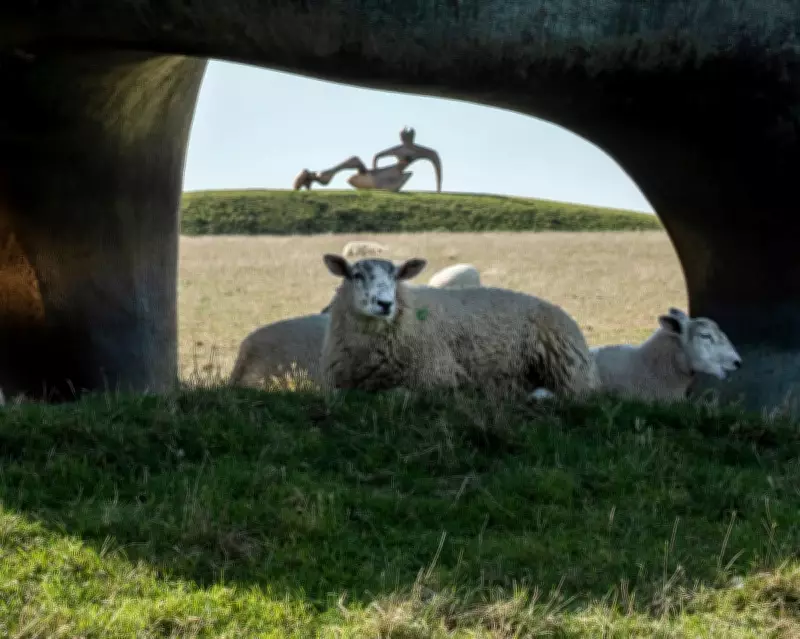
Sheep remain integral to the Perry Green landscape, both as living elements and artistic inspiration. Moore would tap on his studio window to attract them for drawing sessions, leading to his famous Sheep Piece bronze. The animals would later use sculptures as scratching posts, embodying Moore's belief that art should be touched and experienced physically.
With the barn's reopening and a major exhibition at Kew Gardens opening in May, Moore's work continues to resonate. Despite early controversies that saw his sculptures vandalized in Dumfries, Leeds, and New York, he ultimately became a national treasure who fundamentally reshaped British sculpture. As he once declared, "Art is the expression of the imagination, not the reproduction of reality." The Shelter Drawings exhibition at the renovated Sheep Field Barn powerfully demonstrates this philosophy, connecting his wartime observations to his enduring artistic vision.