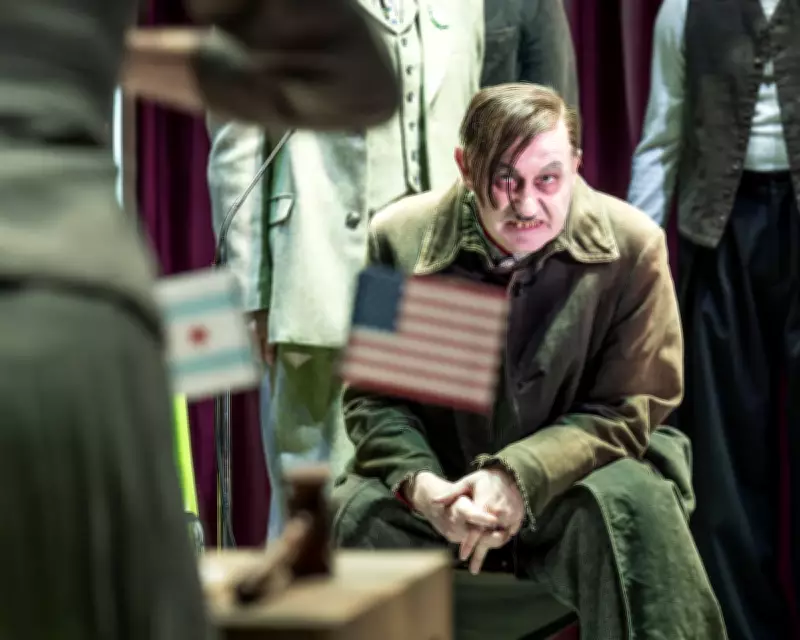
Mark Gatiss Terrifies as Brecht's Fascistic Cauliflower Racketeer in RSC Revival
In a striking revival at the Swan theatre in Stratford-Upon-Avon, Mark Gatiss delivers a performance that is both terrifying and transformative in Bertolt Brecht's The Resistible Rise of Arturo Ui. Directed by Seán Linnen for the Royal Shakespeare Company, this production reimagines Brecht's comic grotesque parable, drawing parallels to historical and contemporary fascism through a circus-like staging.
A Cartoon Gangster with Depth
Gatiss initially appears as a tragicomic figure, clad in tramp-like clothing with a powdered face and melancholy eyes, reminiscent of Charlie Chaplin's iconic style. However, as the narrative unfolds, his portrayal of Arturo Ui evolves into something truly menacing. Gatiss embodies a blend of Hitler, with signature moustache and hair, Scrooge, and a ghoul, utilizing distinctive tics and a wavering accent that hints at German or American influences. This transformation renders him almost unrecognisable, showcasing his remarkable acting range.
Brecht's Parable Brought to Life
Translated by Stephen Sharkey, the play juxtaposes Ui's takeover of Chicago's cauliflower racket with the rise of the Third Reich, scene by scene. Key mobster characters represent historical figures such as Joseph Goebbels, played by LJ Parkinson as Givola, and Ernst Röhm, portrayed by Kadiff Kirwan as Roma. Christopher Godwin's Dogsborough stands in for German president Paul von Hindenburg, a tragic figure undermined by weakness, while Mahesh Parmar provides comic relief as his son, zipping on a scooter or blowing bubbles.

Immaculate Performances and Staging
The cast delivers immaculate performances, mastering the balance between cartoonishness and threat. Mawaan Rizwan shines in dual roles as an MC and Giri, a satirical version of Hermann Göring, bringing magnetic and maniacal energy. Janie Dee oozes emotion in her non-comic parts, adding depth to the ensemble. Linnen's circus-like staging, described as carnivalesque and influenced by Angela Carter, highlights the theatricality of fascism, from Ui's goose-step walk to public oratory learned from a local actor.
Sound and Design Enhance the Experience
Sound design by Johnny Edwards features stylised jazzy swing cymbal patterns, while music by Placebo injects a thumping rock'n'roll energy, making gangster violence feel adrenalised and unsettling, akin to a Tarantino soundtrack. Jennifer Jackson's choreography seductively complements the sound, and Georgia Lowe's set and costumes add vibrant chaos, with 1930s gangster garb for the cauliflower crew and shambolic outfits for Ui that gradually transform into polished Nazi-wear, mirroring their rise to fascism.
Contemporary Relevance and Final Impact
While previous revivals, such as the 2017 production starring Lenny Henry, heavily emphasized parallels to Donald Trump's ascendancy, this version subtly references it only once, with Gatiss slipping into a distinctive voice in a courtroom scene. The connection to current world grotesqueries feels inherent, making explicit nods redundant. The production concludes powerfully as Gatiss steps out of character to deliver a sobering line, reminding audiences of the enduring warning against fascism. Running until 30 May, this revival is a magnificent exploration of Brecht's epic theatre, blending laughter, ludicrousness, and menace into a chilling spectacle.